
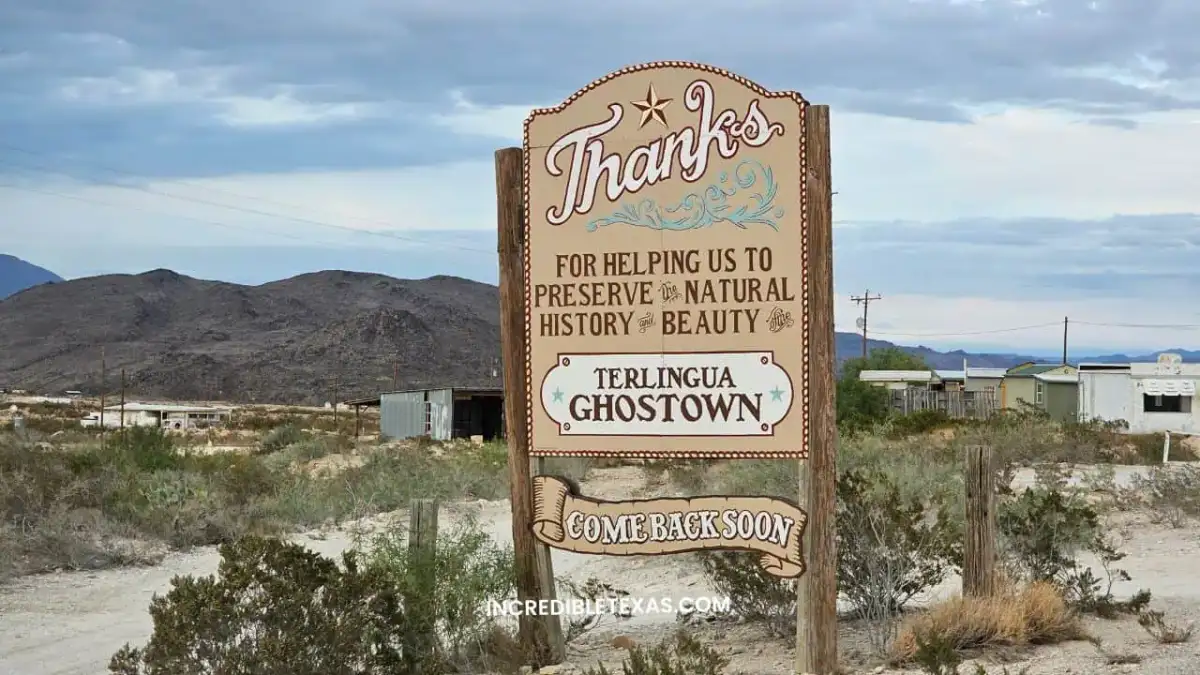
Terlingua Ghost Town extends across the rugged foothills of the Chisos Mountains in southern Brewster County, located just seven miles west of Big Bend National Park. Once an abandoned quicksilver boomtown that supplied over 40% of America’s mercury, this outpost now operates as a living desert community where historic unmortared ruins share the horizon with casual eateries, open-air music porches, and luxury stargazing domes.
Note
Part of our comprehensive Texas Ghost Towns Road Trip Guide. Explore our complete statewide frontier itinerary, boomtown histories, and regional itineraries.
Key takeaways
- Terlingua Ghost Town offers free year-round public access to explore its historic unmortared sandstone ruins, sealed mining shafts, and cemetery.
- The Starlight Theatre serves dinner, cold drinks, and live evening music seven nights a week starting at 5:00 p.m.
- The historic Terlingua Cemetery features stone-mounded graves from the early 1900s cinnabar mining era that require respectful viewing.
- Unique accommodations in the area include restored 1930s adobe casitas, transparent stargazing bubbles, and rustic desert campsites.
- The ghost town sits roughly 15 minutes west of Big Bend National Park’s Maverick Junction entrance along Texas State Highway 118.
What to Expect in Terlingua Ghost Town
Terlingua Ghost Town Texas welcomes travelers seeking authentic desert history paired with unconventional community gatherings. Positioned along Highway 118, this settlement serves as the cultural basecamp for regional backcountry exploration.
This practical Terlingua ghost town visitor guide helps road-trippers plan every stop efficiently. Among regional Big Bend gateway towns, this outpost offers the closest evening dining and entertainment options.
Visitors arriving from the north can use our Alpine Texas visitor guide to plan supply stops before entering the remote desert basin. Park entrance details are also available via the National Park Service Big Bend History and Culture Portal.
| Location / Outpost | Proximity to Big Bend | Primary Experience | Key Amenities | Best For |
|---|---|---|---|---|
| Terlingua Historic District | 7 miles (15 min) | Historic mining ruins, Porch culture | Starlight Theatre, Trading Company | Basecamp dining, history, live music |
| Study Butte | 5 miles (10 min) | Modern gateway services | Gas station, full grocery, motel units | Fueling, general provisions |
| Lajitas | 17 miles (25 min) | Luxury resort recreation | Golf course, spa, equestrian center | Resort comfort, Rio Grande excursions |
| Castolon Historic District | Inside National Park | Historic cavalry and border trading | Restrooms, basic water, visitor store | Park road-tripping, adobe history |
A Living Frontier Community
Unlike commercial theme parks, this district is an authentic unincorporated community where roughly 80 permanent residents live alongside historic structures. Old sandstone miner shacks sit across the dirt lanes from restored private residences and working artist workshops.
Walking through the district gives visitors an unvarnished look at how desert inhabitants adapt to extreme arid conditions. The landscape remains raw, peaceful, and largely free of corporate commercialization.
The Sunset Gathering on The Porch
The wooden porch outside the Terlingua Trading Company serves as the informal town square of the ghost town. Every evening before dusk, locals and road-trippers gather on the wooden benches to trade trail reports and watch the Chisos Mountains change color.
The atmosphere is friendly, relaxed, and community-driven. Musicians often unpack acoustic guitars for impromptu jam sessions as the desert heat dissipates into cool evening air.
Historic Ruins and the Chisos Mining Company
Walking among the Terlingua mining ruins reveals the industrial heritage of the Big Bend region. Explorers seeking hidden gems in West Texas will discover that this remote canyon was once the most productive mercury extraction center in the United States.
Detailed records archived in the Texas State Historical Association Chisos Mining Company Record document how deep shafts produced quicksilver that fueled national manufacturing during both World Wars.
Quote-Worthy Historical Fact During its operational peak from 1903 to 1942, the Chisos Mining Company in Terlingua produced over 40% of the entire quicksilver output in the United States, until plunging mineral yields forced the enterprise into bankruptcy on October 1, 1942.
The Rise and Fall of Howard Perry’s Empire
Howard E. Perry directed operations from his imposing Moorish-style mansion overlooking the town, which still stands today as a private residence. At its peak, the enterprise supported almost 3,000 miners and their families, complete with its own ice plant, hotel, and company commissary.
As the highest-grade cinnabar deposits were exhausted in the late 1930s, production declined rapidly. The syndicate entered bankruptcy in October 1942, prompting residents to dismantle machinery, salvage metal roofing, and abandon the settlement.
Unmortared Adobe and Sandstone Architecture
The remaining residential ruins demonstrate indigenous building techniques suited to the high desert. Mexican stonemasons built thick walls using native limestone and sandstone blocks without modern cement mortar, relying on precision balance and mud plaster.
Over eight decades of wind and summer cloudbursts have worn down many roofs, leaving dramatic stone skeletons that glow warm orange at sunset. Visitors should admire these fragile historical walls from marked walking paths without climbing on masonry.
Starlight Theatre and Local Dining Culture
An evening at the Starlight Theatre Terlingua delivers classic West Texas hospitality and hearty cooking. Diners gather at The Starlight Theatre Restaurant and Saloon to enjoy craft beverages, grilled steaks, and regional music, often comparing notes with travelers returning from the Balmorhea State Park visitor guide.
Arriving near the 5:00 p.m. opening time is recommended during the busy winter and spring travel seasons. The restaurant operates on a first-come, first-served basis, and peak holiday waitlists can stretch up to two hours.
History of the Roofless Movie House
The Starlight building began in the 1930s as the Chisos Movie Theater, providing entertainment for company laborers. When the mines failed, the theater was dismantled and its corrugated tin roof was sold for salvage.
For several decades, locals gathered inside the roofless shell to host barbecue parties and acoustic music sets under the open desert sky. The building was restored with a solid roof in 1991, preserving the historic name in honor of those starlit celebrations.
Classic Chili and West Texas Fare
The Starlight menu features regional staples such as venison chili, smoked pork chops, antelope burgers, and grilled ribeyes. Every November, the famous Terlingua chili cookoff brings thousands of competitors to the surrounding desert to celebrate this culinary tradition.
Live music performances by touring Americana and Texas country songwriters accompany dinner most evenings. The venue delivers a distinctive combination of frontier history and quality comfort dining.
Tip
Put your name on the Starlight Theatre dinner list right at 5:00 p.m., then walk over to the Trading Company porch with a cold beverage to enjoy sunset views while waiting for your table.
Terlingua Cemetery History and Etiquette
The Terlingua Cemetery represents one of the most poignant historic sites in the American Southwest. Set against the distant rim of the Chisos Mountains, the burial ground holds the graves of miners, ranchers, and early pioneers who lived through the boomtown era.
The site remains an active resting place for local families. Visitors are expected to observe quiet decorum and walk only on established gravel footpaths.
Rock Mounds and Mining Tragedies
Most graves in the cemetery are marked by low mounds of desert limestone stones topped with handmade wooden or iron crosses. This burial method protected graves from desert scavengers in an arid terrain where digging deep into caliche soil was exceedingly difficult.
A substantial number of burials date to 1918, when the global Spanish influenza epidemic swept through the tight-knit mining barracks. Other markers honor Mexican and Anglo miners who lost their lives in underground dynamite explosions or cave-ins.
Respectful Cemetery Visitation Rules
The cemetery is a sacred historic landmark rather than a tourist backdrop. Guests must refrain from walking over rock mounds, moving memorial stones, or disturbing traditional offerings like coins and candles.
Photography is welcomed during late afternoon when the warm sun highlights cross silhouettes, provided visitors keep a respectful distance. Every November, the community gathers here for a traditional Dia de los Muertos observance, decorating graves with marigolds and glowing luminarias.
Unique Lodging and Stargazing Accommodations
Terlingua has evolved into one of the most sought-after dark-sky lodging destinations in Texas. Overnight visitors can choose from historic restored dwellings, secluded campgrounds, or contemporary desert glamping domes.
Campers wanting to split their trip between backcountry sites and developed amenities can review our Big Bend National Park camping guide for campsite reservation timelines.
Restored Historic Mining Casitas
Several original 1930s company structures have been carefully restored into boutique guest casitas. These accommodations preserve thick adobe brick walls and exposed wooden beams while providing modern air conditioning and private bathrooms.
Staying in an authentic casita allows guests to appreciate the insulating properties of traditional adobe construction. The thick earthen walls keep interiors cool during sunny afternoons and retain warmth throughout crisp desert nights.
Clear Stargazing Bubbles and Desert Domes
Modern glamping resorts surrounding Terlingua feature geodesic domes and clear inflatable bubbles designed for night sky observation. These climate-controlled units offer king beds and private outdoor fire pits situated beneath Bortle Class 1 dark skies.
Because light pollution is practically nonexistent in Brewster County, guests can observe the Milky Way from their pillows. Booking these specialized units several months ahead is necessary for peak spring and autumn dates.
Travel Logistics, Fuel, and Connectivity Realities
Traveling to Terlingua requires careful advance preparation due to the remote nature of the Trans-Pecos desert. Road-trippers exploring historic settlements across the state can also explore the coal-mining ruins detailed in our Thurber ghost town guide, high-desert railroad ruins at Lobo ghost town, or the legendary silver mines at the Shafter ghost town.
The nearest commercial airports sit over four hours away in Midland-Odessa and El Paso. Visitors must ensure their vehicles are in excellent mechanical condition before descending into Brewster County.
Fuel Supply and Grocery Stops
There are no gasoline stations inside the historic Ghost Town district itself. The nearest service station is located four miles east in Study Butte along Highway 118, where a small supermarket also stocks groceries and camping supplies.
Drivers should never allow their fuel tank to drop below a quarter-full when venturing onto remote desert routes. Carrying extra drinking water, high-protein snacks, and basic emergency gear in your vehicle is essential for backcountry safety.
Navigating Without Cellular Service
Cellular reception becomes intermittent or disappears entirely once travelers drive south of Alpine. Standard smartphone navigation apps will fail unless regional maps are downloaded for offline use before your trip.
Most local accommodations and cafes provide satellite Wi-Fi for basic messaging and trail research. Visitors should embrace the limited digital connectivity as an opportunity to unplug and experience the desert landscape.
Frequently Asked Questions About Terlingua Ghost Town
Is Terlingua a real ghost town if people live there?
Terlingua is classified as a living ghost town because historic mining ruins sit alongside a small resident population of fewer than 100 people. Many original sandstone structures remain abandoned, while select buildings now house galleries, homes, and restaurants.
Do you have to pay to enter the ghost town?
No entrance fee is required to walk through the historic district ruins, view the old mining jail, or visit the cemetery. Visitors only pay for private commercial services such as dining at the Starlight Theatre, shopping, or overnight accommodations.
Why did Terlingua become a ghost town?
The town collapsed into bankruptcy on October 1, 1942, after the local Chisos Mining Company depleted its richest cinnabar mercury veins. Following World War II market declines, the mining population vacated the area, leaving behind stone homes and industrial structures.
Are the old quicksilver mine shafts open for tours?
No, all subterranean mercury mine shafts remain closed and sealed with iron grates for visitor safety. Guests may inspect above-ground foundations, stone ruins, and processing retorts from marked surface trails.
What is the best time of year to visit Terlingua?
Late October through mid-April provides the most comfortable weather, with daytime temperatures hovering between 65 and 80 degrees. Summer brings extreme desert conditions with temperatures frequently exceeding 105 degrees.