
Beyond congested interstate corridors and crowded metropolitan hubs, the Piney Woods region shelters tranquil botanical sanctuaries, century-old timber estates, and clear spring-fed waters. Exploring the top hidden gems in East Texas reveals historic architecture, mountain-like overlooks, and seasonal wildflower displays without high gate admissions or long ticket queues.
These destinations rank among the most unique places to visit in Texas, connecting quiet pine forests with historic historic small towns in East Texas. Discovering secret spots in East Texas allows travelers to escape commercial tourist traps.
Whether exploring blooming floral trails or diving quarry wrecks, these off the beaten path East Texas locations reward curious road trippers with unhurried access to nature and local history.
Key takeaways
- The Tyler Municipal Rose Garden displays over 38,000 rose bushes across 14 acres in Smith County with free year-round admission.
- Mrs. Lee’s Daffodil Garden in Gladewater opens exclusively from mid-February through March, featuring millions of golden blooms along a four-mile driving loop.
- Love’s Lookout near Jacksonville sits at 713 feet elevation, providing a free 35-mile panoramic view from the Cherokee County Safety Rest Area off US Highway 69.
- The Texas Freshwater Fisheries Center in Athens features 107 acres with 300,000 gallons of native fish aquariums and a stocked catch-and-release pond for $5.50 adult admission.
- Shangri La Botanical Gardens in Orange provides free general admission to 252 acres of formal gardens and cypress-tupelo bayou wetlands.
At-A-Glance: 9 Best Hidden Gems in East Texas
East Texas spans millions of forested acres across dozens of historic counties, offering travelers exceptional scenic variety within a short driving radius. While popular East Texas tourist attractions like major reservoirs draw large weekend crowds, smaller nature centers and historic homes provide quiet alternatives. When compiling memorable things to do East Texas offers a rich blend of living history, scuba diving, and botanical gardens.
| Attraction | City / County | Operating Hours | Admission Fee | Key Highlight |
|---|---|---|---|---|
| Tyler Municipal Rose Garden | Tyler (Smith Co.) | Dawn to dark daily | Free | 38,000 rose bushes across 14 manicured acres |
| Mrs. Lee’s Daffodil Garden | Gladewater (Smith Co.) | 10 AM to 4 PM (Mid-Feb to March) | Free (donations welcomed) | Millions of blooming daffodils on a 4-mile loop |
| Love’s Lookout | Jacksonville (Cherokee Co.) | Open 24/7 year-round | Free | 713-foot ridge summit with 35-mile valley views |
| Starr Family Home | Marshall (Harrison Co.) | Tue to Sat 10 AM to 4 PM | $5 adults, $2 youth | 1870 Maplecroft Victorian mansion and grounds |
| Texas Freshwater Fisheries Center | Athens (Henderson Co.) | Wed to Sat 9 AM to 4 PM, Sun 1 to 4 PM | $5.50 adults, $3.50 kids | 300,000-gal aquariums and stocked fishing pond |
| Shangri La Botanical Gardens | Orange (Orange Co.) | Tue to Sat 9 AM to 5 PM | Free | 252-acre cypress swamp and formal floral rooms |
| Athens Scuba Park | Athens (Henderson Co.) | Seasonal (Mid-March to Sept) Wed-Sun | $20 to $25 diver pass | 25+ sunken planes, buses, and quarry dive trails |
| Davy Crockett National Forest | Kennard (Houston Co.) | Open 24/7 (Day use 6 AM to 10 PM) | $5 vehicle pass (Ratcliff Lake) | 160,000 forest acres and 20-mile Four C Trail |
| Piney Woods Wine Trail | Multi-County Region | Tasting rooms vary (typically Thu-Sun) | Free entry, flights $10 to $20 | 20+ boutique wineries and estate vineyards |
Tyler Municipal Rose Garden: America's Rose Capital Collection
The Tyler Municipal Rose Garden spans 14 acres at 420 Rose Park Drive in Tyler, featuring over 38,000 rose bushes across 500 varieties with free daily admission from dawn until dark. Established in 1952, this public horticultural landmark anchors Smith County's historic commercial nursery trade.
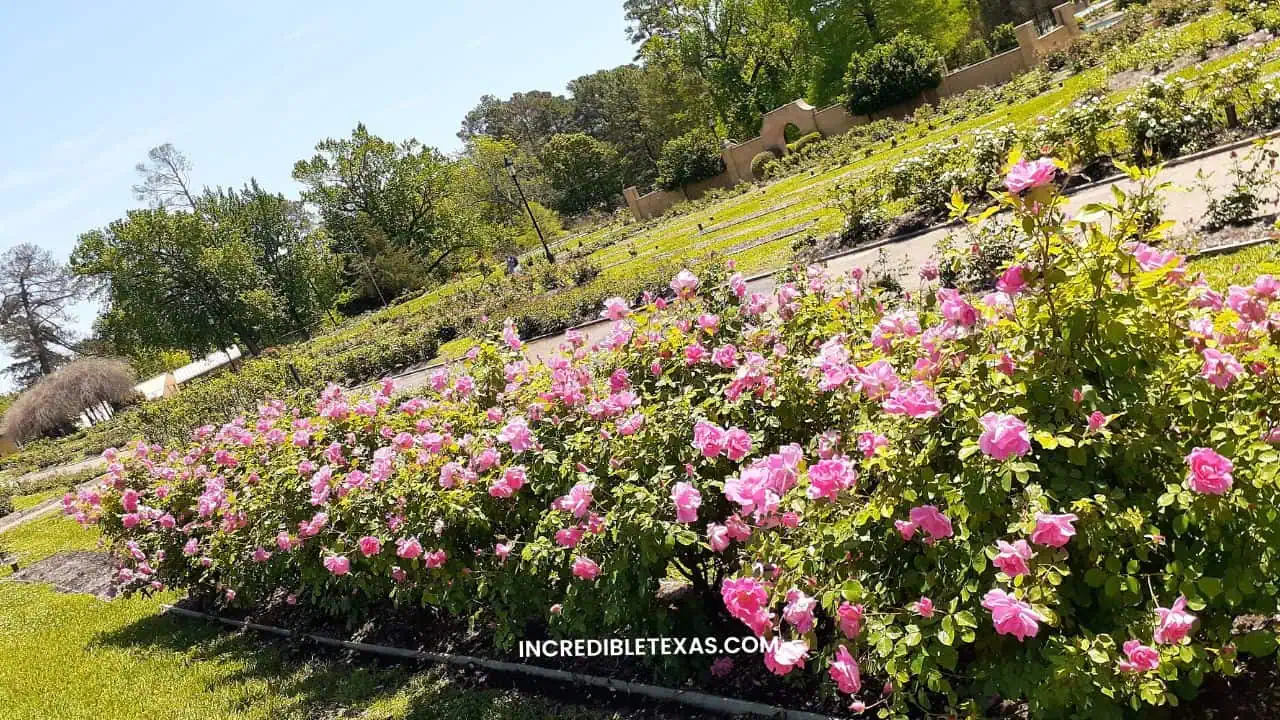
Commercial rose production in Tyler dates back to the late 19th century when local growers discovered that the acidic, sandy loam soil of East Texas provided an ideal medium for cultivating robust rootstocks.
According to historical records from the Texas Rose Festival archives, the Tyler agricultural district processed more than half of all commercially sold garden rose bushes in the United States during the mid-20th century. Today, the municipal garden preserves this heritage with manicured walking paths, tiered reflection ponds, and shaded gazebos.
Heritage Rose Varieties and Seasonal Bloom Windows
The collection displays modern hybrid teas, floribundas, grandifloras, and antique shrub roses dating back to the 19th century. Walking corridors allow visitors to observe historical breeding progressions, from tough heritage varieties to modern disease-resistant cultivars. The adjacent IDEA Garden and Sensory Garden demonstrate companion landscaping with native perennial plants suited for the southern climate.
Peak blooms occur in two distinct annual waves across Tyler. Mid-May delivers the primary spring flush, coating the terraced beds in rich crimson, blush, and gold blossoms. A second major flowering period arrives in mid-October, coinciding with the historic Texas Rose Festival. Summer visitors will still encounter flowering bushes, though intense heat typically prompts park staff to deadhead and prune plants between cycles.
Tyler Rose Museum and Visitor Tips
Directly adjacent to the garden entrance sits the Rose Garden Center and the Tyler Rose Museum. The museum interprets regional nursery history and displays elaborate hand-sewn velvet gowns worn by festival queens since 1933.
Museum admission costs $3.50 for adults and $2.00 for children ages 2 to 11. The museum operates Monday through Friday from 9:00 AM to 4:30 PM, Saturday from 10:00 AM to 4:30 PM, and Sunday from 1:30 PM to 4:30 PM, with Sunday and Monday closures during winter months.
Admission to the outdoor grounds remains completely free year-round. Concrete walkways are wheelchair accessible throughout the main tiers. For visitor guidelines and festival schedules, consult the City of Tyler Parks and Recreation Municipal Rose Garden Directory, or read our detailed Tyler Rose Garden visitor guide for comprehensive photography tips.
Tip
Morning visits between 8:00 AM and 10:00 AM offer soft photography lighting and pleasant temperatures, especially during warm spring and autumn weekends.
Mrs. Lee's Daffodil Garden: Gladewater's Spring Blossom Trail
Mrs. Lee's Daffodil Garden is an 816-acre private preserve near Gladewater that opens annually from mid-February through March, showcasing millions of blooming daffodils along a scenic four-mile one-way driving route. The property transforms quiet pine woodlands into rolling fields of golden flowers for four to six weeks each year.
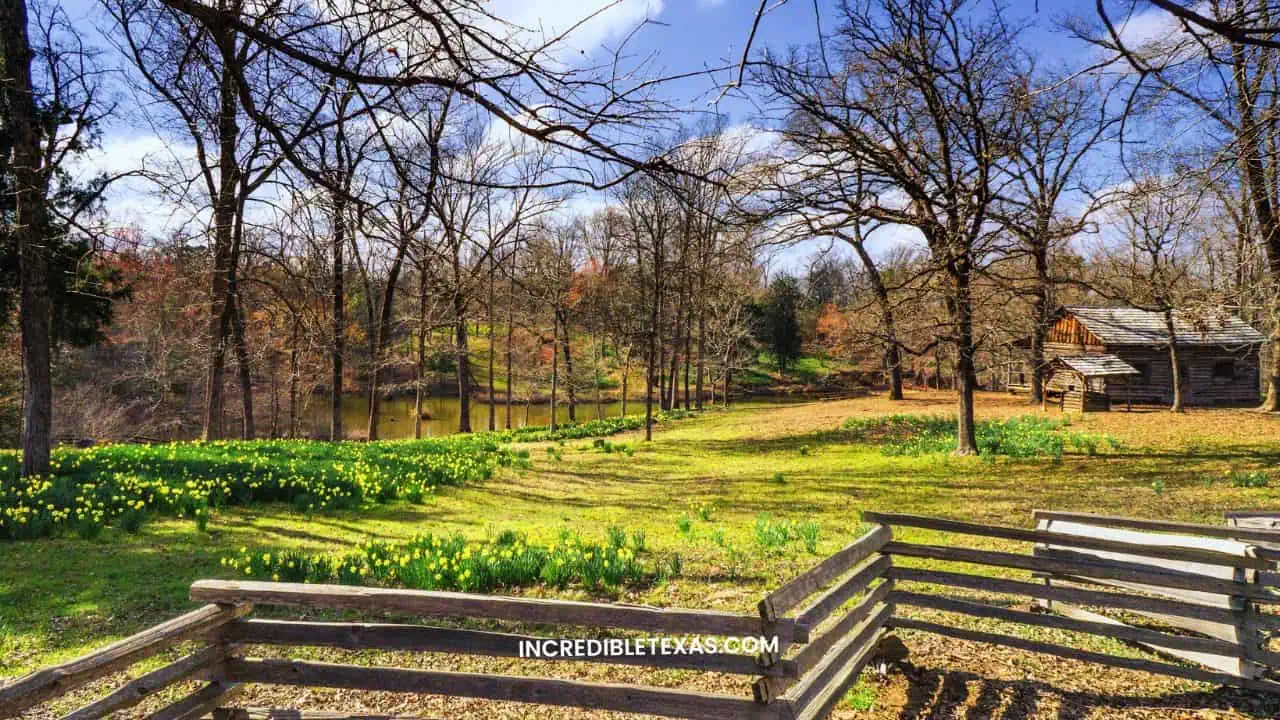
The floral project began in the 1950s when Helen Lee purchased a boxcar load of Dutch daffodil bulbs following the death of her husband, oilman T.W. Lee. Over several decades, workers planted millions of bulbs across the pastures, ridges, and wooded lake perimeters. Following her passing, the T.W. Lee Memorial Foundation preserved the property for public enjoyment, maintaining the landscape as a peaceful spring destination.
Driving Loop, Lake Josephine, and Pioneer Cabin
Visitors experience the estate primarily by vehicle along a gentle, one-way gravel road that winds past wooded knolls and open meadows. The loop leads down toward Lake Josephine, a quiet five-acre impoundment framed by clusters of golden trumpet narcissus. Nearby stands a replica 1800s pioneer log cabin, complete with rustic timber framing and a broad front porch overlooking the blooms.
Designated parking areas near the lake and cabin allow travelers to step out, walk along cleared footpaths, and photograph the flowers up close. Shaded picnic tables situated under tall loblolly pines provide convenient spots for an outdoor lunch. Dogs are welcome on the grounds, provided owners keep pets leashed and clean up after them.
Bloom Windows and Weather Advisory Logistics
Because the garden relies entirely on natural rainfall and seasonal soil temperatures, the bloom calendar shifts each year. Early varieties typically emerge in mid-February, while later large-cup daffodils peak toward early March. Entrance is free, though the foundation maintains a donation box at the entry gate to support year-round property maintenance.
The unpaved clay and gravel interior roads cannot support vehicle traffic when soaked. Foundation staff close the property during and immediately following heavy spring rains to prevent road damage and protect vehicles. Travelers should always check local status reports or phone the garden directly at (903) 845-5780 before making the drive from Dallas or Shreveport.
Note
Sturdy walking shoes are recommended when exploring the trail perimeters, as spring moisture can create soft grass and mud patches near the lake edge.
Love's Lookout: 35-Mile Panoramic Overlook in Cherokee County
Love's Lookout is a free scenic overlook on US Highway 69 North in Jacksonville, perched at 713 feet elevation to deliver panoramic 35-mile views across the rolling timberlands of Cherokee County. Rising 240 feet above the valley floor, this mountain-like crest provides one of the widest vistas in the Piney Woods region.
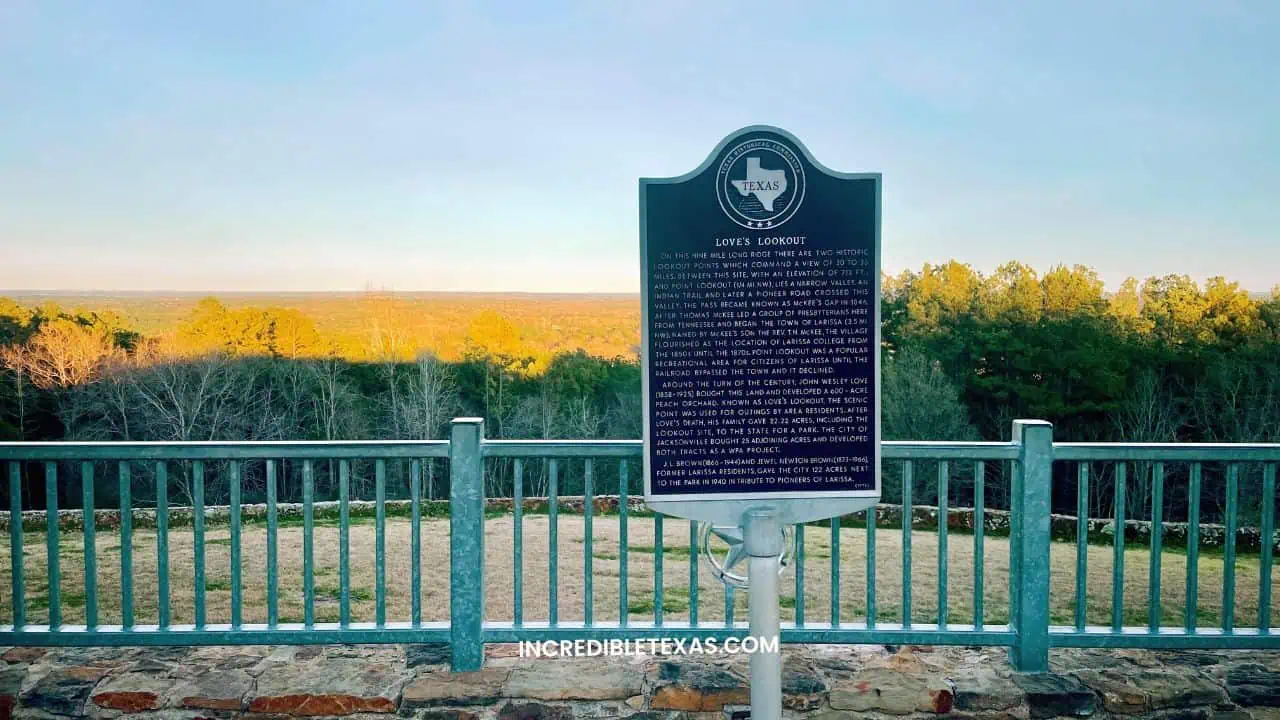
The crest was named after John Wesley Love, a grocer who acquired the ridge in 1904 to establish commercial peach orchards. Travelers along the highway routinely pulled over to admire the sweeping expanse, prompting the Love family and local civic groups to donate acreage for a public park in the 1920s. Over the decades, the site evolved into a popular regional stop for motorists exploring East Texas scenic drives.
Overlook Views and Photography Timing
Standing on the stone observation deck, visitors look east across a vast basin of pine canopies, cattle pastures, and distant ridges. On clear days with low atmospheric haze, landmarks more than thirty miles away stand visible on the horizon. The elevated vantage point offers birdwatchers a direct perspective on soaring red-tailed hawks, turkey vultures, and migratory songbirds riding warm thermal updrafts.
Sunset is the ideal hour to visit Love's Lookout. Late afternoon light filters through towering longleaf and loblolly pines, casting warm amber and crimson tones across the valley below. Covered picnic pavilions along the rim feature solid concrete tables, making the site an ideal roadside dinner stop for road trippers.
TxDOT Cherokee County Rest Area Amenities
In December 2004, the Texas Department of Transportation opened a modernized 5,500-square-foot Safety Rest Area on the summit. The architecture honors the region's historic tomato-shipping industry, featuring broad roof overhangs, exposed timber beams, and native red iron ore stonework. Inside, motorists enjoy clean, air-conditioned lobbies, immaculate restrooms, regional travel literature, and vending areas.
The facility also houses a Cherokee County Sheriff substation, ensuring a safe, well-lit environment around the clock. Ample paved parking accommodates passenger cars, travel trailers, and motorhomes. Detailed facility specifications are available through the official TxDOT Cherokee County Safety Rest Area at Love's Lookout guide.
Starr Family Home State Historic Site: Marshall's 1870 Heritage
The Starr Family Home State Historic Site in Marshall preserves 150 years of Texas political and social history centered on Maplecroft, an ornate 1870 Victorian mansion managed by the Texas Historical Commission. Located at 407 West Travis Street, the 2.5-acre property reflects the elegance and influence of one of the state's most prominent founding families.
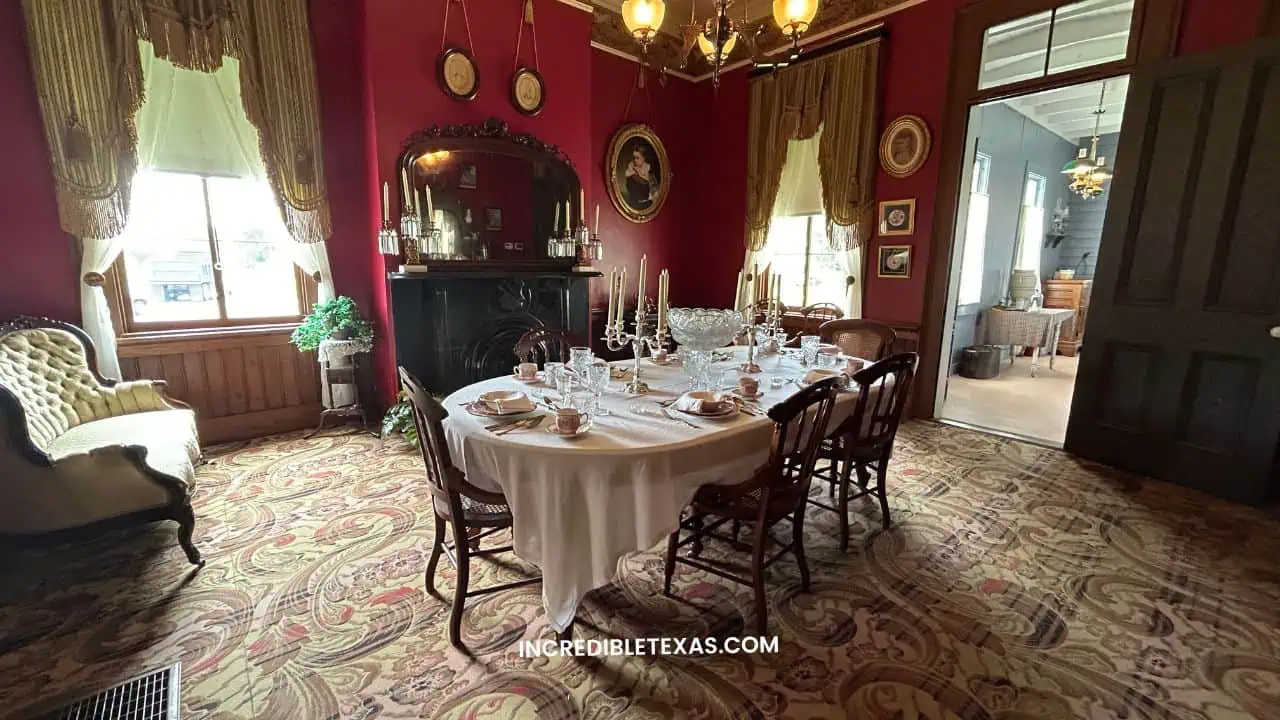
Dr. James Harper Starr served as Secretary of the Treasury under Mirabeau B. Lamar during the Republic of Texas era. Later, he established a thriving real estate and land agency that helped settle vast tracts of East Texas. His son, James Franklin Starr, built Maplecroft in 1870 as an architectural showplace, combining Classical Revival elements with Victorian detailing and high-ceilinged parlors designed to catch summer breezes.
Maplecroft Mansion and Historic Grounds
The interior of Maplecroft contains an extraordinary collection of original family furnishings, decorative arts, and historical documents. Visitors can examine Louis XVI-style parlor suites, rare Persian carpets, 19th-century oil portraits, and intricate Venetian glassware acquired during European grand tours. Unlike historic sites furnished with period-appropriate reproductions, the items displayed in Maplecroft belonged directly to four generations of the Starr family.
Beyond the main residence, the manicured grounds include Rosemont Cottage, the historic carriage house, a schoolhouse, and formal heirloom gardens. Giant magnolia trees and mature pecan canopies provide continuous shade across the crushed brick pathways. Interpretive signs explain the daily routines, agricultural operations, and domestic labor that maintained the urban estate.
Guided Tours and Visitor Hours
Tours led by knowledgeable Texas Historical Commission docents guide guests through the main house, sharing personal letters and financial ledgers that illuminate life in Marshall during the railroad boom of the 1870s and 1880s. Special community programs throughout the year include heritage gardening workshops and seasonal holiday celebrations.
The site welcomes visitors Tuesday through Saturday from 10:00 AM to 4:00 PM. Admission is $5 for adults, $3 for seniors, military veterans, and first responders, and $2 for students ages 6 to 17. Children five and under enter free of charge. For tour schedules and program reservations, visit the Texas Historical Commission Starr Family Home Historic Site portal.
Texas Freshwater Fisheries Center: Athens Aquatic Exhibits & Fishing Pond
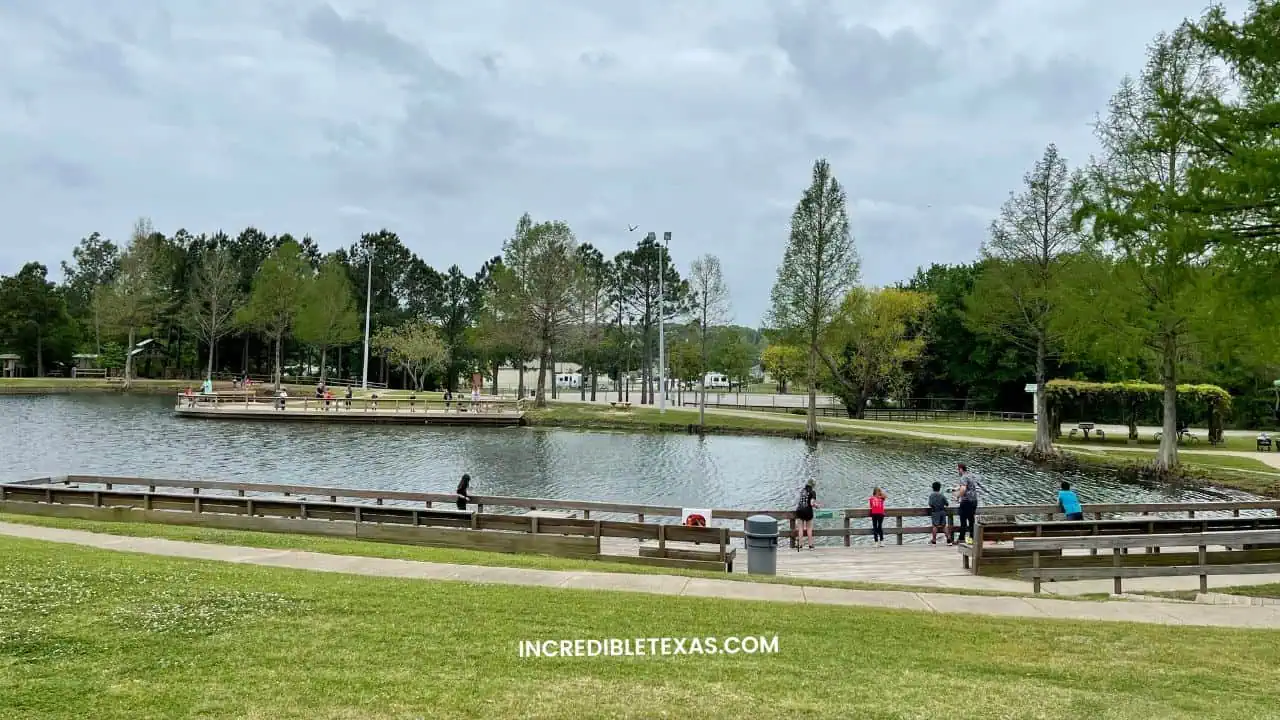
The Texas Freshwater Fisheries Center in Athens combines a working fish hatchery with 300,000 gallons of native aquatic exhibits and a stocked 1.2-acre catch-and-release fishing pond for $5.50 adult admission. Operated by the Texas Parks and Wildlife Department, this 107-acre educational complex sits just seventy miles southeast of Dallas.
The center serves as the headquarters for the renowned Toyota ShareLunker program, which collects, breeds, and studies largemouth bass weighing thirteen pounds or heavier to improve genetic stocks across Texas public reservoirs. Visitors can view state record catches, explore aquatic conservation displays, and observe scientific hatchery operations that produce millions of fingerlings annually.
Aquarium Galleries and Daily Diver Feeding Shows
Indoor and outdoor aquarium galleries introduce guests to diverse Texas freshwater environments. Massive glass viewing walls reveal monster alligator gar, prehistoric paddlefish, channel catfish, and sunfish swimming naturally among submerged timber and limestone ledges. The outdoor ponds also host native waterfowl, turtles, and American alligators basking in the sun.
In the air-conditioned Anheuser-Busch Theater, guests gather for popular dive shows. A scuba diver enters the 26,000-gallon aquarium tank with a two-way microphone to hand-feed trophy bass while explaining fish biology and taking live questions from the audience. Theater shows provide an engaging, kid-friendly look at underwater food chains.
Stocked Angling Pond and Wetlands Trail
One of the facility's best amenities is the 1.2-acre casting pond, stocked year-round with catfish and sunfish, and bolstered by rainbow trout during winter months. Staff provide loaner cane poles, modern reels, and bait free of charge, with volunteers on hand to help beginners bait hooks and land catches. Anglers do not need a state fishing license to fish on the center's ponds.
After fishing, visitors can walk the 0.8-mile ADA-accessible Wetlands Trail. The elevated wooden boardwalk winds across natural marshlands, spring seeps, and pitcher plant bogs. For hours of operation, seasonal dive schedules, and group bookings, refer to the official Texas Parks and Wildlife Texas Freshwater Fisheries Center Portal.
Tip
Cane poles and frozen bait are provided free with admission, making the casting pond an effortless first-time fishing experience for young children.
Shangri La Botanical Gardens: 252 Acres of Wetlands in Orange
Shangri La Botanical Gardens and Nature Center in Orange encompasses 252 acres of formal floral gardens, sculpture courtyards, and cypress-tupelo bayou wetlands with free year-round general admission. Developed by the Nelda C. and H.J. Lutcher Stark Foundation along Adams Bayou, it stands as one of the notable ecological retreats on the Upper Texas Gulf Coast.
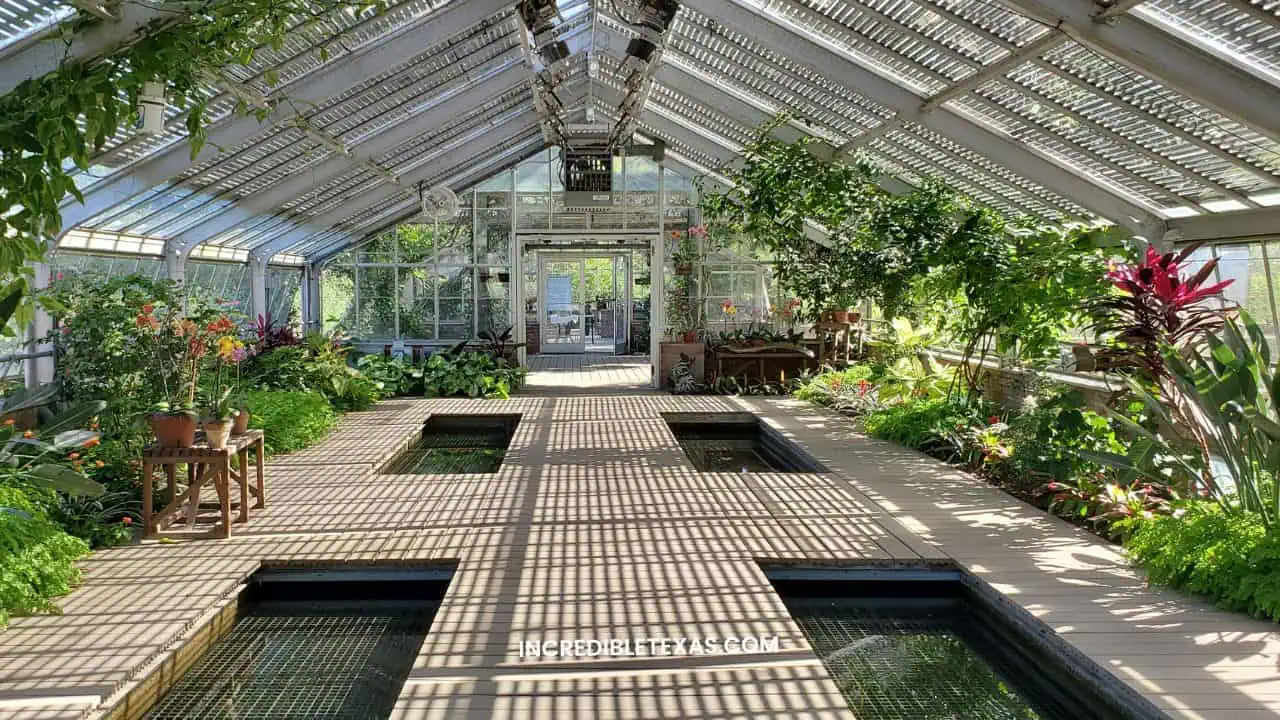
Lumber magnate H.J. Lutcher Stark initially landscaped the private estate in 1942, planting thousands of azaleas and camellias around a cypress swamp. A devastating freeze in 1958 shuttered the gardens for decades until the Stark Foundation undertook a comprehensive environmental restoration. Reopened in 2008, Shangri La became the first project in Texas to earn Platinum LEED certification from the U.S. Green Building Council.
Cypress-Tupelo Boardwalk and Formal Garden Rooms
The grounds feature a succession of themed "Garden Rooms" structured around visual color, geometric shape, plant texture, and scent. Brick paths lead past perennial borders, seasonal bulb displays, and tranquil reflecting pools like the Pond of the Blue Moon. Outdoor sculptures created from reclaimed stone and bronze accent the manicured greenery.
Leaving the formal plots behind, visitors step onto wide wooden boardwalks that bridge the Cypress-Tupelo Swamp. Massive bald cypress trees with buttressed trunks and prominent knees rise from dark, reflective waters draped with Spanish moss. An enclosed bird blind overlooking Ruby Lake gives wildlife photographers clear views of nesting egrets, herons, roseate spoonbills, and anhingas.
Free Admission and Adams Bayou Excursions
The Stark Foundation provides free general admission to ensure broad community access to the botanical collection and nature center. Visitors can also reserve seats aboard quiet, electric-powered pontoon boat excursions that navigate the winding waterways of Adams Bayou. Expert naturalists describe wetland ecology, coastal flood control, and regional wildlife during the 45-minute river cruises.
Shangri La operates Tuesday through Saturday from 9:00 AM to 5:00 PM, with the final entry permitted at 4:30 PM. The nature center remains closed on Sundays and Mondays. For detailed seasonal exhibits, boat tour timings, and packing advice, consult our comprehensive [Shangri La Botanical Gardens visitor guide](/shangri-la-botanical-gardens-orange-tx/). Visitors can also verify seasonal festival schedules and reserve boat seats through the Shangri La Botanical Gardens and Nature Center Official Portal.
Athens Scuba Park: Spring-Fed Quarry Diving & Sunken Wrecks
Athens Scuba Park is a spring-fed clay quarry in Athens offering 30-to-80-foot visibility and more than 25 submerged wrecks, including aircraft and buses, for certified divers from mid-March through September. Situated on an eight-acre lake at 701 County Road 4814, it ranks among the top spots for scuba diving in Texas.

The site originally served as a commercial clay mining pit for the Athens Brick Company during the early 20th century. After miners struck strong natural freshwater springs, crystal-clear water flooded the excavation to create a secluded quarry lake. In 1987, local entrepreneurs developed the lake into a dedicated underwater adventure park tailored for diving certifications, navigation training, and recreational exploration.
Submerged Aircraft, Buses, and Underwater Navigation
Underwater obstacles at the park rival specialized coastal dive wrecks. The lake floor contains a retired Hawker 125 twin-engine corporate jet, a Lockheed jetliner cockpit, multiple full-size school buses, speedboats, sailing yachts, and even a sunken Volkswagen Beetle. Submerged guide lines connect underwater features, allowing divers to navigate between attractions without surfacing.
Water depths range from shallow entry shelves to deep sections dropping to 35 feet. Spring flow keeps water clarity far superior to murky inland reservoirs, with visibility reaching up to eighty feet during calm weather. Submerged dive platforms anchored at ten and twenty feet provide ideal stations for open-water instructors teaching student divers buoyancy control.
Certification Requirements and Seasonal Hours
All active divers must present a valid certification card (C-card) from recognized agencies such as PADI, NAUI, or SSI upon check-in. Diver day passes cost $20 to $25 per person, while non-diving companions pay a $10 spectator fee. An on-site dive shop provides compressed air fills, equipment rentals, gear service, and hot showers.
The park operates seasonally from mid-March through late September, opening Wednesday through Sunday from 10:00 AM to 5:00 PM. Weekend camping is available on grassy shoreline sites for $10 per night. Because the facility closes during cold winter months and severe storm fronts, visitors should verify current lake conditions before heading out.
Davy Crockett National Forest: Ratcliff Lake & Four C Trail
Davy Crockett National Forest covers over 160,000 acres across Houston and Trinity counties, anchored by Ratcliff Lake Recreation Area and the 20-mile Four C National Recreation Trail. Managed by the USDA Forest Service, it represents one of four federally designated national forests in Texas, offering scenic protected woodlands alongside the best East Texas state parks and nature reserves.
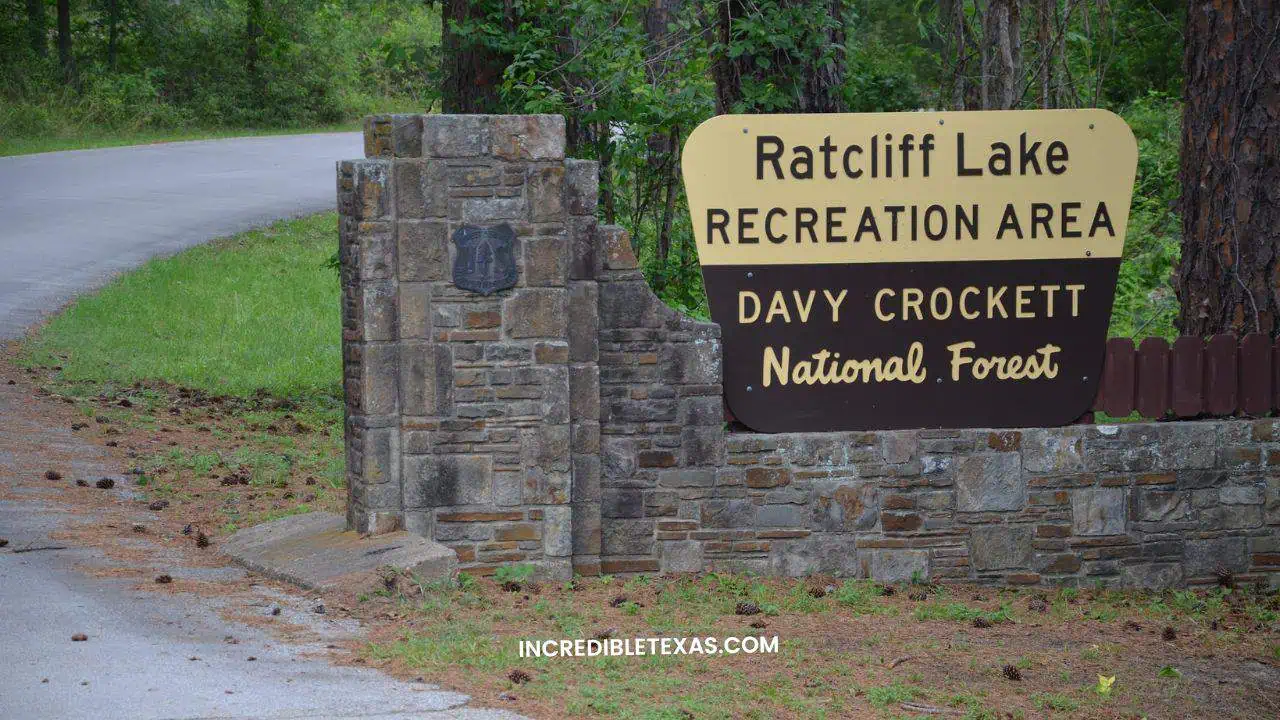
Named after the Alamo defender and Tennessee frontiersman, the federal forest protects mixed pine-hardwood woodlands between the Neches and Trinity river basins. Uncut timber tracts inside the Big Slough Wilderness preserve old-growth shortleaf and loblolly pines that escaped early 20th-century clear-cutting. Wildlife enthusiasts routinely spot white-tailed deer, river otters, and endangered red-cockaded woodpeckers nesting in mature pines.
Four C National Recreation Trail and Neches River Bluff
Backpackers consider the 20-mile Four C National Recreation Trail one of the finest point-to-point footpaths in the state. The trail begins at Ratcliff Lake Recreation Area and travels north through hardwood bottoms and pine ridges before ending at the Neches Bluff Overlook. The route follows the historic central tramway constructed by the Central Coal and Coke Company during historic logging operations.
Hikers can complete the trail as an ambitious weekend trek, camping at designated primitive trailside shelters such as the Walnut Creek shelter. Shorter day hikes along the 1.5-mile Tall Pines Trail and 0.75-mile Trail Tamers loop deliver accessible woodland walks for families with children.
Ratcliff Lake Day Use, Camping, and Paddling
Ratcliff Lake Recreation Area centers on a 45-acre lake built around an abandoned sawmill millpond. The developed recreation site features shaded picnic sites, a swimming beach, modern flush restrooms, and a boat launch. Boaters may use canoes, kayaks, and electric trolling motors, but gasoline outboards are prohibited to preserve water quality and peaceful surroundings.
Day-use entry to Ratcliff Lake costs $5.00 per vehicle. Outdoor enthusiasts seeking peaceful East Texas camping can pitch a tent beneath towering loblolly pines at Ratcliff Lake. Developed campsites with 30-amp electrical hookups are available for $20.00 per night, while non-electric tent sites rent for $15.00 per night. For campsite bookings and facility information, consult the Recreation.gov Ratcliff Lake Recreation Area Portal.
Piney Woods Wine Trail: Self-Guided Vineyard Route Across East Texas
The Piney Woods Wine Trail connects more than 20 independent vineyards and tasting rooms across East Texas, highlighting locally grown grape varietals such as Blanc du Bois and Black Spanish. Spanning a multi-county triangle between Athens, Tyler, Pittsburg, and Lindale, this self-guided driving route pairs artisanal vintages with countryside hospitality and complements top things to do in Tyler.

While the Texas Hill Country garners widespread attention for viticulture, East Texas winemakers have carved out a distinctive niche. The region's warm summer days, gentle breezes, and sandy soils yield excellent fruit when planted with disease-resistant hybrid grapes. Connecting charming East Texas towns such as Athens, Tyler, Gladewater, and Marshall, these stops make rewarding weekend excursions.
Key Vineyard Stops Along the Trail
Notable destinations along the trail provide distinct atmospheres. In Tyler, Kiepersol Vineyards and Winery combines 63 acres of estate-grown vines with fine dining, craft distillery spirits, and a comfortable bed-and-breakfast inn. West in Athens, Tara Vineyard and Winery operates on a historic hillside property centered on a restored 1880s Victorian home with outdoor patio seating overlooking the vines.
Further north in Pittsburg, Los Pinos Ranch Vineyards serves Italian-inspired culinary fare alongside award-winning wines on a shaded Tuscan-style terrace. In Lindale, Red 55 Winery offers convenient downtown tasting rooms showcasing vintages selected by country music artist Miranda Lambert. Each stop introduces visitors to regional winemakers passionate about their craft.
Tasting Room Etiquette and Tour Planning
Most boutique tasting rooms open Thursday through Sunday during afternoon hours, though operating times vary widely between rural vineyards. Tasting flights generally cost between $10 and $20 for four to six pours, with fees often credited toward bottle purchases. Many properties host live acoustic music on Friday and Saturday evenings.
Visitors planning a full-day wine route should designate a driver or hire local tour shuttles operating out of Tyler. Wineries welcome picnic baskets on outdoor lawns, though outside alcoholic beverages are strictly forbidden by Texas Alcoholic Beverage Commission regulations. Check individual tasting room schedules on the Piney Woods Wine Trail Official Directory before departing.
Best Time to Visit East Texas Hidden Gems by Season
Spring from March through May and autumn from October through November offer the most pleasant weather, lowest humidity, and peak floral blooms across East Texas attractions. These destinations serve as convenient Piney Woods day trips from both Dallas-Fort Worth and Houston. Understanding regional weather patterns helps travelers maximize time outdoors while avoiding intense summer humidity.
Spring arrives early in the Piney Woods. Temperatures range from the mid-60s to upper 70s, coinciding with wild daffodil blooms in Gladewater, azalea trails in Tyler, and fresh dogwood flowers across national forest canopies. Spring also brings occasional heavy rainstorms, making flexible travel plans important for unpaved country roads.
Autumn brings crisp morning air and comfortable afternoon temperatures in the 70s. The Tyler Municipal Rose Garden experiences its secondary bloom flush in October, while hardwood forests in Davy Crockett National Forest display rich copper, amber, and red foliage by early November. Winter remains relatively mild, allowing year-round hiking and fishing, though seasonal operations like Athens Scuba Park pause until spring.
Among the most rewarding places to visit in East Texas, these destinations highlight the cultural and natural variety of the Pineywoods ecoregion.
Frequently Asked Questions About East Texas Hidden Gems
Find fast answers to common questions about admissions, seasonal hours, and trip planning for hidden attractions in East Texas.
What are the top hidden gems to visit in East Texas?
Top hidden gems across East Texas include the Tyler Municipal Rose Garden, Mrs. Lee's Daffodil Garden in Gladewater, and Love's Lookout in Jacksonville. Other standout spots include Shangri La Botanical Gardens in Orange and the Texas Freshwater Fisheries Center in Athens.
Are there free hidden gems to visit in East Texas?
Several top East Texas destinations offer free general admission, including the 14-acre Tyler Municipal Rose Garden, Shangri La Botanical Gardens in Orange, and Love's Lookout in Jacksonville. Mrs. Lee's Daffodil Garden in Gladewater is also free to enter, though donations for site upkeep are welcomed.
When is the best time of year to explore East Texas hidden gems?
Spring from mid-February through May offers peak floral displays, including Gladewater daffodils, Tyler azaleas, and early rose flushes alongside mild temperatures. Autumn from October through November brings another peak rose bloom in Tyler and comfortable hiking conditions in Davy Crockett National Forest.
What is unique about Love's Lookout in Jacksonville, Texas?
Love's Lookout rises 240 feet above the surrounding terrain to an elevation of 713 feet along US Highway 69 North. The location features a TxDOT safety rest facility and provides panoramic views stretching up to 35 miles across Cherokee County.