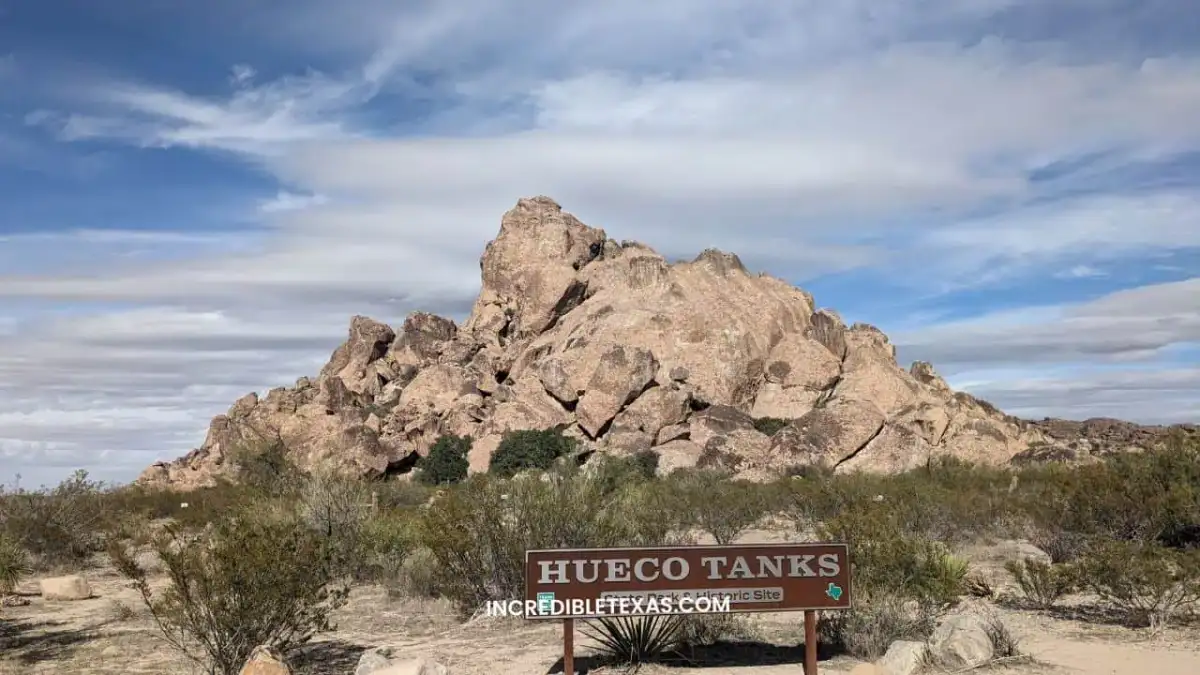
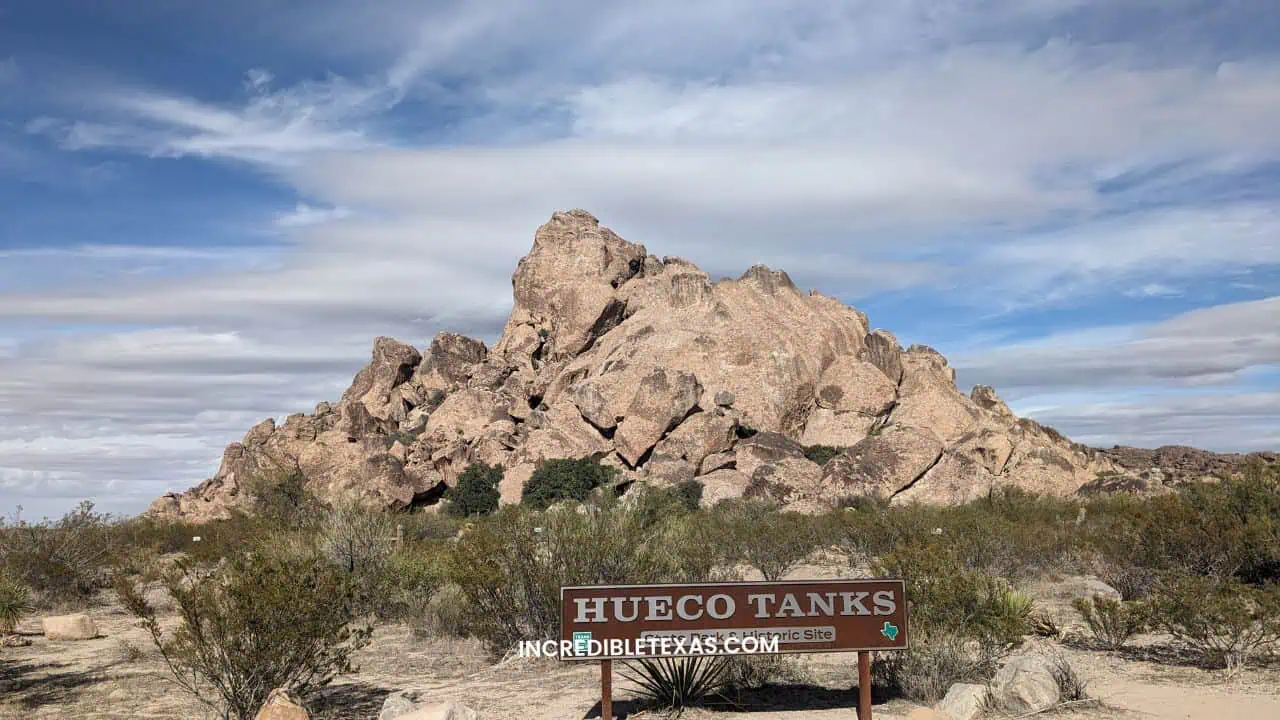
Hueco Tanks State Park and Historic Site is an 860-acre desert oasis located 32 miles northeast of El Paso. The park is renowned for massive syenite rock hills that hold pockets of rainwater called huecos, supporting wildlife and human communities for more than 10,000 years.
Advance planning is mandatory at Hueco Tanks Texas because Texas Parks and Wildlife protects this fragile cultural treasure through strict visitor quotas and access controls.
Key takeaways
- Hueco Tanks State Park and Historic Site charges a daily entrance fee of $7 for adults and provides free admission for children 12 and under.
- North Mountain self-guided permits are strictly capped at 70 concurrent visitors, requiring advance telephone reservations at (512) 389-8911.
- East Mountain, West Mountain, and East Spur can only be entered on official guided tours booked in advance by calling (915) 857-1135.
- Every visitor must watch a mandatory 15-minute site orientation video at park headquarters before accessing trails, boulders, or campsites.
- The park campground offers 20 water-and-electric sites subject to a strict three-day stay maximum to prevent overcrowding.
Hueco Tanks State Park at a Glance: Desert Oasis & Historic Site
Hueco Tanks State Park and Historic Site rises dramatically from the surrounding Chihuahuan Desert plateau in eastern El Paso County. For thousands of years, these syenite rock hills acted as natural rainwater cisterns, sustaining desert travelers, archaic hunter-gatherers, and diverse wildlife.
The park sits roughly 32 miles northeast of downtown El Paso. Travelers driving from Hueco Tanks El Paso routes should follow U.S. Highway 62/180 east, turn north onto Ranch Road 2775, and proceed directly to the park gate. Regional driving directions and visitor planning resources are cataloged through the Visit El Paso Outdoor Adventure Directory.
Smartphone navigation applications frequently misdirect drivers onto rough, unpaved ranch tracks along the park’s northern border. Staying on paved highway connectors guarantees a smooth arrival at the visitor center check-in station.
Travelers looking to pair this archaeological visit with rugged mountain hiking can explore nearby Franklin Mountains State Park hiking trails. While Franklin Mountains offers open, unrestricted trail networks, Hueco Tanks operates as a protected outdoor museum where conservation takes priority over free-roaming foot traffic.
| Activity / Zone | Access Mode | Capacity Limit | Booking Window | Best For |
|---|---|---|---|---|
| North Mountain Trails | Self-guided permit | 70 people at once | Up to 90 days ahead | Day hiking, photography, basic bouldering |
| Guided Pictograph Tour | Staff or volunteer guide | 15–25 people per group | Call 1 week ahead | Viewing Jornada Mogollon face masks |
| Guided Climbing Tour | Certified volunteer guide | Small group permit | 1–2 weeks ahead | Technical backcountry bouldering |
| Developed Campground | Overnight reservation | 20 total campsites | Up to 90 days ahead | Dark-sky stargazing, multi-day excursions |
What Is Hueco Tanks State Park Known For?
Hueco Tanks State Park and Historic Site is internationally celebrated for three distinct attributes: over 2,000 ancient Native American pictographs, natural rock rainwater basins, and world-class technical bouldering.
The geological formation consists of syenite porphyry, an igneous rock that weathered over millions of years into cavernous hollows and boulders. These hollows collect seasonal monsoon rains, creating vital desert watering holes that drew migratory herds and indigenous travelers across prehistoric trade corridors.
The rock surfaces preserve the largest concentration of Jornada Mogollon painted mask designs in North America. More than 200 individual mask figures decorate sheltered overhangs, representing spiritual deities, rain ceremonies, and cosmological markers.
Climbers consider this venue an influential training ground of the sport, and an authoritative Hueco Tanks bouldering guide emphasizes respecting fragile holds. The unique texture, steep overhangs, and diverse roof problems led legendary climber John Sherman to invent the V-scale rating system here in the late 1980s.
Desert birding is equally exceptional. Sheltered canyon springs attract more than 200 avian species throughout the year, including white-throated swifts, golden eagles, and migratory warblers. Travelers compiling a broader regional itinerary can discover other unique desert destinations through our guide to hidden gems in West Texas.
Hours, Entrance Fees, and Mandatory Reservations
Knowing Hueco Tanks hours and fees allows travelers to budget and schedule their desert outing smoothly. Daily adult admission costs $7, and children 12 and under enter free of charge. Texas State Parks Pass holders receive unlimited entry for themselves and their vehicle passengers, though guided tour fees remain separate.
Operating schedules adjust seasonally to protect visitors from severe desert heat. From October through April, the park opens daily from 8:00 AM to 6:00 PM. From May through September, gates open from 7:00 AM to 7:00 PM Friday through Sunday, and from 8:00 AM to 6:00 PM Monday through Thursday.
Current admission fees, seasonal gate schedules, and holiday hours are maintained on the Texas Parks and Wildlife Hueco Tanks Park Portal.
The visitor headquarters closes precisely 30 minutes before park gates shut. Late arrivals cannot complete check-in procedures or view the required orientation video, which cancels daytime trail privileges.
Advance Hueco Tanks reservations are vital because day-use capacity fills quickly. Visitors seeking self-guided North Mountain access can book permits up to 90 days in advance by calling the Texas Parks and Wildlife reservation center at (512) 389-8911.
After touring the arid desert basins of Hueco Tanks, many road-trippers head southeast for a refreshing swim at Balmorhea State Park spring swimming, creating an ideal desert-and-oasis travel loop.
Tip
Telephone reservations open 90 days in advance at 8:00 AM Central Time. Holiday weekends and peak winter climbing dates frequently book out within minutes of phone lines opening.
North Mountain Self-Guided Access vs Guided Tours
North Mountain is the only section where visitors may hike and boulder without a guide. To safeguard sensitive vegetation and fragile cultural art, state park rangers enforce a strict cap of 70 concurrent visitors on North Mountain.
Of those 70 permits, 60 may be reserved in advance by telephone, while 10 permits are held for same-day walk-up visitors on a first-come, first-served basis. During cool winter weekends, hopeful walk-up visitors routinely line their vehicles outside the gate before dawn.
East Mountain, West Mountain, and East Spur contain some of the most fragile rock art sites and highest-rated climbing routes in the American Southwest. These three massifs require booking authorized Hueco Tanks guided tours with certified volunteer or commercial leaders.
Guided pictograph and hiking tours cost $5 for adults ages 13 and older, $2 for children ages 2 to 12, and are free for toddlers under 2. Tours operate Wednesday through Sunday and must be booked at least one week in advance by calling the park directly at (915) 857-1135.
Every visitor entering the grounds must watch an informative 15-minute orientation video at headquarters before setting foot on any trail. This orientation explains proper rock art etiquette, bouldering pad regulations, and desert safety protocols. Your orientation certification remains active for one full calendar year.
Ancient Pictographs, Rock Art Etiquette, and Cultural Heritage
The park preserves an extraordinary archaeological record documenting human passage across the Chihuahuan Desert. The site holds spiritual significance for numerous modern tribal nations, including the Kiowa, Mescalero Apache, Comanche, and the Tigua of Ysleta del Sur Pueblo.
Comprehensive archaeological documentation and rock art histories are curated through the TPWD Hueco Tanks History and Rock Art Archive.
Jornada Mogollon Masks and Archaic Paintings
The earliest Hueco Tanks pictographs were painted by archaic hunter-gatherers thousands of years ago, featuring red and yellow abstract geometric symbols. Between 600 and 1400 CE, agricultural Jornada Mogollon artists created vivid face masks, step-fret motifs, and figures of Tlaloc, the Mesoamerican rain deity.
Later historic paintings depict Spanish cavalrymen with lances, Mexican ranchers, church crosses, and Native American horsemen. Notable sites along North Mountain include the Cave of the Mask and Site 17, both accessible via short interpretive pathways.
Rock Art Etiquette and Legal Protections
Preserving ancient pigment panels requires strict visitor discipline. Touching rock art transfers skin oils and acids that cause centuries-old paints to flake away.
State and federal antiquities laws strictly protect every panel here. Visitors must never touch paintings, apply chalk to holds near imagery, make surface rubbings, or deface rock walls. Violations carry severe criminal penalties and permanent bans from the Texas State Park system.
Travelers who appreciate prehistoric Native American iconography should also plan a visit to see Seminole Canyon State Park rock art, where massive Pecos River Style murals adorn limestone rock shelters above the Rio Grande.
Escontrias Ranch and the Butterfield Overland Stage
During the 1850s, the mountain base served as an essential station on the Butterfield Overland Mail route, which transported mail and passengers between St. Louis and San Francisco. The stage company built a fortified adobe station near the mountain base to secure water from the huecos.
In 1898, Mexican rancher Silverio Escontrias purchased the land, establishing a working cattle ranch that operated for several decades. Today, the restored Escontrias ranch house serves as the park interpretive center, exhibiting historical ranching implements and regional artifacts.
Camping Facilities, Birding, and Desert Hiking Preparation
Planning Hueco Tanks camping offers a rewarding overnight base under dark desert skies. The campground features 20 developed campsites situated beneath the southern cliffs of North Mountain. Sites accommodate tents and RVs up to 40 feet in length, providing 50-amp electric hookups, water hookups, picnic tables, and upright shade ramadas.
Campground fee schedules, site dimensions, and utility hookup specifications are detailed on the TPWD Hueco Tanks Fees and Facilities Schedule.
Campers enjoy access to modern restrooms with flush toilets, hot showers, and a central RV dump station. Texas Parks and Wildlife restricts camping stays to a maximum of three consecutive nights to ensure equitable access during peak bouldering seasons.
Campers must note that exploring boulders or rocky outcrops surrounding the campground requires registering each morning at headquarters or joining a guided excursion. Ground fires and wood campfires are strictly prohibited to prevent wind-borne ash from settling onto rock art panels; visitors must use containerized fuel stoves for cooking.
A persistent water shortage affects the park utility system, meaning potable water is strictly reserved for basic hygiene and drinking fountains. Visitors must pack at least one gallon of fresh drinking water per person per day before leaving El Paso. Never drink or filter water from natural hueco pools, which sustain delicate populations of fairy shrimp and spadefoot toads.
Families organizing travel throughout the borderland region can discover engaging indoor and outdoor activities through our roundup of things to do in El Paso with kids.
Frequently Asked Questions About Hueco Tanks
What is the site best known for?
Hueco Tanks State Park and Historic Site is renowned for its natural syenite rock basins that collect desert rainwater, world-class technical bouldering, and more than 2,000 ancient pictographs. The site represents over 10,000 years of continuous human cultural heritage in the Chihuahuan Desert.
Do you need reservations before visiting?
Yes, advance reservations are essential because Texas Parks and Wildlife caps self-guided entry at 70 people at any given time. Day-use passes should be booked up to 90 days in advance by calling the state reservation line at (512) 389-8911.
How much does day-use entry cost?
Daily entrance costs $7 per adult, while children 12 and under enter free of charge. Texas State Parks Pass holders receive complimentary admission, but optional guided interpretive tours cost an additional $5 for adults and $2 for children.
Can visitors explore without a tour guide?
Visitors can explore the North Mountain area independently after securing a self-guided permit and watching the mandatory orientation video. However, East Mountain, West Mountain, and East Spur are accessible exclusively on official guided tours.
Are overnight campsites available in the park?
The park offers 20 developed campsites equipped with water connections, 50-amp electric hookups, and nearby hot showers. Overnight stays are limited to a maximum of three consecutive nights to accommodate high demand among climbers and travelers.
What is the best season to plan a trip?
The prime visiting window runs from late October through March when cool daytime temperatures provide optimal rock climbing and hiking conditions. Summer temperatures routinely exceed 100 degrees Fahrenheit, requiring very early morning arrivals and elevated sun protection.