Copper Breaks State Park: Hours, Trails, Camping & Stargazing
Copper Breaks State Park gives visitors a very specific kind of Texas trip: rocky hills, 10 miles of trails, a 60-acre lake, camping, horseback riding, and some of the darkest skies in the state near Quanah. If visitors want a park that feels remote without being hard to plan, this is the kind of place that rewards a short drive and an early arrival.
Visitors come here for wide-open views, not polished resort amenities. The park sits in the Texas Panhandle, and its mix of prairie, juniper breaks, and rugged trail loops makes it easy to fill a day with hiking, a night with stargazing, and a weekend with camping.
For another quiet West Texas stop, compare it with West Texas hidden gems for more remote stops that fit the same kind of road trip.
What Copper Breaks State Park Is Known For
Copper Breaks is known for its rugged landscape, its dark skies, and its mix of trail, lake, and camping options in one compact park. The land borders the seasonal Pease River, and the park history ties directly to the Comanche and Kiowa people, the Pease River country, and the copper deposits that gave the park its name.
The park’s identity appears in the details: rocky outcrops, rolling plains, and a trail system with 10 miles of routes. The network includes short loops and a 3.8-mile equestrian route, so visitors can choose a short walk or a longer ride-friendly loop.
The park works well for a visitor who wants a place that can handle a slow morning, an active afternoon, and a late-night sky session without forcing visitors to change locations. That is the core reason people build a trip around Copper Breaks instead of treating it like a one-hour detour.
Copper Breaks rewards pacing. If visitors move too fast, visitors miss the contrast between the rough trail tread, the open water, and the quiet that settles in after sunset; if visitors slow down, the park starts to feel layered instead of simple.
It also fits travelers who like parks with a little edge in the landscape. The terrain is not flat pasture from end to end, and that small change in elevation gives the overlooks, the lake edge, and the trail junctions more personality than a quick roadside stop would suggest.
Copper Breaks State Park Hours, Fees, and Reservations
The park address is 777 Park Road 62, Quanah, TX 79252-7679.TPWD park map and directions
The daily entrance fee is $3 for ages 13 and older. Children 12 and under enter free. TPWD entrance fees
Copper Breaks is open daily from 7 a.m. to 10 p.m. TPWD says the park often reaches capacity, so reservations matter for both camping and day use.
Before visitors go, check the current park alert. The alert page currently lists a burn ban, Stage 4 water restrictions, and closures at the boat ramp and fishing pier because of low lake level, so the packing list and activity plan should match those conditions.
Reservations matter even if visitors only plan a day visit. Travelers coming from farther away should reserve first and avoid arriving at dusk and hoping for a campsite or easy day-use entry.
That matters most on busy weekends, when a late arrival can leave less time for a trail loop or an easy camp setup before dark.
The burn ban also changes how visitors think about camp cooking. Containerized fuel stoves are the practical option, and the current water restrictions make it smart to bring their own drinking water instead of depending on a refill plan.
That extra water matters once the sun is up and the trail network starts to warm up. Hydration, shade breaks, and an early start all matter more when the park is open, dry, and exposed.
| Visit detail | Current fact |
|---|---|
| Address | 777 Park Road 62, Quanah, TX 79252-7679 |
| Phone | (940) 839-4331 |
| Hours | Open daily, 7 a.m. to 10 p.m. |
| Reservations | Recommended for camping and day use because the park often reaches capacity |
| Planning habit | Arrive early and check the alert page before visitors leave |
Campers cooking outside should pack for the conditions they will actually face. The current alert page says wood and charcoal fires are not allowed, and containerized fuel stoves are the safe option right now.
That alert also changes how the rest of the visit gets packed. Bring more water than visitors think visitors need, use sun protection, and plan visitorsr first walk while the day is still cool enough to enjoy the rocky sections without rushing through them.
Travelers arriving from another Texas stop should reserve first and drive in with a simple plan. Copper Breaks is not a place where visitors want to arrive late, improvise visitorsr campsite, and then try to squeeze in the trails before sunset.
A day-use visit works smoothly when visitors decide in advance whether the lake, the trails, or the night sky is visitorsr priority. That single choice makes visitorsr packing list smaller and keeps the park from feeling rushed, especially if visitors are trying to fit the visit into one long travel day.
The same logic applies to camping. Set up early, walk at least one trail before the heat settles in, and save the evening for the stars instead of trying to cram every activity into the last hour before dark.
Things to Do at Copper Breaks State Park
Copper Breaks combines hiking, lake time, and night sky viewing in one park. A visitor can hike in the morning, rest near the lake in the afternoon, and finish with an evening sky watch once the light fades.
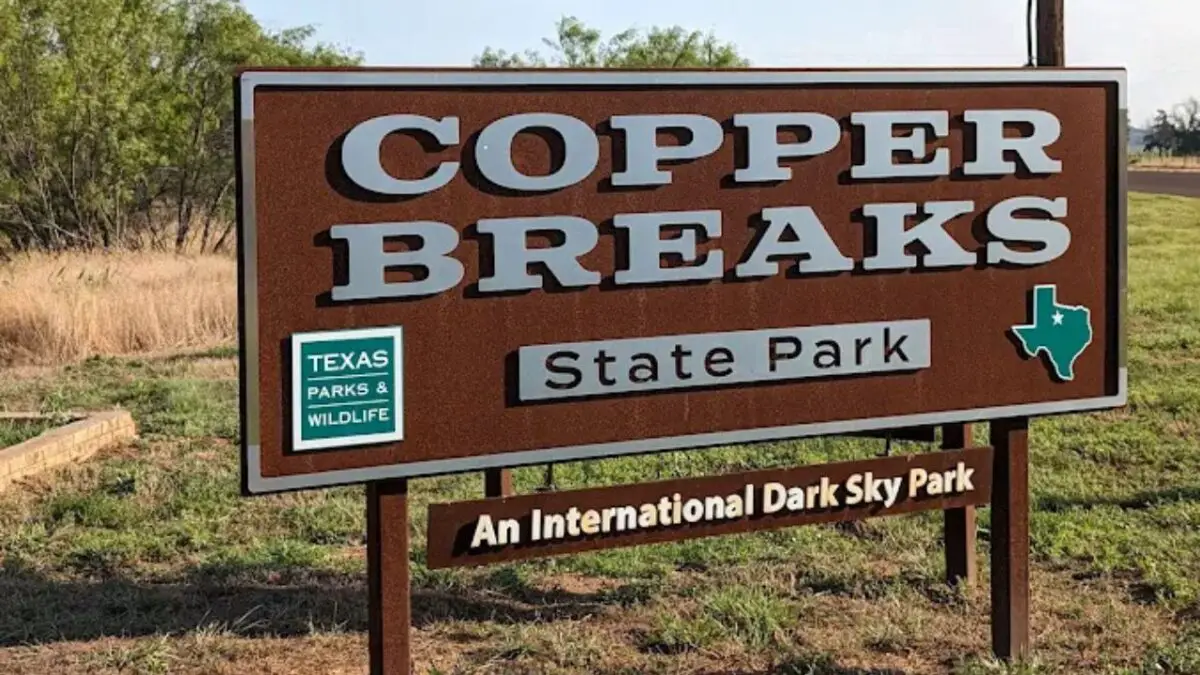
Stargazing is one of the park’s strongest draws. Copper Breaks is an International Dark Sky Park, and TPWD says the park hosts monthly star parties from April through November.
That dark-sky setup matters because visitors do not need a telescope to enjoy the view. On a clear night, the Milky Way can become the main event, and the park’s remote location gives visitors a better shot at a sky that feels wider than the ground beneath it.
An overnight stay gives the sky time to stand out after sunset instead of only for a quick look. The darker the surroundings get, the more the park starts to feel like a separate experience from the daytime trail network.
Early morning and late evening are also the quiet windows for wildlife. TPWD notes birds, deer, coyotes, armadillos, and other species in the park, so the hours that feel slowest often give visitors a better chance to notice movement in the grass and the trees.
- Go after dark for the sky. Monthly star parties run April through November, and the park’s night programs are a major reason people stay overnight.
- Watch for wildlife. The park’s open grassland and rocky cover make it a good place to see birds, deer, and other wildlife during quieter hours.
- Slow down near the lake. The water adds a different pace to the visit, especially if visitors want a calm break between trail time and camp time.
The park’s setting gives visitors a rare combination: daytime movement and nighttime stillness in the same small footprint. That is useful if visitors want a trip that feels full without needing a long itinerary.
Copper Breaks State Park Trails for Hiking, Biking, and Horseback Riding
The trail system totals 10 miles, and TPWD’s official trails page breaks it into short loops, moderate connectors, and a few routes that ask a little more from visitors. All trails allow hiking and biking unless the trail listing says otherwise.
| Trail | Distance | Why visitors would choose it |
|---|---|---|
| Bull Canyon Short Loop | 1.0 mi. | Easy, family-friendly, and useful when visitors want a short scenic loop |
| River Run Trail | 1.4 mi. | Moderate, with a connection between Bull Canyon Short Loop and Rocky Ledges Loop |
| Chris’ Link | 1.3 mi. | Easy, level, and good for moving between the equestrian and Bull Canyon trail areas |
| Equestrian Trail | 3.8 mi. | Moderate, with prairie, woodland, and wetland views |
| Juniper Ridge Nature Trail | 0.7 mi. | Challenging, steep, and ideal when visitors want a strong overlook payoff for a short distance |
| Rocky Ledges Loop | 1.1 mi. | Challenging, with rocky outcrops and a more demanding profile |
The easiest way to choose a trail is to match it to visitorsr energy level. A short visit works well on Bull Canyon Short Loop; a harder outing uses Juniper Ridge Nature Trail or Rocky Ledges Loop for steeper ground and broader views.
For the trail-minded traveler, Copper Breaks fits a West Texas canyon-country loop without demanding a huge park day. For nearby scenery and trail personalities, look at Palo Duro Canyon State Park and Caprock Canyons State Park and Trailway after visitors finish this page.
Stay on the marked path, especially on the steeper sections. TPWD specifically notes that Juniper Ridge is rocky and steep, and staying on the trail helps slow erosion while keeping the route safer for the next person who follows behind visitors.
For the simplest trail day, start with Bull Canyon Short Loop and then add River Run Trail if energy remains. That pairing keeps the mileage manageable while giving visitors both an easy scenic loop and a moderate connector that shows more of the terrain.
Horseback riders get the most specific trail advantage on the Equestrian Trail. At 3.8 miles, it gives visitors a longer route through prairie, woodland, and wetland areas without making the day feel like a full backcountry push.
Copper Breaks State Park Camping, Equestrian Sites, and West Texas Road Trips
Copper Breaks gives visitors several ways to stay overnight, and the variety matters. A visitor can book standard camping, water sites, equestrian sites, primitive hike-in sites, or group spaces depending on how much comfort matters and whether horses are part of the trip.
| Site type | Count | Nightly fee |
|---|---|---|
| Campsites with electricity | 24 | $20 |
| Campsites with water | 11 | $12 |
| Campsites with water (equestrian) | 14 | $12 |
| Primitive hike-in campsites | 6 | $12 |
| Group camp at Big Pond | 5 | $12 |
| Cottonwood group camp | 4 | Check current reservation details before booking |
| Pavilion | 1 | $50 daily |
The equestrian setup is especially practical if visitors bring horses. The park allows non-equestrian camping in the Big Pond Equestrian Camping Area, but horses must arrive with a negative Coggins test that is less than 12 months old, and they must be secured with a string line instead of being tied to trees or shrubs.
Primitive camping is the right fit for a quieter, more stripped-down stay. Those hike-in sites sit about 0.8 miles from the trailhead, do not have water, and do not have fire rings or grills, so the pack list needs to match the site instead of assuming car-camp comfort.
For a broader trip, Copper Breaks pairs well with Big Spring State Park or Balmorhea State Park for a multi-stop West Texas loop that mixes scenery, water, and overnight stays.
That road-trip structure works because Copper Breaks supplies the rugged terrain, while another stop can handle a different pace, such as a swimming break or a more urban overnight. A broader route does not need every stop to serve the same purpose.
Electric sites are the simplest choice for an easier setup, while water sites make sense when comfort matters more than simplicity. Primitive hike-in sites are the quietest option, but they only work if visitors are happy carrying in what visitors need and leaving the car behind for the night.
Travelers with horses should look closely at the equestrian campsites. The negative Coggins rule is not a small detail, and the park also says visitors should be ready to secure horses with a string line and manage manure and waste hay before visitors settle in for the night.
Lake Copper Breaks: Fishing, Swimming, and Boating
Lake Copper Breaks adds another layer to the park day. TPWD describes it as a 60-acre lake, and it gives visitors a place to fish, swim, or sit by the water between trail time and camp time.
If visitors fish inside the state park, visitors do not need a fishing license. TPWD also loans fishing gear for use in the park, which is useful if visitors want a simple fishing session without packing their own tackle.
| Lake activity | What to know right now |
|---|---|
| Fishing | No fishing license is required on state park property; gear loan is available |
| Swimming | There is a designated swimming area, and no lifeguards are on duty |
| Boating | The lake is a no-wake zone, jet skis are not allowed, and the boat ramp is currently closed because of low lake level |
The current park alert also says the fishing pier is closed because of low lake level. That matters if visitors were planning to use the pier for a quick cast, so it is worth adjusting the plan before arrival.
Swimming is the easiest water activity to fold into a general park day, but the lack of lifeguards means visitors need to treat it like any other unsupervised swim area. The most practical approach is simple: check the alert page, bring what is needed, and do not assume a full marina-style setup.
The boating picture is more limited right now, which is why the lake works better as a scenic and fishing stop than as a launch-heavy water recreation area. If a plan depends on the ramp, the pier, or a wider boating day, the current alert page should be part of the trip planning instead of a footnote.
Even with those limits, the lake still matters because it breaks up the park day. A visitor can hike in the morning, cool off near the water, and then shift into sunset or stargazing mode without leaving the park boundary.
Copper Breaks State Park FAQ
What is Copper Breaks State Park known for?
Copper Breaks State Park is known for its rugged West Texas scenery, 10 miles of trails, camping, a 60-acre lake, and dark-sky viewing. Its official identity is a blend of outdoor recreation and history, with the Pease River landscape, Comanche and Kiowa history, and the park’s star-party program all shaping the experience.
The park also stands out because those pieces fit together instead of competing with each other. A visitor can spend the morning on a trail loop, use the middle of the day for the lake or campsite, and save the evening for the sky without needing a second location to make the trip feel complete.
What can visitors do at Copper Breaks State Park?
Visitors can hike, bike, ride horses, camp, fish, swim, and watch the night sky. The park’s trail network gives visitors the most active daytime options, while the lake and dark-sky programs make it easy to stretch the visit into the evening without changing locations.
That range is why Copper Breaks works for more than one kind of traveler. A family can keep the day light and simple, while a longer-stay visitor can stack the trails, the campsite, and the night program into a fuller weekend plan.
Which trail is the right fit at Copper Breaks State Park?
The right trail depends on how much time and effort visitors want to spend. Bull Canyon Short Loop works well for a short easy walk, Juniper Ridge Nature Trail gives visitors a harder climb and a stronger overlook payoff, and the Equestrian Trail is the longest named route in TPWD’s trail list at 3.8 miles.
Families with kids and first-time visitors usually find Bull Canyon Short Loop and Chris’ Link the most forgiving choices. For a bit more texture underfoot, River Run Trail and Rocky Ledges Loop add more movement without turning the outing into a major endurance project.
How many trails are in Copper Breaks State Park?
TPWD says the park has 10 miles of trails. The official trail list includes River Run Trail, Bull Canyon Short Loop, Chris’ Link, Equestrian Trail, Juniper Ridge Nature Trail, and Rocky Ledges Loop, so visitors have several route combinations even if visitors only stay for a day.
That mileage is enough to make the park feel flexible, not crowded with options. A visitor can finish one loop, reset at the car or campsite, and still have enough left for another short walk if the weather and daylight cooperate.
Is Copper Breaks State Park good for stargazing?
Yes. Copper Breaks is an International Dark Sky Park, TPWD rates it Bortle 2, and monthly star parties run from April through November.
The night-sky setup is part of the park’s personality, not just a bonus. If visitors are camping, that matters even more, because the stars do not require a special ticket or a separate drive after dinner.
Do visitors need a fishing license at Copper Breaks State Park?
No. If visitors fish inside the state park, visitors do not need a fishing license.
That rule keeps the lake easy to use for spontaneous visits and beginner anglers. The shoreline stays simple to use, and the rest of the day can still go to trails or the night sky.
Before visitors leave for the park, save the address, check the alert page, and decide whether visitors want trails, camping, or a night-sky stay. Copper Breaks works well when visitors treat it as a full outdoor day instead of a quick photo stop.
When choosing between a one-day stop and an overnight, the overnight version is easier to justify because the trails, the lake, and the star-party schedule work better with more time.
Wind, sun, and water limits are part of the planning picture at Copper Breaks. A visitor who checks the alert page, brings extra drinking water, and leaves room for a shorter trail if the heat builds up will have a more comfortable day than someone trying to force every activity into the same schedule.
The same habit helps with timing. A morning arrival gives more flexibility for trails and camp setup, while a late arrival leaves less room before the park closes in the evening and the light starts to fade.