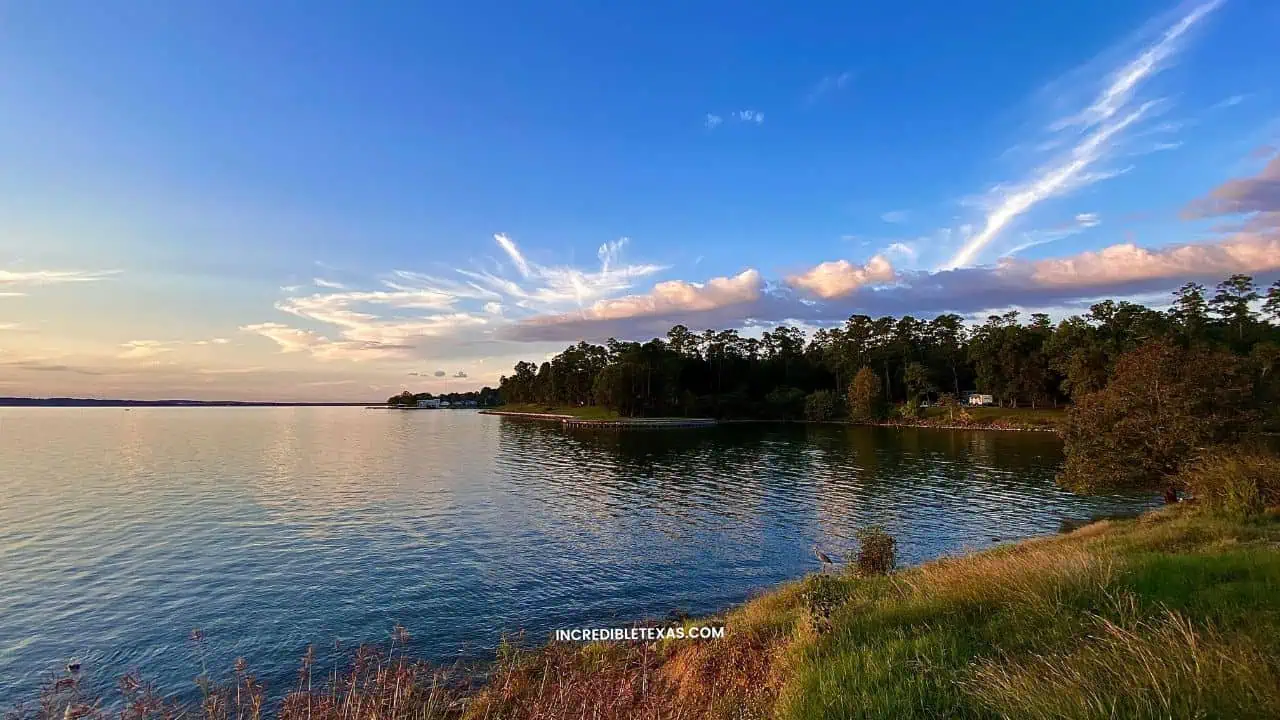
Set in Polk County just 75 miles north of downtown Houston, Lake Livingston State Park protects 635.5 acres of loblolly pine and hardwood bottomlands along the eastern shore of Texas’s second-largest in-state reservoir. The park serves as a hub for open-water boating, shaded camping, and spring white bass angling.
Key takeaways
- Lake Livingston State Park charges a daily entry fee of $6 for adults, while children aged 12 and under enter free.
- Overnight camping rates at Lake Livingston State Park range from $14 per night for primitive water-only tent sites in Briar Loop to $30 per night for 50-amp full-hookup RV sites in Red Oak and Piney Shores.
- The park features three multi-lane public boat ramps, a lighted fishing pier, two modern fish-cleaning stations, and a self-service Paddle EZ kayak and canoe rental kiosk near the marina.
- Anglers can fish from the shoreline, park banks, and fishing pier without a Texas fishing license under the TPWD Free Fishing in State Parks program.
- The park trail network offers approximately six miles of multi-use hiking and biking routes, highlighted by the 2.1-mile Trinity Trace Trail and the 0.9-mile Pineywoods Boardwalk Trail.
Lake Livingston State Park Quick Facts and Overview
Lake Livingston State Park encompasses 635.5 acres of Pineywoods terrain along the eastern edge of Texas’s 82,970-acre reservoir in Polk County, offering hiking, full-hookup RV camping, boat ramps, and world-class white bass fishing. It ranks among the most visited best lakes in Texas for travelers seeking forested water recreation within easy reach of the Gulf Coast.
| Facility / Site Type | Nightly Rate | Utilities Included | Best For | Reservation Rule |
|---|---|---|---|---|
| Briar Loop Campsites | $14 | Water spigot, picnic table, fire ring | Tent campers seeking tent-only quiet | Two-night minimum weekend stay |
| Hercules Club Loop | $20 | 30-amp electric, water, picnic table | Small travel trailers and camper vans | Two-night minimum weekend stay |
| Red Oak & Piney Shores | $30 | 50-amp electric, water, sewer | Large RVs requiring full utility connections | Two-night minimum weekend stay |
| Screened Shelters | $35 | Overhead roof, electricity, screened walls | Weather-protected camping without an RV | Two-night minimum weekend stay |
| Adult Day-Use Pass | $6 daily | Complete day access to trails, ramps, and pier | Day hikers, boaters, and bank anglers | Online day pass reservation advised |
Admission Prices, Passes, and Day-Use Hours
Lake Livingston State Park daily entrance costs $6 for adults aged 13 and older, while children 12 and under enter free. The entry gates remain open daily from 6:00 AM to 10:00 PM for day-use visitors.
The published Lake Livingston State Park price schedule delivers exceptional value for families touring outdoors. A Texas State Park Pass covers day entrance fees for the cardholder and all passengers in their vehicle across an entire calendar year.
Official reservation guidelines and pricing rules are published on the Texas Parks and Wildlife Lake Livingston Fee Schedule. Day visitors must display their entrance permit on their vehicle windshield while inside the boundaries.
Standard Lake Livingston State Park hours run from 6:00 AM until 10:00 PM seven days a week. The park store and marina operate on a separate schedule, opening daily from 8:30 AM to 4:30 PM for bait, firewood, and grocery supplies.
Tip
Capacity limits take effect on holiday weekends from Memorial Day through Labor Day. Reserving your day-use pass up to 30 days in advance through the TPWD reservation portal guarantees entry if gates close to drive-up traffic.
Lake Livingston Camping Options, Rates, and Loop Comparisons
The preserve provides over 140 campsites categorized into tent-only loops ($14/night), 30-amp electric loops ($20/night), 50-amp full-hookup RV sites ($30/night), and lakeside screened shelters ($35/night). As a top destination for camping near Houston, the park offers diverse lodging setups beneath pine canopies.
Campers can secure their spots through Lake Livingston camping reservations up to five months ahead of arrival. When booking a Friday or Saturday night, TPWD mandates a two-night minimum weekend reservation for all overnight pads.
Piney Shores and Red Oak: Full-Hookup RV Loops
The Piney Shores and Red Oak loops cater directly to motorhomes, travel trailers, and fifth-wheels. These sites provide 50-amp electrical connections alongside municipal water and dedicated sewer drops for $30 per night.
Paved parking pads accommodate large rigs, and select sites in Piney Shores offer unobstructed views of the open reservoir. Each site includes a picnic table, an upright barbecue grill, and a ground fire ring with a cooking grate.
Hercules Club: Electric and Water Camping
The Hercules Club loop features 26 shaded campsites equipped with 30-amp electricity and pressurized potable water for $20 per night. The loop winds through mature hardwoods and loblolly pines, providing natural canopy protection against midday summer heat.
These sites are popular with pop-up campers, camper vans, and tent campers who require electricity for fans or medical devices. Restrooms with flush toilets and hot showers sit within easy walking distance of all Hercules Club pads.
Briar Loop: Quiet Tent-Only Campsites
Briar Loop provides 23 dedicated tent campsites equipped with shared water spigots for $14 per night. To ensure a peaceful wooded environment, park regulations strictly prohibit RVs, travel trailers, and motor generators inside Briar Loop.
Campers park on paved vehicle spurs and pitch tents on level sand-and-loam pads positioned under shade trees. The loop offers immediate walking access to the Trinity Trace Trail connector path.
Screened Shelters on the Lake Perimeter
For visitors who want outdoor shelter without pitching a tent, the park rents 10 lakeside screened shelters for $35 per night. These wooden units feature solid roofs, concrete slab foundations, full window screens, interior electrical outlets, and outside picnic tables.
Reserving Lake Livingston screened shelters requires guests to bring sleeping cots, pads, and bedding since interior furnishings are not provided. Cooking inside the shelters is prohibited, but outdoor fire rings and barbecue grills stand outside each doorway.
Boating, Boat Ramps, and Paddle EZ Kayak Rentals
The park features three paved boat ramps, a marina store open daily from 8:30 AM to 4:30 PM, and a smartphone-enabled Paddle EZ rental kiosk for kayaks and canoes. With 82,970 surface acres to explore, getting onto the water is a focal point for weekend visitors.
The reservoir was impounded in 1969 by the Livingston Dam to secure municipal water supplies for the greater metropolitan area. Hydrological data and elevation records are tracked on the Texas Water Development Board Lake Livingston Survey database.
The three public Lake Livingston boat ramps inside the park handle everything from tournament bass boats and pontoon cruisers to personal watercraft. Staging docks assist solo boaters with launching, though parking lanes for boat trailers fill before 8:30 AM on sunny spring Saturdays.
Visitors without personal watercraft can rent single kayaks, tandem kayaks, and stand-up paddleboards through the automated Paddle EZ kayak rentals station near the marina. Boaters unlock vessels using a smartphone application, grab life jackets from the storage rack, and launch directly into a protected cove.
Note
All children under 13 years old must wear an approved USCG life jacket while underway on any vessel in Texas waters. Adult paddlers must carry a wearable personal flotation device on board their craft at all times.
White Bass Fishing and Shoreline Pier Access
The reservoir ranks among the finest white bass fisheries in the United States, complemented by productive blue catfish, largemouth bass, and crappie habitats across the Trinity River basin. Each spring, massive schools of white bass migrate upstream, initiating a celebrated seasonal fishery detailed in the Texas Parks and Wildlife Lake Livingston Fishing Report.
Under the Texas Parks and Wildlife Free Fishing in State Parks initiative, no fishing license required from shore applies to all park banks, bulkheads, and piers. Anglers of all ages can fish without purchasing a state fishing license or freshwater endorsement, provided they remain within park boundaries.
The lighted Lake Livingston fishing pier extends into deep water, allowing night anglers to target crappie and channel catfish attracted by underwater illumination. Two illuminated fish-cleaning stations with running water and deep sinks sit near the marina for processing your daily catch.
Anglers targeting open-water schools from motorized vessels must hold a valid Texas freshwater fishing license once navigating beyond state park shoreline markers. Trolling silver spoons, inline spinners, and small shad-pattern crankbaits around underwater humps produces consistent white bass limits from March through June.
Hiking and Biking Trails Across the Pineywoods
Park staff maintain six multi-use trails totaling approximately six miles through pine and hardwood forest, accommodating hikers, trail runners, and mountain bikers. Visitors navigating Lake Livingston State Park TX can view the official layout on the Texas Parks and Wildlife Lake Livingston Map.
Downloading an updated Lake Livingston State Park map before arrival assists with navigating trail connections and water spigots. Elevation changes remain gentle throughout the park, making routes manageable for young children and casual trail walkers.
Trinity Trace Trail (2.1 Miles)
The Trinity Trace Trail forms the main hiking and biking artery of the park, winding for 2.1 miles between camping loops and day-use facilities. The path cuts through towering loblolly pines, sweetgums, and American holly, offering abundant shade on warm afternoons.
Trail runners frequently utilize Trinity Trace for morning conditioning because the tread is wide and well-cleared. Hikers can access the route from marked trailheads located at the Piney Shores loop, Briar Loop, and the park group pavilion.
Pineywoods Boardwalk Trail (0.9 Miles)
The Pineywoods Boardwalk Trail extends 0.9 miles through wetland bottomlands and sensitive marsh habitats. Elevated wooden walkways keep visitors dry above standing wetland water while protecting root systems of native water tupelo and bald cypress trees.
Along the boardwalk, an observation tower rises above the wetland canopy, giving photographers elevated vistas across the marsh out toward the open lake basin. The route includes a wheelchair-accessible bird blind overlooking a sheltered duck pond.
Short Forest Connectors: Bakba and Fosi Trails
The 2.0-mile Bakba Trail circles through secondary pine growth along the western boundary, providing a quieter woodland trek isolated from lake traffic. The 0.5-mile Fosi Trail connects campground loops to interior picnic pavilions through dogwood and red oak thickets.
Casual walkers can also explore the 0.3-mile Oak Flat Trail and 0.2-mile Hawthorn Trail for quick woodland strolls near the park headquarters. Sturdy walking shoes handle the exposed tree roots and sandy loam trail surfaces without difficulty.
Wildlife Viewing, Birding, and Alligator Safety
The wooded peninsula provides critical nesting habitat for bald eagles, pileated woodpeckers, and over 330 migratory bird species, alongside resident white-tailed deer and American alligators. Biological details and habitat profiles are maintained on the Texas Parks and Wildlife Lake Livingston Nature Portal.
During winter and early spring, bald eagles hunt shad along the shoreline and nest in towering loblolly pine crowns near the park boundary. Birders visiting for East Texas birdwatching frequently spot pileated woodpeckers, brown-headed nuthatches, barred owls, and an array of seasonal warblers along the boardwalk.
American alligators inhabit the wetlands, sloughs, and quiet coves of the lake. These native reptiles generally avoid human presence, but visitors must respect fundamental alligator safety rules to prevent dangerous encounters.
Never feed, corner, or approach alligators under any circumstances. Keep children close at hand near water edges, avoid swimming outside the designated beach zone, and consult our Brazos Bend State Park alligator safety tips for additional reptile awareness protocols.
For travelers planning dog-friendly camping, pets must remain on a hand-held leash no longer than six feet at all times. Pets are strictly prohibited inside park buildings, screened shelters, and the roped swimming beach area.
Lake Livingston State Park vs. Huntsville State Park
When comparing state parks near Houston, many outdoor travelers debate whether to choose Lake Livingston or Huntsville for a Pineywoods weekend. Among popular East Texas state parks, each property serves distinct outdoor preferences.
Lake Livingston is anchored by an 82,970-acre reservoir, making it the clear choice for boaters, jet skiers, open-water anglers, and water sports enthusiasts. Its modern boat ramps, wide lake basins, and aggressive white bass runs provide high-energy water recreation.
By contrast, the Huntsville State Park visitor guide highlights a quieter 210-acre body of water, Lake Raven, which enforces idle-speed limits on motorized craft. Huntsville focuses on extensive trail loops connecting to the Lone Star Hiking Trail and quiet paddle craft exploration.
If your priority centers on wakeboarding, large-boat cruising, and spring white bass schooling, Lake Livingston is your ideal destination. If you prefer peaceful woodland hiking, canoe paddling on quiet waters, and minimal motorboat noise, Huntsville offers a calmer retreat.
Swartwout Ghost Town History and Regional Day Trips
The land framing Lake Livingston holds human history spanning thousands of years, from early indigenous hunter-gatherers along the Trinity River to nineteenth-century steamboat ports. During the 1830s, the river landing of Swartwout was established near the modern park entrance.
Named for New York financier Samuel Swartwout, who supported the Texas Revolution, Swartwout operated as a steamboat depot shipping East Texas cotton downstream to the port of Galveston. As documented in the Texas State Historical Association Swartwout Entry, the community served as the initial meeting place for Polk County commissioners before railroads bypassed the river port.
Visitors planning family camping near Houston can combine park recreation with regional cultural attractions in Lake Livingston TX. Just 15 miles east of Livingston, travelers can tour the Alabama-Coushatta Indian Reservation to learn about tribal heritage in the Pineywoods.
Hikers seeking additional trail miles can venture into the adjacent Sam Houston National Forest to trek secluded segments of the Lone Star Hiking Trail. Anglers exploring eastern waterways can also read our guide to Martin Dies Jr. State Park on B.A. Steinhagen Reservoir.
Frequently Asked Questions
Do you have to reserve a spot at Lake Livingston State Park?
Advance reservations through the Texas Parks and Wildlife online reservation portal are strongly recommended for both day passes and campsites. The park routinely reaches maximum vehicle capacity on sunny spring and summer weekends, turning away drive-up visitors without bookings.
Can you swim in Lake Livingston?
Visitors can swim at the designated shoreline beach located near the Piney Shores camping loop. Lifeguards are not on duty, so all swimmers and children must exercise personal water safety precautions.
Are there alligators in the park?
American alligators live naturally within the freshwater wetlands, coves, and shoreline shallows of Lake Livingston. Visitors should observe all posted TPWD alligator safety signs, keep pets leashed, and maintain a minimum distance of thirty feet from any reptile.
Do I need a fishing license to fish from the pier?
A Texas fishing license is not required when fishing from the park banks, shoreline, or lighted fishing pier under the TPWD Free Fishing in State Parks program. Anglers casting from a motorized boat or kayak on the open waters of the reservoir must hold a valid Texas freshwater fishing license.
Are dogs allowed on park trails and campgrounds?
Dogs are welcome on all outdoor park trails, day-use picnic areas, and camping loops provided they remain on a leash no longer than six feet. Pets are not allowed inside park buildings, screened shelters, or within the designated swimming beach area.