A Route 66 Texas road trip spans 178 historic miles across the Texas Panhandle, connecting iconic landmarks from the Art Deco U-Drop Inn in Shamrock to the graffiti-painted Cadillac Ranch in Amarillo. The journey ends at the quiet border ghost town of Glenrio.
Officially designated a Texas Historic Highway, the route traces original concrete segments and frontage roads along Interstate 40. This corridor offers a nostalgic slice of American automotive heritage best explored over one to two days.
Key Takeaways
- Panhandle Highway Span: The Texas Route 66 corridor covers 178 miles from the Oklahoma border near Shamrock to the New Mexico border at Glenrio.
- Signature Historic Landmarks: Must-see stops include the restored 1936 U-Drop Inn, the Devil’s Rope Museum, Amarillo’s Sixth Street Historic District, and Cadillac Ranch.
- Mathematical Midpoint: Adrian marks the official Geo-Midpoint of Route 66, situated exactly 1,139 miles from both Chicago and Los Angeles.
- Flexible Pacing: Driving straight through takes 3.5 hours, but scheduling two full days allows ample time for roadside museums and local diners.
- Public Art Access: Cadillac Ranch remains completely free and open 24 hours daily along the south frontage road of I-40, welcoming visitors to bring spray paint.
How to Plan the Texas Route 66 Drive
Planning a Route 66 Texas road trip requires balancing modern interstate highway travel with slower historic frontage road detours. While Interstate 40 replaced the original two-lane highway between 1956 and 1985, roughly 85 percent of the original Mother Road corridor remains drivable across the Panhandle plains.
According to the Texas Historical Commission Route 66 Historic Highway Guide, the route extends across 178 miles and seven Panhandle counties, linking historic communities from Shamrock and McLean to Vega, Adrian, and Glenrio. State historical markers and brown scenic bypass signs guide drivers onto original concrete paving and brick city streets.
Most travelers choose an east-to-west direction, mirroring the historic westward migration pattern of the Dust Bowl era. Road-trippers often allocate a full day to explore cultural attractions and outdoor excursions highlighted in our guide to things to do in Amarillo before venturing into the rural plains.
| Town / Landmark | Mile Marker | Key Feature | Recommended Time | Admission Fee | Top Highlight |
|---|---|---|---|---|---|
| Shamrock (U-Drop Inn) | Mile 160 (I-40) | 1936 Art Deco Tower | 45 minutes | Free | Restored Conoco station & cafe |
| McLean (Devil’s Rope) | Mile 141 (I-40) | Barbed Wire Museum | 1 hour | Free (Donations) | Panhandle cattle ranching exhibits |
| Groom (Leaning Tower) | Mile 114 (I-40) | Engineered Leaning Tower | 15 minutes | Free | Classic kitsch roadside photo stop |
| Amarillo (Sixth Street) | Mile 70 (I-40) | Mile-long historic district | 2 - 3 hours | Free | Antique shops, cafes, neon signs |
| Amarillo (Cadillac Ranch) | Mile 60 (I-40) | 10 buried Cadillacs | 45 minutes | Free | Interactive public graffiti art |
| Adrian (Midpoint Cafe) | Mile 22 (I-40) | Halfway to Chicago & LA | 45 minutes | Free | Famous ugly crust pies & sign |
| Glenrio (Ghost Town) | Mile 0 (I-40) | Borderline ghost town | 30 minutes | Free | Abandoned motels & historic roadbed |
East-to-West Route: Shamrock to McLean and Groom
Crossing the state line from Oklahoma brings motorists directly into Shamrock, the eastern gateway of Route 66 in Texas. The town's crowning jewel is the U-Drop Inn Shamrock Texas, an exquisite 1936 Art Deco architectural masterpiece featuring two flared spires and green neon accents that inspired Ramone's body shop in the animated movie Cars.
Continuing 19 miles west leads to McLean, home to the Texas Route 66 Museum McLean and the Devil's Rope Museum. This preservation facility houses the world's largest collection of barbed wire artifacts, showcasing hundreds of patented fencing designs that transformed the open Texas range into fenced ranchland during the 1880s.
Between McLean and Groom, drivers pass through Alanreed, home to the oldest continuously operating cemetery along Texas Route 66. In Groom, two roadside landmarks dominate the flat skyline: the Leaning Tower of Texas, a deliberately tilted municipal water tower built in 1980 as a marketing stunt, and the 190-foot Cross of Our Lord Jesus Christ.
Travelers charting a wider Panhandle circuit can venture south toward the rugged red cliffs and wild bison herds of Caprock Canyons State Park before heading west into Amarillo's urban corridor.
Amarillo Highlights: Sixth Street and Cadillac Ranch
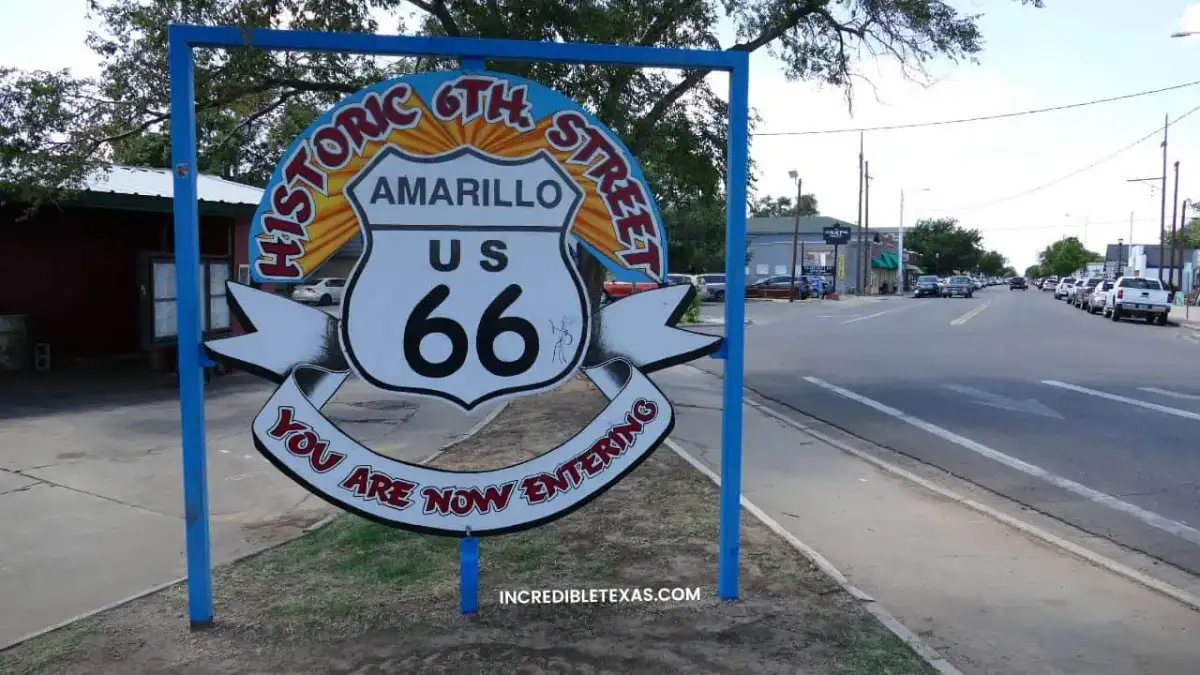
Amarillo stands as the urban anchor of the Texas Panhandle and the commercial center of Route 66 Amarillo Texas travel. The city's Sixth Street Historic District encompasses a mile of original two-lane roadway lined with commercial brick buildings constructed between 1920 and 1940.
According to the Visit Amarillo Route 66 Visitor Resource, the district features a walkable concentration of antique emporiums, craft taprooms, and roadside diners. Restored mid-century neon signs light up the avenue after dark, creating a nostalgic setting for evening strolls and dinners.

Just west of the city along Interstate 40 sits Cadillac Ranch Amarillo, the world-famous public art installation conceived in 1974 by the Ant Farm art collective. Ten vintage Cadillacs dating from 1949 to 1963 are buried nose-down at the same angle as the Great Pyramid of Giza.
Visitors are actively encouraged to bring spray paint cans to spray their names, messages, and designs onto the continuously evolving automotive sculptures. For a deeper dive into spray paint guidelines and parking logistics at the art installation, explore our comprehensive guide to Route 66 in Amarillo.

West of Amarillo: Vega, Adrian Midpoint, and Glenrio
West of Amarillo, the roadside scenery opens into expansive high-plains shortgrass prairie with dramatic 50-mile vistas. In Vega, motorists can admire the restored 1920s Magnolia Service Station and visit the Milburn-Price Culture Museum, which chronicles early frontier settlement and ranching families in Oldham County.
Another 15 miles west brings drivers to the Midpoint Cafe Adrian Texas, which marks the exact geographical halfway point of the 2,278-mile Mother Road. Commemorative highway signs in front of the cafe proclaim 1,139 miles to Chicago and 1,139 miles to Los Angeles, creating one of the most photographed road-trip milestones in America.
The western terminus of the Texas corridor arrives at Glenrio ghost town Texas, straddling the Texas-New Mexico boundary line. Documented in the National Park Service Glenrio Historic District Archive, Glenrio was completely bypassed when Interstate 40 opened in 1975.
Today, visitors can drive original asphalt along State Loop 504 to photograph the evocative ruins of the Longhorn Motel, the State Line Cafe, and vintage gas pumps. These abandoned border landmarks are documented alongside other Mother Road ruins in our guide to Texas Panhandle ghost towns.
One-Day Versus Two-Day Driving Itineraries
Choosing between a one-day or two-day Texas Route 66 itinerary depends on how much time you wish to spend browsing museums, photographing roadside neon, and sampling regional food. Driving Route 66 through Texas straight through takes roughly 3.5 hours, but rushing through overlooks the route's most captivating heritage.
A single-day itinerary works well for fast-paced road-trippers: start at 8:30 AM in Shamrock at the U-Drop Inn, make brief stops at McLean and Groom, enjoy lunch and antique shopping along Sixth Street in Amarillo, visit Cadillac Ranch at 3:30 PM, stop for pie in Adrian by 5:00 PM, and reach Glenrio for sunset photos.
A two-day itinerary allows a far more relaxed pace: dedicate Day One to exploring eastern towns like Shamrock and McLean before spending an entire afternoon and evening enjoying dining and nightlife in Amarillo. Adding an extra morning allows travelers to take a scenic 30-minute detour south of Amarillo to hike among the red rock formations of Palo Duro Canyon State Park before continuing west through Vega and Glenrio.
Frequently Asked Questions
How long does it take to drive Route 66 through Texas?
Driving the 178-mile Texas Route 66 corridor without stopping takes about 3.5 hours on Interstate 40. However, travelers should budget one to two full days to tour museums, dine on Sixth Street, and photograph Cadillac Ranch.
What are the best Route 66 stops in Texas?
The top attractions include the U-Drop Inn in Shamrock, the Devil's Rope Museum in McLean, the Route 66 Historic District in Amarillo, and Cadillac Ranch. The Midpoint Cafe in Adrian and the Glenrio Historic District also provide classic roadside experiences.
Where does Route 66 start and end in Texas?
Route 66 enters Texas from Oklahoma on Interstate 40 east of Shamrock and exits into New Mexico at the historic townsite of Glenrio. The route traverses 178 miles through seven Panhandle counties.
Can you visit the ghost town of Glenrio on Route 66?
Yes, visitors can exit Interstate 40 at Exit 0 to drive the historic State Loop 504 roadbed through Glenrio. Travelers must respect private property boundaries and avoid entering deteriorating or abandoned roadside structures.
Is Route 66 in Texas worth driving?
Yes, Texas offers one of the most accessible and well-preserved stretches of the Mother Road anywhere in the country. Restored Art Deco architecture, illuminated neon corridors, and public art make it a rewarding American road trip.