The Ultimate National Videogame Museum Guide: Tickets, MSF-1 Prototype, and Arcade Tips
The pixelated glow of a 1980s arcade greets you before you even reach the ticket counter at 8004 Dallas Parkway in Frisco. You have arrived at the Frisco Discovery Center, the unexpected permanent home of the world’s most comprehensive archive of gaming history.
The National Videogame Museum Frisco TX offers a hands-on journey through 50 years of consoles, including the rare Sony MSF-1 Nintendo PlayStation prototype. Tickets are $12 for adults and $10 for children, and every entry comes with four complimentary tokens for the in-house arcade.
You can find everything needed to navigate this 100,000-piece collection below, from planning your day around adventures at Trinity Forest Adventure Park to specific strategies for the Pixel Dreams arcade.
The museum is a centerpiece of the Frisco Discovery Center ecosystem and serves as a vital historical anchor for the North Texas region.
National Videogame Museum: Tickets, Discounts, and Pricing
You should secure your spot at the museum ticket window located just inside the Frisco Discovery Center main lobby. Admission pricing is straightforward, but you must remember that all sales are final once you receive your wristband and tokens.
You can compare these entry rates to the costs of visiting the National Museum of Funeral History or other specialized Texas institutions. Every paid adult admission supports the ongoing preservation of the museum’s massive physical software archive.
| Visitor Category | Admission Price |
|---|---|
| Adults (Ages 11+) | $12.00 |
| Children (Ages 3-10) | $10.00 |
| Seniors, Educators, Military | $10.00 |
| Children Under 3 | Free |
National Videogame Museum Admission Prices and Membership Tiers
Your ticket price includes access to every exhibit hall and the “Pixel Dreams” arcade located at the back of the facility. If you plan on visiting more than once a year, you should consider the individual and family membership tiers which provide unlimited entry for twelve months.
Members receive a unique advantage called the “Double Token Entry” which doubles your starting tokens to eight every time you visit. [CHECK CURRENT MEMBERSHIP PERKS AT: https://nvmusa.org/membership]
How to Get the Best Value with Combo Tickets
You can extend your day at the Discovery Center by purchasing a “Discovery Center Combo” ticket at the front desk. This allows you to bundle your videogame history visit with the Sci-Tech Discovery Center or the Museum of the American Railroad located in the same complex.
These combo passes often save you 15% to 20% compared to buying individual tickets at each counter. You must confirm current availability of these bundles upon arrival as they can change based on current rotating exhibits.
Pixel Dreams Arcade: The Heart of the Frisco Experience
You will find the Pixel Dreams arcade at the far end of the museum, past the historical consoles and across from the rotating gallery. This section functions as a working time capsule, where the standard “no touching” rules of a traditional museum are entirely suspended.
Quick Tip: Most arcade games use one token per play, meaning your initial four tokens allow for a quick sample of the classics before you need to reload.
The Token Policy: Maximizing Your Four Complimentary Plays
Your wristband grants you access, but your tokens provide the interaction that makes this museum unique in North Texas. If you run through your initial batch, you can find a change machine located directly inside the arcade that accepts small bills for additional 25-cent tokens.
You should also check with the front desk if you are an educator or active military member, as some special admission tiers provide extra token surges during promotional weeks. If you are staying at a nearby hotel, keep your tokens for your next visit, as they do not expire within the current calendar year.
How to Use Your Arcade Tokens: A Step-by-Step Guide
- Insert your complimentary tokens into the slot of any marked arcade machine found in the Pixel Dreams area.
- Select your game mode or character using the era-accurate physical joysticks and arcade buttons.
- Purchase additional batches of four tokens for one dollar at the automated change machines if your supply runs low.
Top Arcade Cabinets You Cannot Miss
You must prioritize a visit to the full-sized “Killer Instinct” and “Street Fighter II” cabinets which are maintained in pristine, original condition. The arcade also features a rotating selection of rare vector-based games like “Asteroids” and “Tempest” that provide a visual experience you cannot replicate on modern screens.
Each cabinet features a historical plaque explaining its significance and the year of its release. This allows you to learn about the hardware’s engineering while you are actively engaged in the high-score competition.
Level-by-Level: Rarest Console Prototypes and Must-See Exhibits
The museum is organized chronologically, leading you from the pre-computing roots of gaming into the 8-bit, 16-bit, and modern eras. You will encounter over 100,000 pieces in the archive, though the curated floorspace focuses on the most revolutionary shifts in the industry.
This layout mirrors the educational depth found in the galleries of the Houston Museum of Natural Science. Each “level” of the museum highlights a specific technological leap that changed how we perceive digital entertainment.
Timeline of Consoles: From Pong to the Modern Era
You can track the physical evolution of controllers and console hardware along the massive central timeline wall. This exhibit allows you to see how early wood-grain aesthetics transitioned into the high-tech plastics of the late 90s.
Look for the “Odyssey” corner to see the world’s first home gaming console in its original packaging. This section is a favorite for historians who want to see the birth of the medium before the era of Nintendo and Atari domination.
The Immersion Zones: 80s Bedrooms and 90s Living Rooms
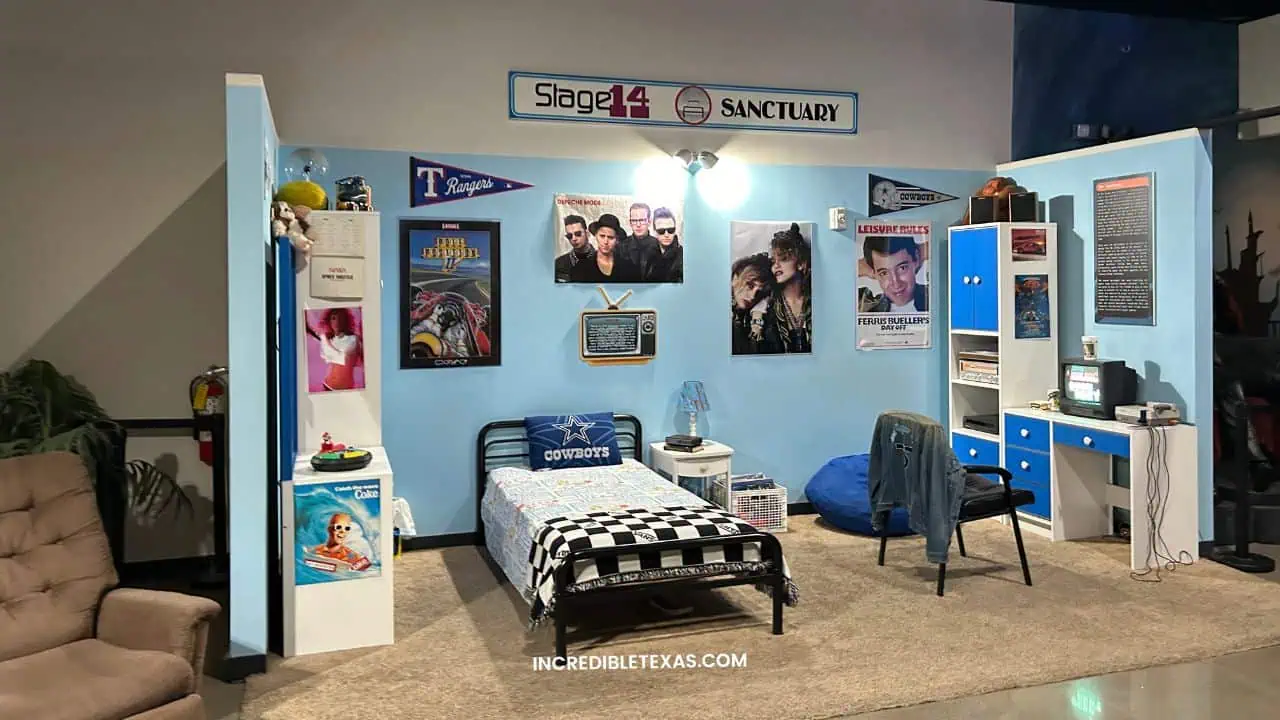
The “80s Bedroom” is perhaps the most photographed spot in the entire Frisco Discovery Center for its perfect period accuracy. You can step into a recreation of a 1980s child’s room, complete with Wood-paneled TV sets, E.T. posters, and a working NES connected to a period-accurate CRT television.
The 90s living room exhibit offers a similar hit of nostalgia for Gen X and Millennial visitors, featuring the early era of 3D gaming. You are encouraged to sit on the vintage sofas and play a few rounds of “GoldenEye 007” or “Mario Kart 64” to truly feel the era’s social gaming culture.
The Great Video Game Crash: Lessons from the 1983 Landfill
You will encounter a somber exhibit dedicated to the 1983 industry crash, which nearly ended the home console market before it truly began. This section details the over-saturation of poor-quality games and the loss of consumer confidence that led to thousands of cartridges being buried in a New Mexico landfill.
The museum displays actual recovered artifacts from the Alamogordo landfill, including the infamous “E.T. the Extra-Terrestrial” Atari cartridges. Seeing these physical remains of a dead industry serves as a powerful reminder of how precarious the gaming world once was before Nintendo’s resurgence.
The Sony MSF-1: Inside the Acquisition of the Oldest ‘Nintendo PlayStation’
You are looking at one of the rarest artifacts in the entire history of technology when you stand before the Sony MSF-1 display case. Acquired by the museum in March 2026, this unit is recognized as the oldest known existing prototype of the “Nintendo PlayStation” hardware.
Why the Nintendo PlayStation is the ‘Holy Grail’ of Gaming History
You must understand the historical weight of this failure: the MSF-1 represents a brief period in 1991 when Sony and Nintendo were partners. This prototype was designed as a CD-ROM attachment for the Super Nintendo, intended to bring massive storage capacity to the cartridge-based system.
When the deal collapsed at the 1991 Consumer Electronics Show, Sony decided to use the technology they developed to create their own standalone console. This rift birthed the original PlayStation and fundamentally changed the landscape of the global gaming industry forever.
Seeing the MSF-1 Prototype in Frisco Today
You should pay close attention to the raw, industrial finish of this particular prototype, which differs significantly from later, more polished iterations. This unit is an early development model that plugs directly into the SNES slot, featuring exposed circuitry and hand-soldered components.
The museum provides a digital interface next to the case that explains the specific engineering challenges the team faced in 1991. You can see the internal architecture of the CD-ROM drive and learn about the “Super Disc” format that never made it to market.
The acquisition of the MSF-1 represents the museum’s commitment to preserving not just the hits, but the “unseen” history of gaming. This prototype is one of only a handful believed to exist, making its presence in North Texas a significant draw for international technical historians.
A Parent’s Survival Guide: Visiting NVM with Modern Kids
You might find that your children are initially confused by the lack of touchscreens and the presence of bulky, corded controllers. The National Videogame Museum Frisco TX is designed to bridge this generational gap by encouraging parents to act as “guides” through the history of play.
Introduction to Retro Gaming: Tips for Younger Generations
You should start your visit in the “Pixel Dreams” arcade, as the tactile feedback of a joystick is often easier for modern kids to understand than a complex 1980s computer. High-visibility games like “Pac-Man” or “Q*bert” offer instant gratification and help younger visitors appreciate the difficulty of early digital games.
You can also use the “80s Bedroom” to explain the context of gaming before the internet existed. Showing your kids how a cartridge had to be “cleaned” (though the museum prefers you don’t actually blow into them) is a core part of the historical experience.
Sensory-Friendly Hours and Peak Crowd Times
You should plan your visit for a Tuesday or Wednesday morning if your child is sensitive to loud sounds or crowded environments. The arcade section can become quite loud on Saturday afternoons, with dozens of machines chirping and flashing simultaneously.
Checking for sensory-friendly hours is the best way to ensure a low-stress environment for sensitive visitors.
The museum staff is trained to help families who need a quieter space or specific accommodations for children with disabilities. You can always ask for a “Sensory Map” at the front desk to identify the quieter zones within the Frisco Discovery Center exhibits.
Similar planning applies to the scientific exhibits at the Corpus Christi Museum of Science and History. These institutions prioritize accessibility to ensure every visitor can engage with the collections safely and comfortably.
Educational Value: Logic Gates and Binary Basics
You might be surprised to find that the museum includes several exhibits focused on the mathematical and logical foundations of computing. These interactive stations teach children about binary code and logic gates using physical blocks and switches, grounding their gaming experience in computer science.
This “STEM-lite” approach ensures that your visit is as educational as it is entertaining, fulfilling the museum’s dual mission of preservation and education. You can watch your children solve logic puzzles that represent the way early engineers had to think before modern coding languages simplified the process.
Beyond the Console: Logistics, Parking, and Local Frisco Favorites
You will find that the Frisco Discovery Center is a multi-use facility, requiring you to park in the main lot shared with several other local institutions. Getting here is straightforward from the Dallas North Tollway, though you should prepare for heavy traffic during North Texas rush hours.
Nerdvana and the Discovery Center Ecosystem
You can make your trip a full-day event by visiting Nerdvana Food + Spirits which is located just a five-minute drive from the museum entrance. As a visitor to the NVM, you should keep your wristband on; showing it at Nerdvana currently earns you a 10% discount on your meal.
Nerdvana is a gaming-themed restaurant where the tables are equipped with consoles, allowing you to continue your gaming session while you eat. It provides the perfect thematic capstone to a day spent exploring the history of video game culture.
Free Parking and Travel Tips from Downtown Dallas
You will be pleased to find that parking at the Frisco Discovery Center is entirely free and typically ample even on weekends. If you are traveling from downtown Dallas, you should budget at least 35 to 45 minutes for the drive, depending on your choice of the Tollway or surface streets.
While there is no direct DART rail line to the museum, you can take the rail to the Plano stations and use a rideshare service for the final ten-mile leg. This is a common strategy for visitors who want to avoid the Frisco traffic while exploring the Fort Worth Botanic Garden or other DFW landmarks.
National Videogame Museum Visitor Roadmap
| Category | Details |
|---|---|
| Physical Address | 8004 Dallas Parkway, Frisco, TX 75034 |
| Standard Hours | Tuesday-Sunday (Closed Mondays) |
| Adult Tickets | $12.00 (Includes 4 Arcade Tokens) |
| Average Visit | 2 to 4 Hours |
| Parking Status | Free Main Lot Parking |
The Discovery Center Neighbors: Trains and Science
You should not leave the complex without at least peeking into the Museum of the American Railroad, which shares the same Frisco Discovery Center grounds. This outdoor museum features a massive collection of vintage locomotive engines and Pullman cars that provide a different kind of historical scale.
Additionally, the Sci-Tech Discovery Center offers more traditional science museum exhibits that are perfect for younger children who might find the gaming history too complex. Combining these three locations into a single “Frisco Discovery Day” is the most efficient way to maximize the value of your North Texas travel budget.
National Videogame Museum FAQ
You may still have lingering questions about the specifics of your visit to the National Videogame Museum in Frisco. Below are the most common inquiries from first-time visitors looking to maximize their experience.
What is inside the National Videogame Museum?
You can expect a blend of historical exhibits and interactive stations featuring over 100,000 pieces of gaming history. The museum covers everything from the birth of “Pong” to modern virtual reality, including rare prototypes like the Sony MSF-1 and fully immersive room recreations from the 80s and 90s.
The facility is split into distinct “levels” that guide you through the engineering, marketing, and cultural impact of the industry over the last five decades.
How much are tickets for the National Videogame Museum Frisco?
Admission is currently set at $12 for adults and $10 for children between the ages of three and ten. Seniors, military members, and educators also qualify for the $10 discounted rate when presenting a valid form of identification at the ticket window.
Children under the age of three are admitted for free, making it an affordable destination for families traveling with toddlers in the North Texas region. Admission includes access to all permanent exhibits and the arcade area at the back.
Is there an arcade at the National Videogame Museum?
You will have access to the “Pixel Dreams” retro arcade, which is located in the final section of the museum floor. Every paid admission comes with four complimentary tokens, and you can purchase more at a rate of four for one dollar at the change machines or gift shop.
Most arcade cabinets require only one token per play, allowing you to sample several different classics during your visit without needing a significant additional budget for gaming.
How long does it take to go through the National Videogame Museum?
You should budget approximately two to three hours for a complete walkthrough, depending on how much time you spend playing in the arcade. If you are a hardcore gaming historian who reads every plaque and explores the technical specs of the prototypes, you may find yourself staying for four hours or more.
The museum operates on a self-guided basis, so you are free to linger in specific eras that resonate most with your personal gaming history.
Is the National Videogame Museum good for kids?
You will find that the museum is exceptionally family-friendly, though younger children may need guidance to understand the older, non-touchscreen technology. The interactive exhibits and the arcade keep kids engaged while the historical sections provide educational context for parents and grandparents.
Can I have a birthday party at the National Videogame Museum?
You can definitely host private events and birthday parties within the Frisco Discovery Center’s dedicated party rooms. These packages often include museum admission for groups and a dedicated block of time for gaming in the Pixel Dreams arcade area. [CHECK CURRENT PARTY PACKAGES AT: https://nvmusa.org/groups]