Lady Bird Lake Austin: Trail, Kayaking, Parking, and Best Things to Do
Lady Bird Lake Austin is the city’s most useful all-in-one outdoor stop because it combines a downtown waterway, the Ann and Roy Butler Hike-and-Bike Trail, easy paddling routes, skyline views, and several distinct entry points around the shoreline. For most visitors, the core Lady Bird Lake Austin plan is simple: walk part of the 10-mile trail, pick a launch point or rental area if paddling is on the agenda, and use the boardwalk, bridges, or park segments to shape the outing around sunrise, late afternoon, or sunset.
The lake works equally well for a short break, a workout, a date outing, or a half-day Austin itinerary. It also rewards planning more than many first-time visitors expect, because boardwalk hours, launch choices, bridge crossings, and current I-35 detours all affect how smooth the visit feels.
Lady Bird Lake is not a swimming lake, but it is one of Austin’s best places for walking, running, kayaking, canoeing, paddleboarding, fishing from select areas, and watching the skyline change with the light. Travelers building a broader city plan can also pair the lake with nearby stops from Austin attractions later in the day.
| Quick fact | Lady Bird Lake Austin details |
|---|---|
| Location | Central Austin along the Colorado River corridor between Tom Miller Dam and Longhorn Dam |
| Main land route | Ann and Roy Butler Hike-and-Bike Trail around the lake |
| Trail length | About 10 miles for the full loop |
| Boardwalk hours | 5:00 a.m. to midnight daily; curfew from midnight to 5:00 a.m. |
| Best activities | Walking, running, biking, kayaking, canoeing, paddleboarding, skyline views, bat watching |
| Swimming | Not allowed |
| Launch points | Festival Beach, launch west of I-35, and the Austin High carry-in ramp among the most practical public options |
| Best time windows | Sunrise, late afternoon, and sunset |
What Lady Bird Lake Austin is
According to the Texas Parks and Wildlife Lady Bird Lake paddling trail page, the reservoir was formed in 1960 by the construction of Longhorn Dam and was renamed from Town Lake to Lady Bird Lake in 2007. That history helps explain the lake’s unusual identity: it feels like a natural centerpiece of the city, but it is also a deliberately shaped urban recreation corridor.
The lake is best understood as a long recreational spine running through central Austin rather than as a single park. Downtown towers, bridges, boat launches, lawns, tree cover, cultural sites, and neighborhood edges all meet along the shoreline, which is why one outing can feel calm and scenic in one segment and busy and social in the next.
That flexibility is a major reason the lake stays near the top of Austin itineraries. It can anchor a first visit to the city, and it also fits neatly beside more curated stops like unique things to do in Austin for travelers balancing classic scenery with other local experiences.
- Best identity: Austin’s central urban outdoor corridor.
- Best match for: Walkers, runners, paddlers, photographers, couples, and visitors who want a low-friction outdoor plan.
- Least suitable use: A swim outing, because swimming is not allowed in the lake.
- Strongest appeal: Variety without a long drive away from downtown.
Many Austin parks do one thing especially well, but Lady Bird Lake does several things well at once. The result is a stop that can be shaped around fitness, scenery, food, a quick paddle, or a sunset walk without needing to leave the urban core.
Ann and Roy Butler Hike-and-Bike Trail and the Boardwalk
According to the Austin Parks trail and boardwalk page, the Ann and Roy Butler Hike-and-Bike Trail is about 10 miles long and the Boardwalk closed a 1.3-mile gap along the south shore. For most visitors, that makes the trail the easiest way to experience Lady Bird Lake without committing to a full-water outing.
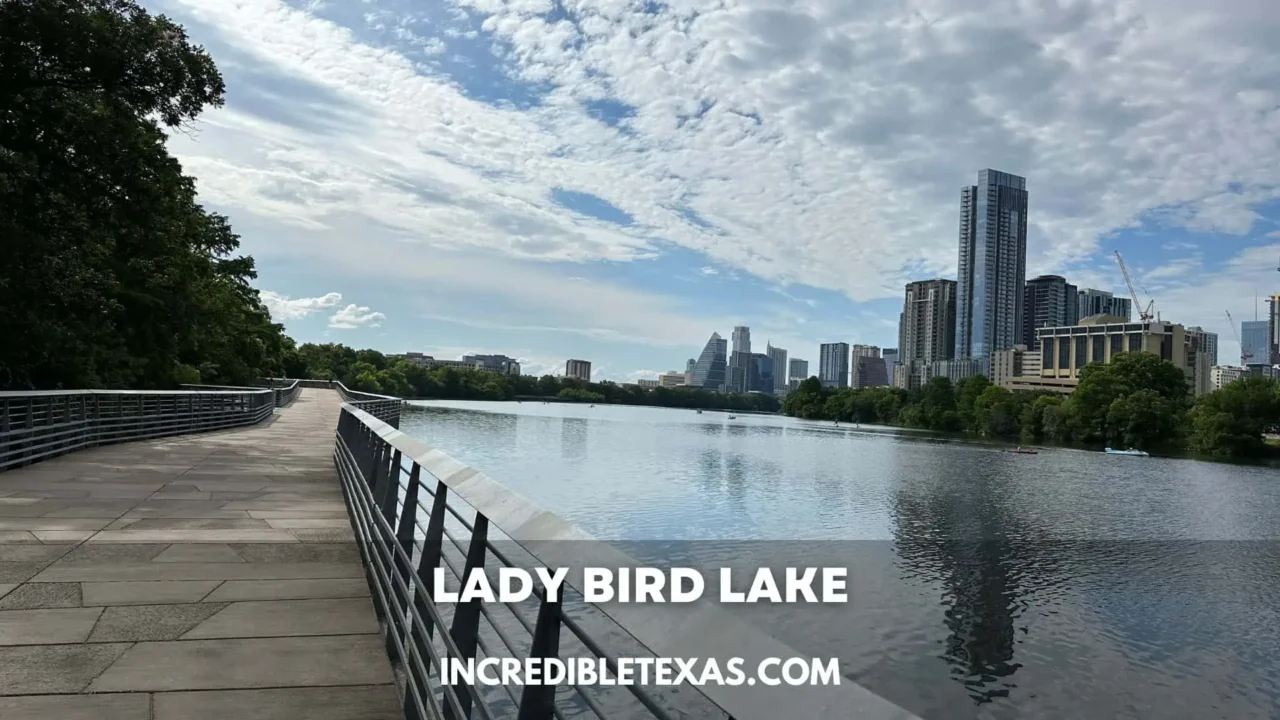
The boardwalk adds one of the lake’s most photogenic segments. The over-water path brings broad skyline views, a slightly elevated look across the shoreline, and a smooth section that feels more open than some of the tree-shaded inland stretches.
The same Austin Parks page lists boardwalk hours from 5:00 AM to midnight, with a curfew from midnight to 5:00 AM. Those hours are especially useful for sunrise walks, evening runs, and post-dinner strolls.
| Trail choice | What it feels like | Best use |
|---|---|---|
| Full loop | Long, varied, and scenic with multiple bridge choices | Dedicated walkers, runners, and cyclists |
| Boardwalk segment | Open views over the water with a downtown backdrop | Sunset walks, photos, and casual first visits |
| West-side segments | Greener and more park-like near popular launch areas | Paddle-and-walk combinations |
| East-side segments | Flatter urban stretches with evolving access conditions | Longer loops and neighborhood-based entry points |
The trail is also practical, not just scenic. The Trail Conservancy describes the route as open to all individuals and notes ADA-accessible entrances, rest areas, restrooms, and drinking fountains, which helps explain why the loop supports both casual recreation and daily exercise at a city scale.
Fishing is allowed on boardwalk rest areas but not along the main trail, which keeps that segment from turning into an all-purpose shoreline. The result is a route that stays focused on walking, running, cycling, and sightseeing while still leaving space for a few targeted activities.
Kayaking, paddleboarding, canoeing, and rowing
Lady Bird Lake is one of the easiest Austin locations for paddling because the water stays close to downtown while still offering enough length for short or longer sessions. According to the City of Austin’s Lady Bird Lake page, the lake supports boating and rental activity while remaining a non-swimming waterway with rules shaped around safer, lower-wake recreation.
The paddling trail layout is especially strong because it offers multiple outing lengths instead of forcing one standard route. TPWD lists loop options of roughly 3.15 miles, 3.25 miles, 4.8 miles, and about 11 miles total, which makes the lake workable for first-timers, fitness paddlers, and people who only want a short scenic window on the water.
Several commercial operators around the shoreline keep entry easy for visitors without their own gear. The best-known rental zones center on the west and downtown sections of the lake, while the route variety means the choice of launch point matters almost as much as the type of boat.
| Paddling goal | Best route length | Why it works |
|---|---|---|
| Short first outing | About 3 to 3.25 miles | Enough scenery without turning the session into a long commitment |
| Balanced half-day paddle | About 4.8 miles | More shoreline variety with manageable return timing |
| Long urban paddle | Up to about 11 miles | Best for experienced paddlers or strong fitness-focused outings |
| Photo-forward outing | Short downtown-centered paddle | Fast access to skyline angles, bridge views, and bat-watching zones |
- Kayaks work well for first-time renters and longer mileage.
- Paddleboards fit calm, warm-weather sessions and skyline-focused outings.
- Canoes suit pairs and slower scenic trips.
- Rowing shells and sculls are common on the lake, which is one reason launch etiquette matters.
The best paddling windows are usually early morning and late afternoon. Wind, heat, and heavier water traffic tend to make the middle of the day less comfortable, especially for visitors more interested in scenery than workout intensity.
Parking, launch points, and current detours
Parking is the detail that most often determines whether Lady Bird Lake feels effortless or frustrating. As of March 25, 2026, the Trail Conservancy detours page lists several active I-35-related impacts, including the east-side I-35 pedestrian crossing closure that began the week of February 9, 2026, plus a Riverside Drive pedestrian ramp closure that started February 16, 2026.
Those closures do not make the lake a bad destination, but they do make entry-point planning more important than usual. The simplest response is choosing a side of the lake first, then building the outing around a nearby lot, launch, or walking segment instead of assuming a seamless last-minute crossing at I-35.
According to the TPWD Lady Bird Lake access page, Festival Beach, the launch west of I-35, and the Drainage Ditch Ramp across from Austin High are among the practical public access points. TPWD also notes that those launch points are open all year and do not require a fee.
| Access point | Best for | What to know |
|---|---|---|
| Festival Beach | East-side launches and simpler trail starts | Public launch access with nearby trail connections |
| Launch west of I-35 | North-shore entries near downtown-oriented outings | Current detours can affect the surrounding approach |
| Austin High carry-in ramp | Small boats, canoes, and cartop craft | Useful when a carry-in launch is enough |
| South Lakeshore area | Boardwalk access | Street parking can work well for walking-focused visits |
| West-side rental zones | Paddle rentals and shorter scenic launches | Often the easiest option for visitors without gear |
The boardwalk area has its own access pattern. Austin Parks lists entry points near the American-Statesman area, Blunn Creek, the Riverside and I-35 corner, and International Shores Park, while street parking along South Lakeshore Boulevard can be useful for visitors prioritizing the boardwalk over the full loop.
For trail-only outings, the easiest strategy is often parking once and walking an out-and-back segment rather than forcing a full loop. For paddling, the smarter strategy is usually choosing a launch first and treating the walk as a secondary add-on.
Fishing, bats, and the lake’s wildlife appeal
Lady Bird Lake is more than a trail-and-rentals destination. The lake also supports fishing, birding, and one of Austin’s best-known wildlife spectacles around the Congress Avenue Bridge area.
TPWD describes the lake as a place where anglers commonly target largemouth bass, sunfish, and large carp. That does not turn the reservoir into a quiet rural fishing lake, but it does give the waterway more range than many visitors expect from a downtown setting.
The most famous natural draw is the bat emergence. TPWD notes that the Congress Avenue Bridge area is associated with the largest urban Mexican free-tailed bat colony in North America, with about 1.5 million bats on summer evenings, which makes sunset one of the strongest viewing windows on and around the lake.
- Fishing fit: Better for casual urban anglers than for a remote all-day fishing trip.
- Bat watching fit: Excellent in warm months near sunset, especially from bridges, shoreline spots, and some paddle routes.
- Birding fit: Consistently good around quieter sections, trees, and early-morning shoreline areas.
- Photography fit: Strong at sunrise for calm water and strong at sunset for skyline and bridge silhouettes.
The wildlife layer is part of what keeps Lady Bird Lake from feeling like a generic urban greenway. The lake still reads as distinctly Austin, but it also delivers enough ecological texture to make repeat visits feel different from one season or one time of day to the next.
Rules, safety, and common planning mistakes
The biggest rule to remember is the no-swimming rule. That single fact changes the way the lake should be planned, because the shoreline, trail, and paddling culture make the water look inviting even though it is not intended for swimming.
Motor restrictions matter too. The lake’s recreation pattern is built around paddling, rowing, and low-wake use, which is a major reason the water stays so attractive for kayaks, canoes, paddleboards, and rowing shells.
The most common planning mistakes are parking too far from the intended activity, assuming a convenient crossing at I-35 without checking current detours, or combining the full loop and a paddle in one outing without accounting for heat and fatigue. Lady Bird Lake works best when the plan is focused rather than overpacked.
| Common mistake | Better approach |
|---|---|
| Treating the lake like a swim spot | Plan for trail use, paddling, scenery, or fishing instead |
| Parking first and deciding later | Choose the activity and shoreline side before leaving |
| Assuming every bridge crossing is simple | Check current detours and build the route around an open crossing |
| Starting in peak heat | Use sunrise or late afternoon for the most comfortable conditions |
| Trying to do the whole loop plus a paddle | Pick one primary activity and let the rest stay optional |
Best time to visit and how long to stay
The best time to visit depends on the activity. Sunrise is usually strongest for running, cooler walks, and quieter paddling; late afternoon works well for casual recreation; and sunset is the most photogenic window for skyline views and bat-watching plans.
Season matters more than many travel writeups admit. Austin heat can turn a long midday loop into a draining outing for much of the year, while spring and fall make the lake feel dramatically easier for longer walks, boardwalk photos, and mixed walking-and-food plans.
| Visit length | Best use of time |
|---|---|
| 45 to 60 minutes | Short boardwalk walk, quick skyline photos, or a simple waterside stroll |
| 90 minutes | Focused trail segment plus coffee, rest stop, or one scenic pause |
| 2 to 3 hours | Paddle session or longer walk with room for food and nearby add-ons |
| Half day | One major activity, a meal, and one nearby Austin stop without rushing |
Weekday mornings are often the smoothest overall choice. The trail is still active, but the rhythm is calmer than weekend afternoons, and the shoreline has more room for people who want a scenic outing rather than a social crowd.
Best ways to enjoy Lady Bird Lake Austin
The best Lady Bird Lake outing depends less on budget than on pace. Some visits work best as a pure trail session, some as a paddle, and some as a scenic connector between food, downtown, and other parts of the city.
- Best first visit: Boardwalk walk plus one short shoreline segment.
- Best active visit: Long trail session early in the day.
- Best social visit: Paddle rental followed by a meal nearby.
- Best couple outing: Late-afternoon walk and sunset views, paired with ideas from Austin date planning.
- Best low-stress option: One launch or one walking segment, not both.
The lake is especially strong for travelers who want a real Austin outdoor experience without committing to a state park drive or a day-long itinerary. That balance of accessibility and atmosphere is the lake’s biggest competitive advantage.
The most memorable visits usually stay simple: one shoreline, one main activity, and enough unstructured time to enjoy the skyline, bridges, and light on the water. Lady Bird Lake usually rewards that approach more than a tightly packed checklist does.
What to pair with Lady Bird Lake nearby
Lady Bird Lake is easiest to fold into a broader Austin day because so much sits nearby. A walk or paddle can lead naturally into rooftop dining, South Congress time, downtown sightseeing, or a more food-focused outing without a long reset between stops.
For travelers who want a scenic follow-up, Austin restaurants with a view pair especially well with a lake outing because the shift from trail or water to skyline dining feels natural. For visitors who want something more activity-driven afterward, Austin food tours can turn the lake into the outdoor half of a longer city plan.
The lake also connects smoothly with downtown landmarks and South Congress plans. That centrality is one reason it works so well for visitors who only have one or two days in Austin and need one outdoor stop that fits almost any itinerary shape.
Lady Bird Lake FAQs
Can people swim in Lady Bird Lake Austin?
No. Swimming is not allowed in Lady Bird Lake, so the lake is best planned around paddling, trail use, fishing from allowed areas, scenery, and wildlife viewing.
How long is the Lady Bird Lake trail?
The Ann and Roy Butler Hike-and-Bike Trail around the lake is about 10 miles long. Many visitors choose a partial out-and-back walk instead of the full loop.
What are Lady Bird Lake boardwalk hours?
The boardwalk is open daily from 5:00 AM to midnight, with a curfew from midnight to 5:00 AM. Those hours make sunrise and evening visits especially practical.
Where to park for Lady Bird Lake Austin?
The best parking depends on the activity. South Lakeshore Boulevard works well for boardwalk-focused walks, while public launch areas such as Festival Beach or the carry-in ramp near Austin High make more sense for paddling plans.
Where can visitors launch kayaks or canoes on Lady Bird Lake?
Festival Beach, the public launch west of I-35, and the carry-in ramp across from Austin High are among the most practical public access points. Rental operators on the west and downtown sections are often easier for visitors without their own gear.
Is Lady Bird Lake good for paddleboarding?
Yes, especially during calmer morning and late-afternoon windows. Shorter loops and central launch zones are usually the easiest fit for casual paddleboard outings.
What is the best time to visit Lady Bird Lake Austin?
Sunrise is best for cooler exercise and quieter water, while late afternoon and sunset are best for skyline views, boardwalk walks, and seasonal bat-watching plans.
Can people fish at Lady Bird Lake?
Yes, but the setting is an urban lake rather than a remote fishing destination. Fishing is allowed from boardwalk rest areas but not along the main trail, and other shoreline access points can be more practical for anglers.
Are there current detours around Lady Bird Lake?
Yes. As of March 25, 2026, current I-35-related detours affect the east-side pedestrian crossing and the Riverside Drive pedestrian ramp area, so checking trail notices before arrival is worthwhile.
Is Lady Bird Lake worth visiting for a first Austin trip?
For most first-time visitors, yes. The lake gives a strong introduction to Austin’s outdoor culture, skyline, and central neighborhoods while staying close to downtown and many other major stops.
Final take on Lady Bird Lake Austin
Lady Bird Lake Austin stands out because it supports several versions of a good city outing at once. The trail, boardwalk, paddling routes, skyline views, and wildlife moments all sit close enough together that visitors can shape the experience around energy level instead of around a rigid itinerary.
The smartest plan is usually the simplest one: choose a shoreline, choose one main activity, and leave room for light, weather, and nearby Austin add-ons to shape the rest. That approach gives Lady Bird Lake the best chance to feel like Austin’s outdoor centerpiece rather than just another box on a city checklist.