Living in the fourth-largest metropolitan area in the United States means enduring intense artificial skyglow every evening. The sprawling urban core washes out all but the brightest celestial bodies, hiding the Milky Way and constellations behind an amber dome.
Fortunately, dedicated nature lovers can escape this urban haze by driving less than an hour from downtown to the best stargazing spots near houston. Finding rewarding options for stargazing near houston allows city residents to enjoy deep-space observation, telescope viewings, and peaceful night environments across protected state parks and national forests.
Key takeaways
- Escaping Houston’s Bortle 8/9 urban light dome requires driving 45 to 75 miles southwest, west, or north into rural state parks and national forests.
- George Observatory at Brazos Bend State Park is the leading public astronomy facility in Southeast Texas, featuring a historic 36-inch research telescope.
- Saturday Night Stargazing at George Observatory requires $10 advance timed tickets in addition to Texas State Park entrance fees.
- Stephen F. Austin State Park and Sam Houston National Forest provide accessible Bortle Class 4 camping within an hour of the city.
- High coastal humidity requires dew heaters or moisture towels to prevent optical condensation during summer observation sessions.
Plan your visit
Verified
- Location
- Southeast Texas, Fort Bend, Austin, Walker & Polk counties
- Hours
- Parks open daily 8:00 AM - 10:00 PM; camping allows overnight viewing
- Admission
- $4 to $7 day-use entry; $10 George Observatory ticket
- Best time to go
- October through April (low humidity), New Moon phases
Escaping the Houston Light Dome: How Far Do You Need to Drive?
Stargazers must drive approximately 45 to 75 miles outside the Grand Parkway to escape Houston’s intense urban light dome. Reaching Bortle Class 4 skies takes roughly 50 minutes toward the southwest or west, while Bortle Class 3 conditions require an 80-minute drive north.
Planning your journey requires understanding how regional light pollution spreads across Southeast Texas flatlands. If you are comparing coastal prairie viewings with Central Texas river terrain, review our Blanco State Park stargazing guide for Hill Country sky conditions.
The Bortle Scale Around the Greater Houston Area
The Bortle scale categorizes night sky brightness on a scale from 1 (pure darkness) to 9 (inner-city sky). The central houston light dome bortle scale rating sits firmly at Class 8 and 9, meaning only the Moon, Venus, Jupiter, and handfuls of first-magnitude stars penetrate the haze.
As you travel past outer suburbs like Katy, Sugar Land, and The Woodlands, sky brightness drops to Class 5 and Class 6. True dark sky parks near houston begin at Class 4, where the Milky Way becomes distinctly visible to the naked eye on clear summer nights.
Class 4 locations allow observers to resolve delicate celestial features like the Andromeda Galaxy, the Hercules Globular Cluster, and the Lagoon Nebula. Choosing observation sites that sit southwest or west of Houston ensures the brightest urban light dome remains behind your primary viewing angles.
Seasonal Weather, Humidity, and Dew Shields
Southeast Texas weather strongly influences astronomical clarity throughout the year. Autumn and winter bring crisp continental air masses from the north that displace humid tropical air, creating superior seeing conditions and steady planetary details.
Summer offers direct alignments with the dense galactic core, but Gulf Coast moisture creates persistent haze and heavy evening condensation. Photographers and telescope owners must carry dew shields or electric warming bands to prevent moisture from settling on chilled glass optics.
Checking regional cloud-cover satellite models and humidity forecasts before leaving home prevents wasted drives. Clear evenings following cold frontal passages provide the sharpest telescope resolution of the entire year.
George Observatory at Brazos Bend State Park
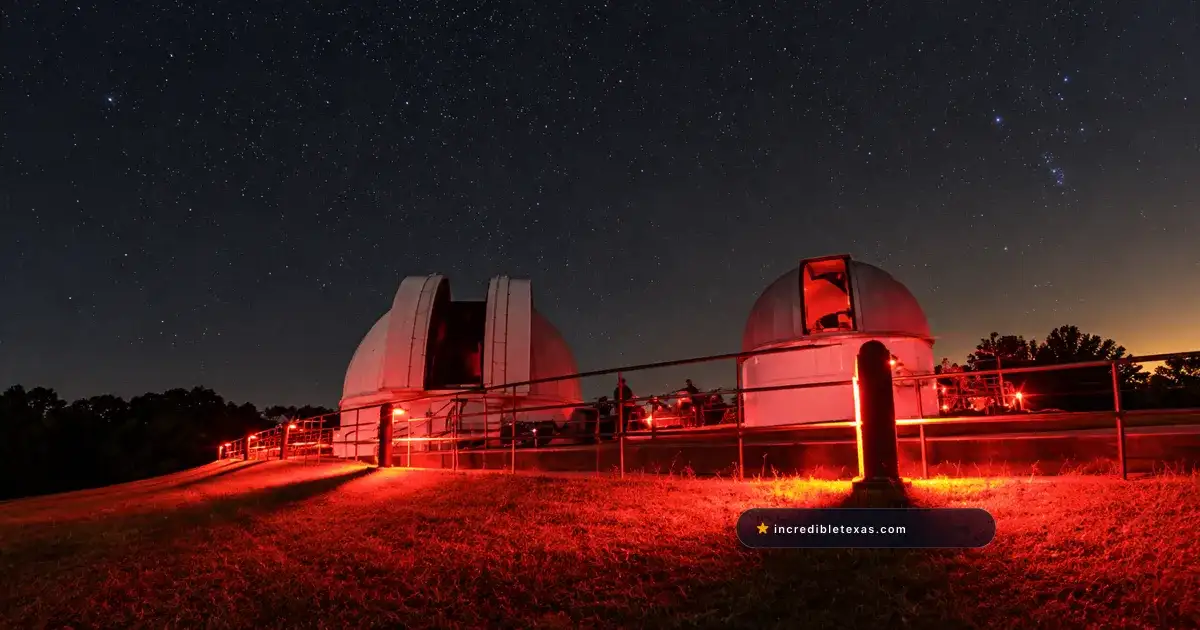
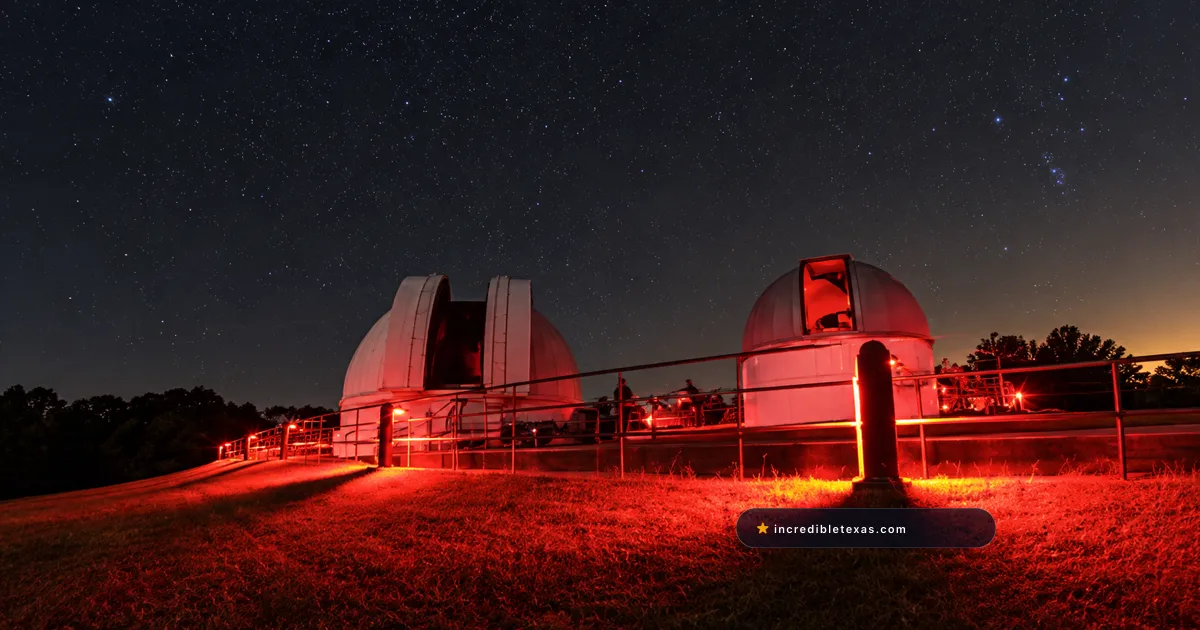
Located about 45 miles southwest of Houston in Needville, the George Observatory sits inside Brazos Bend State Park near Creekfield Lake. It is a satellite facility of the Houston Museum of Natural Science.
Surrounding bottomland hardwood forests buffer the site from commercial highway glare, creating an ideal suburban dark-sky pocket. Experiencing brazos bend stargazing is especially rewarding during new moon weekends, as detailed in our comprehensive Brazos Bend State Park visitor guide.
The 36-Inch Gueymard Research Telescope Experience
The observatory houses three large dome telescopes, highlighted by the historic 36-inch Gueymard Research Telescope. Ranking among the largest public-access optical instruments in the country, this giant reflector provides unmatched views of deep-sky objects.
During public viewing nights, visitors climb spiral observation stairs to peer through the massive eyepiece mechanism. Looking through the primary scope reveals intricate cloud bands on Jupiter, subtle Saturnian ring divisions, and gossamer filaments in the Orion Nebula.
Volunteer astronomers from regional astronomy clubs also set up dozens of personal telescopes across the expansive outdoor observation deck. These passionate volunteers point their instruments at binary star pairs, planetary nebulae, and star clusters while answering visitor questions.
Saturday Night Tickets, Parking, and Park Entry Passes
Attending the weekly george observatory stargazing houston programs requires careful advance planning. Saturday night tickets cost $10 per person and must be purchased online prior to arrival via the Houston Museum of Natural Science George Observatory Portal.
In addition to observatory tickets, guests must reserve a day-use vehicle permit through the Texas Parks and Wildlife Brazos Bend State Park Portal. Park admission is $7 for adults, while children 12 and under enter free.
Visitors park at the main Creekfield Lake lot and follow a paved, lighted boardwalk to the observatory entrance. Flashlights with white bulbs are strictly banned along the path, so bring a red flashlight or pick up red cellophane covers from park staff.
| Stargazing Destination | Driving Distance | Bortle Rating | Key Attraction | Overnight Option |
|---|---|---|---|---|
| Brazos Bend State Park | 45 miles SW | Class 4 | 36-inch Gueymard Telescope & deck viewing | Developed campsites |
| Stephen F. Austin State Park | 50 miles W | Class 4 | Brazos River bottomland meadows | Tent & RV sites |
| Sam Houston National Forest | 60 miles N | Class 3/4 | Stubblefield Lake reflections | Forest campgrounds |
| Lake Livingston State Park | 75 miles N | Class 3/4 | Broad open-water western horizon | Screened shelters & RV |
| Huntsville State Park | 65 miles N | Class 4 | Pine forest lake shorelines | Wooded campsites |
Top State Parks and Dark Sky Escapes Near Houston
Beyond Brazos Bend, several state and federal parklands provide excellent night viewing environments for regional astronomers. Selecting where to stargaze near houston depends on your preferred balance between travel time and sky darkness.
These rural public lands feature open clearings, minimal security lighting, and designated campsites for overnight astronomy retreats. Booking campsites ensures you have legal access to park meadows well past standard 10:00 PM day-use curfews.
Stephen F. Austin State Park: Brazos River Night Skies
Situated roughly 50 miles west of Houston near San Felipe, Stephen F. Austin State Park provides quiet Bortle Class 4 skies. The park sits along a bend of the Brazos River, where towering post oaks shield viewing fields from regional highway lights.
Taking part in stephen f austin state park stargazing is especially rewarding near the open recreation hall clearings. As documented on the Texas Parks and Wildlife Stephen F. Austin State Park Portal, the park offers secluded walk-in tent sites and full-hookup RV spaces.
The western direction of travel places the Houston light dome behind your back when facing south toward the summer Milky Way. This orientation allows observers to spot faint Sagittarius nebulae without significant background glow.
Sam Houston National Forest: Stubblefield and Double Lake
Located an hour north of Houston past Conroe, Sam Houston National Forest spans over 160,000 acres of protected piney woods. The massive timber buffer filters out highway glare and suburban developments, delivering Bortle Class 3/4 skies across its recreation areas.
Setting up camp for a weekend of sam houston national forest dark sky observation provides exceptional solitude. Stubblefield Lake Recreation Area at the northern tip of Lake Conroe features an open bridge and shoreline that offer panoramic views of celestial coordinates.
Campers can choose between developed sites at Double Lake or dispersed primitive camping along the Lone Star Hiking Trail. Towering loblolly pines create natural light barriers that block residual highway glow from distant county corridors.
Lake Livingston State Park: Open Water Horizons
Perched 75 miles north of the city in Polk County, Lake Livingston State Park provides wide western and southwestern vistas across 83,000 surface acres of water. The open lake horizon creates unobstructed sightlines for observing low-altitude constellations and evening planetary conjunctions.
Park rangers frequently host public astronomy nights on the park observation tower and boat launch plazas. The reflection of bright stars across the still reservoir water adds a magical visual element to weekend stargazing trips.
Screened shelters and lakefront campsites allow astronomers to observe celestial transits directly outside their tent doors. Traveling this far north places visitors in one of the most reliable stargazing spots southeast texas offers outside of remote Hill Country sanctuaries, as detailed in our Lake Livingston State Park guide.
Essential Gear and Viewing Tips for Gulf Coast Stargazing
Enjoying a safe, productive night under the stars in Southeast Texas requires specific gear tailored to local environmental conditions. High humidity, biting insects, and dark park trails demand thoughtful preparation before departing Houston.
Packing the right equipment ensures your eyes remain focused on celestial marvels rather than physical discomforts. For photographers interested in capturing the night sky with digital cameras, explore our Texas astrophotography and Milky Way guide for camera settings and lens formulas.
Managing Coastal Humidity and Lens Fogging
Heavy Gulf air causes optical glass surfaces to cool below the dew point rapidly after dusk, resulting in blurred telescope views and foggy camera lenses. To prevent fogging, attach passive foam dew shields to telescope tubes or wrap battery-powered 5-volt USB warming strips around camera lenses.
Never wipe fogged optical elements with abrasive clothing or facial tissues, which can scratch delicate anti-reflective glass coatings. Instead, use a portable 12-volt hair dryer powered by a portable jump-starter pack to gently warm and clear condensation.
Keeping optical gear in sealed cases inside your air-conditioned car until sunset helps equalize temperatures gradually. This thermal acclimation minimizes internal condensation on complex multi-element eyepieces and camera sensors.
Red-Light Etiquette and Insect Protection
Human scotopic vision takes up to thirty minutes of darkness to achieve full chemical adaptation. A single burst of white flashlight illumination instantly bleaches visual rhodopsin, resetting the adaptation cycle and frustrating nearby observers.
Equip every family member with dedicated red LED headlamps or cover regular flashlights with layers of red painter’s tape. When walking past other stargazers or telescope stations, keep beam angles pointed strictly downward at the trail surface.
Southeast Texas wetlands and river bottomlands harbor active mosquito and chigger populations during warmer months. Apply insect repellent containing DEET or picaridin around ankles and cuffs before reaching viewing clearings, but keep sprays far away from optical glass and rubber focus rings.
Frequently Asked Questions
Where is the darkest sky near Houston?
The darkest accessible night skies within 90 minutes of Houston are in Sam Houston National Forest and Lake Livingston State Park. These northern locations offer Bortle Class 3 and 4 skies with minimal light pollution.
Can you see the Milky Way near Houston?
You cannot see the Milky Way from inside the city, but it is visible to the naked eye on clear, moonless summer nights from Brazos Bend State Park, Stephen F. Austin State Park, and Sam Houston National Forest.
How do you get tickets for George Observatory stargazing?
Tickets for Saturday Night Stargazing must be purchased online in advance through the Houston Museum of Natural Science website for $10 per person. Visitors must also reserve a state park day pass via Texas Parks and Wildlife.
What is the Bortle scale rating for Houston?
Downtown Houston and surrounding urban neighborhoods register as Bortle Class 8 and 9, the highest levels of light pollution. Stargazers can reach Bortle Class 4 skies by driving 45 to 60 miles from the city center.
Where can you stargaze for free near Houston?
Dispersed areas of Sam Houston National Forest offer free public night sky viewing away from city lights. While state parks require modest entrance fees ($4 to $7), the dark-sky access they provide is well worth the nominal admission.