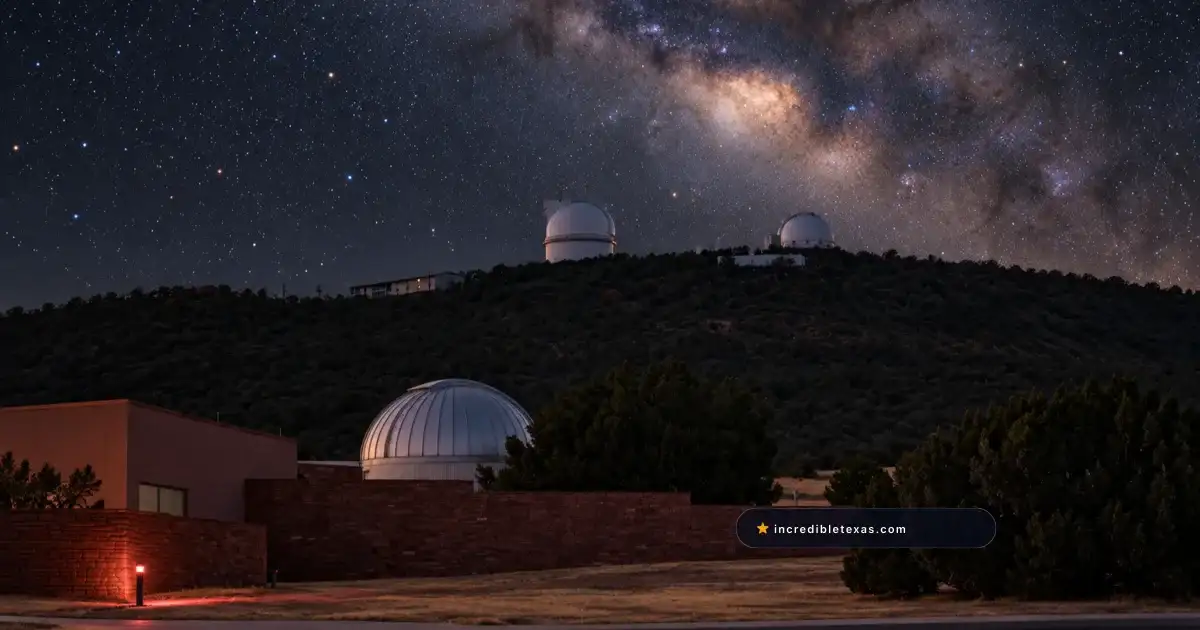
McDonald Observatory operates the leading public astronomy program in the American Southwest from its high-altitude dark-sky perch in the Davis Mountains of West Texas. Managed as an active research unit of the University of Texas at Austin, the facility offers visitors direct access to world-class optical telescopes and guided night sky interpretation.
Securing mcdonald observatory tickets for an evening gathering requires careful forward planning. The high-altitude desert setting delivers crystal-clear celestial views, but it also demands strict adherence to lighting rules, advance ticketing deadlines, and cold-weather preparation.
Key takeaways
- Advance online reservations are required for all McDonald Observatory Star Parties via mcdonaldobservatory.org; walk-up tickets are not sold at the gate.
- Programs operate year-round on Tuesday, Friday, and Saturday evenings, lasting roughly two hours across the outdoor amphitheater and Rebecca Gale Telescope Park.
- Standard tickets cost $25 for adults, $20 for students and seniors, and $5 for children ages 0 to 4.
- Elevation at Mount Locke reaches 6,791 feet, requiring warm layers even during summer because mountain temperatures drop 30 degrees after dusk.
- Strict red-light protocols protect night sky adaptation; white flashlights, phone screens, and camera flashes are prohibited on the viewing grounds.
Plan your visit
Verified
- Location
- 3640 Dark Sky Drive, Fort Davis, TX 79734
- Hours
- Star Parties: Tue, Fri, Sat (sunset); Visitor Center: Tue-Sat 12-5pm
- Admission
- $25 adults, $20 students/seniors, $5 children ages 0-4
- Best time to go
- New moon weekends, year-round
McDonald Observatory Star Party Tickets, Pricing, and Booking Windows
McDonald Observatory Star Party tickets cost $25 for adults, $20 for students and military personnel, and $5 for children ages 0 to 4. All passes must be reserved online through the official University of Texas McDonald Observatory Visitors Portal, as programs routinely sell out four to six weeks in advance.
The observatory limits attendance for each evening session to ensure that every visitor receives ample time at the eyepieces of multiple telescopes. Spontaneous travelers arriving at the gate without an advance reservation confirmation barcode are turned away. For overnight stays nearby, compare campsite options in our Davis Mountains State Park visitor guide.
Admission Categories and Pass Pricing
Standard adult admission is $25 per person, while discounts for seniors, educators, active military, and students bring the ticket price to $20. Understanding the mcdonald observatory star party cost helps families calculate total travel expenses before booking.
Every attendee must hold an individual ticket, including infants and toddlers. The registration confirmation email contains a scannable bar code that gate attendants verify at the Frank N. Bash Visitors Center entrance.
| Pass Type | Cost | Eligibility | Details |
|---|---|---|---|
| Adult General Admission | $25 | Ages 13 to 64 | Full amphitheater talk and telescope viewing |
| Student / Youth | $20 | Ages 5 to 12 or with student ID | Includes educational program access |
| Senior / Military / Educator | $20 | Ages 65+, active duty, teachers | Valid identification verified at check-in |
| Child Admission | $5 | Ages 0 to 4 | Mandatory reservation for venue capacity |
| Observatory Friends Member | Free | Registered donor pass | Advance booking reservation still required |
Booking Horizons and When Tickets Sell Out
Tickets are released on a rolling seasonal calendar roughly three months in advance through the University of Texas ticketing system. High-demand periods including spring break, Memorial Day, July Fourth, and Thanksgiving weekend sell out within days of opening.
Acquiring mcdonald observatory passes requires tracking these release dates carefully. Travelers targeting moonless weekends during prime Milky Way season from May through September should monitor ticket releases early to secure preferred dates.
Star Party Schedule: Days of the Week and Seasonal Sunset Hours
McDonald Observatory hosts public Star Parties on Tuesday, Friday, and Saturday evenings throughout the entire year. Program start times change each month based on astronomical twilight, beginning as early as 7:00 PM during mid-winter and as late as 8:45 PM during peak summer.
Checking the published mcdonald observatory schedule ensures smooth arrival before the gates lock. Gates at the Frank N. Bash Visitors Center open one hour prior to the scheduled program start time so guests can browse exhibits and adjust their eyes.
Seasonal Program Start Times Across the Year
Arrival windows open one hour before scheduled twilight talks to allow parking at the Frank N. Bash Visitors Center and check-in processing. The outdoor program begins promptly at twilight and runs for two full hours.
The mcdonald observatory twilight program introduces guests to stellar cartography before complete darkness falls. During summer months, twilight arrives late over the mountains, pushing program conclusions past 10:30 PM, whereas winter sessions finish comfortably before bedtime.
| Season | Typical Start Time | Check-In Window Opens | Program Concludes |
|---|---|---|---|
| Winter (Dec - Feb) | 7:00 PM | 6:00 PM | 9:00 PM |
| Spring (Mar - May) | 8:00 PM | 7:00 PM | 10:00 PM |
| Summer (Jun - Aug) | 8:45 PM | 7:45 PM | 10:45 PM |
| Fall (Sep - Nov) | 7:30 PM | 6:30 PM | 9:30 PM |
What Happens During Overcast or Rainy Nights
Star Parties proceed rain or shine inside the Frank N. Bash Visitors Center auditorium with live astronomer-led constellation presentations and telescope demonstrations. If heavy cloud cover prevents outdoor observation, visitors receive rain checks valid for future visits.
Astronomers use high-resolution digital projection systems to guide attendees through the local cosmos during cloudy sessions. While looking through physical eyepieces is the ideal experience, the indoor science presentations provide deep insight into modern astrophysics.
The Star Party Experience: Amphitheater Talks and Telescope Viewing
Each Star Party begins with an interactive constellation tour in the outdoor amphitheater using high-power green laser pointers to map constellations and satellites. Visitors then transition to the Rebecca Gale Telescope Park to view deep-sky nebulae, star clusters, and planetary disks through high-aperture telescopes.
Attending a frank n bash visitors center star party is widely recognized as one of the finest public astronomy traditions in North America. Under Bortle Class 1 conditions, the glow of the Milky Way casts soft shadows across the limestone hills, which you can contrast with the desert vistas in our Big Bend National Park camping and trails guide.
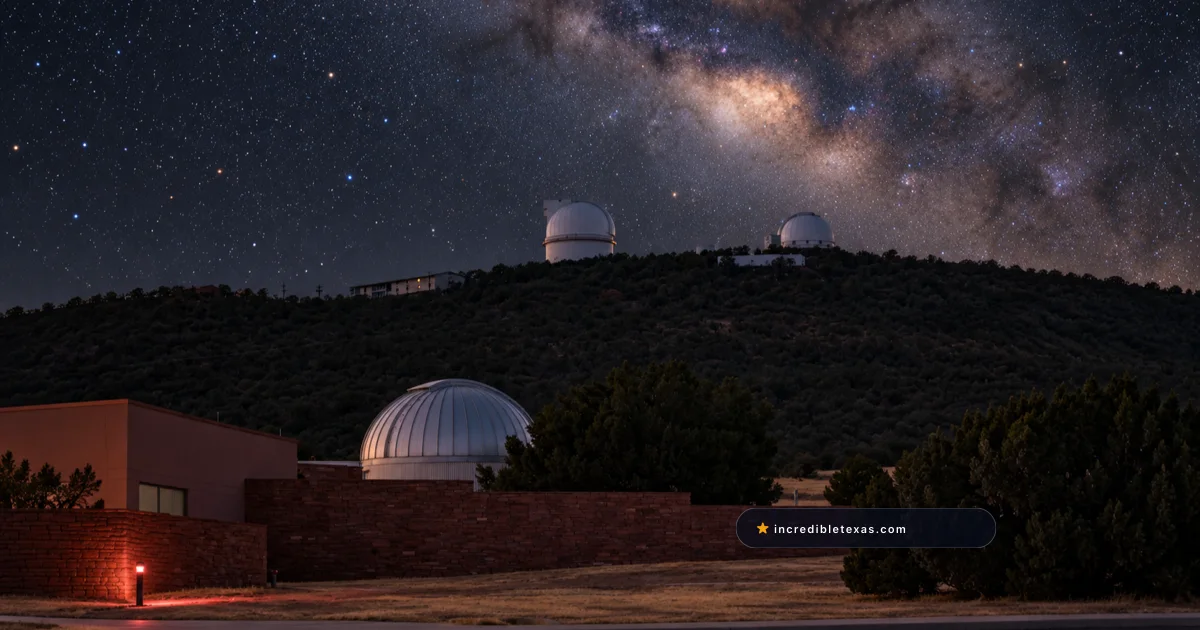
Adapted from a photograph by John Cummings, licensed under CC BY-SA 3.0. Changes made; this adaptation is shared under the same license.
Constellation Orientation in the Dark Sky Amphitheater
Staff astronomers utilize high-powered green laser pointers to trace planetary orbits, zodiacal constellations, and deep-space milestones across the sky. The outdoor amphitheater features stadium-style stone benches oriented toward the darkest southern horizon.
The presentation introduces visitors to cultural star mythology and the modern astronomical coordinate system. Guests learn how to navigate the night sky using bright anchor stars like Vega, Arcturus, and Polaris.
Viewing Through Research-Grade Scopes at Telescope Park
The Rebecca Gale Telescope Park features multiple permanently mounted 16-inch to 24-inch Ritchey-Chretien and Dobsonian reflector telescopes operated by staff and volunteer astronomers. Visitors rotate freely among instruments targeted at the Moon, globular clusters, and distant spiral galaxies.
Each telescope station focuses on a different celestial object. Station operators explain the distance, chemical composition, and light-travel time of each target, answering questions as guests look through the eyepieces.
Essential Visitor Rules: Red-Light Protocols, Cold Weather, and Gear
Strict lighting ordinances prohibit white flashlights, camera flashes, and illuminated smartphone screens anywhere in the observatory park to preserve night vision. Visitors must wear winter clothing, thermal coats, and closed-toe shoes because nighttime mountain temperatures drop 30 degrees below daytime forecasts.
The human eye requires 20 to 30 minutes to develop full scotopic vision in dark conditions. A single flash of white light resets that biological adaptation instantly, compromising the experience for everyone nearby.
Red Flashlights and Headlamp Protocols
Only red LED flashlights and red-filtered headlamps are permitted beyond the visitor center patio doors. The gift shop sells red flashlights and provides adhesive red film to cover white phone lights for arriving visitors.
Car headlights must be dimmed to parking lights when approaching the visitor center parking terrace after twilight. Observatory staff guide vehicles into designated bays to ensure headlights face away from the outdoor telescope park. Photographers traveling to the Davis Mountains can consult our Texas astrophotography and Milky Way guide for camera settings and red-light guidelines.
Mount Locke Elevation and Severe Mountain Cold
Mount Locke sits at 6,791 feet above sea level, producing brisk winds and severe temperature drops that catch unprepared valley travelers by surprise. Even in July and August, evening temperatures frequently dip into the 50s, while spring, fall, and winter nights plunge near or below freezing.
Adhering to a practical mcdonald observatory star party dress code is essential for comfort. Spur 78 reaches an elevation of 6,791 feet at Mount Locke, making it the highest maintained roadway on the Texas highway system, where night temperatures routinely drop 30 degrees below valley forecasts. Pack heavy winter coats, gloves, knit beanies, and insulated footwear regardless of daytime highs in the desert lowlands.
Tip
Bring thick stadium seat cushions or wool blankets for the outdoor amphitheater benches. The stone seats absorb daytime warmth quickly and radiate intense cold into your body during the one-hour constellation talk.
Daytime Passes and Guided Tours of Mount Locke and Mount Fowlkes
Daytime general admission passes allow travelers to tour exhibits in the Frank N. Bash Visitors Center and take self-guided tours of the summit telescopes. Guided tours offer behind-the-scenes access inside the 107-inch Harlan J. Smith Telescope and the massive 11-meter Hobby-Eberly Telescope on Mount Fowlkes.
Taking part in daytime hobby eberly telescope tours reveals the scale of modern astronomical equipment. Pairing a daytime summit tour with an evening star party gives visitors a comprehensive view of how astronomical research works.
Summit Access to the 107-inch Harlan J. Smith Dome
Perched at the summit of Mount Locke along Spur 78, the historic 107-inch reflector dome features an enclosed catwalk and visitor gallery overlooking the massive equatorially mounted telescope. Self-guided visitors can view the giant telescope assembly between 10:00 AM and 5:00 PM.
Dedicated in 1968, the Harlan J. Smith Telescope has contributed to planetary atmosphere studies, pulsar discoveries, and interstellar chemical surveys. Interpretive signs explain how the telescope’s massive counterweights maintain balance during long-exposure observations.
The 11-Meter Hobby-Eberly Telescope on Mount Fowlkes
The Hobby-Eberly Telescope ranks among the largest optical telescopes in the world, featuring an 11-meter segmented spherical primary mirror comprising 91 individual hexagonal mirrors. Guided summit tours take visitors inside the dome facility to study spectroscopic dark energy research equipment.
As highlighted in the National Park Service Big Bend Night Skies Directory, regional dark-sky lighting ordinances protect the sensitive light sensors of West Texas research telescopes from artificial light pollution. The instrument surveys millions of galaxies to measure the expansion rate of the universe.
Where to Stay: Mountain Lodging, Campgrounds, and Nearby Towns
The closest lodging is Indian Lodge and the developed campgrounds within Davis Mountains State Park, situated 12 miles south along Texas Highway 118. Additional historic hotels and motels are available in Fort Davis, while Alpine and Marfa offer boutique options within a 45-minute drive.
Securing accommodations early is just as vital as booking Star Party passes. Fort Davis possesses a limited hotel room inventory, which fills completely during astronomical events and peak holiday weekends.
Indian Lodge and Davis Mountains State Park Camping
Davis Mountains State Park features 93 campsites with water, electric, and full hookups, alongside the historic 39-room adobe Indian Lodge resort. Driving from the state park campground to the observatory takes roughly 18 minutes via Scenic Highway 118.
Reservations for both the historic lodge and tent sites can be completed through the Texas Parks and Wildlife Davis Mountains State Park Portal. Taking advantage of davis mountains stargazing around your campsite provides an unforgettable companion experience to the formal observatory programs.
Gateway Towns: Fort Davis, Alpine, and Marfa Accommodations
Fort Davis offers historic bed-and-breakfasts and the 1910 Hotel Limpia just 16 miles southeast of the observatory gates. Attending a fort davis star party weekend is an easy road trip from regional hubs.
Travelers looking for more dining choices can base in Alpine, located 40 miles south along Highway 118, which also features rail connections via the Sunset Limited. Alternatively, explore our Marathon Texas stargazing lodging guide for historic Gage Hotel accommodations.
Frequently Asked Questions
Can you buy McDonald Observatory Star Party tickets in person at the gate?
McDonald Observatory Star Party tickets must be purchased online in advance through the official ticketing portal. Walk-up tickets are rarely available at the gate because programs frequently sell out weeks ahead of time.
Are children allowed at the McDonald Observatory Star Party?
Children of all ages are welcome at Star Parties, with tickets priced at $5 for children ages 0 to 4. Parents should dress children in warm layers, as evening mountain temperatures drop quickly during the outdoor program.
What happens if a Star Party is clouded out by bad weather?
Programs proceed regardless of weather inside the visitor center theater with interactive astronomy talks, indoor exhibits, and virtual sky tours. If outdoor telescope viewing is completely prevented by cloud cover, the observatory provides rain checks for a future program.
What kind of flashlight should you bring to the Star Party?
Visitors may only use red-light flashlights or headlamps with red filters while navigating outdoor paths after twilight. White lights, camera flashes, and illuminated smartphone screens are strictly prohibited to preserve night vision.
How far is McDonald Observatory from Big Bend National Park?
The observatory sits approximately 120 miles north of Panther Junction Visitor Center in Big Bend National Park. The scenic drive takes about two and a half hours heading north via State Highway 118 through Alpine and Fort Davis.