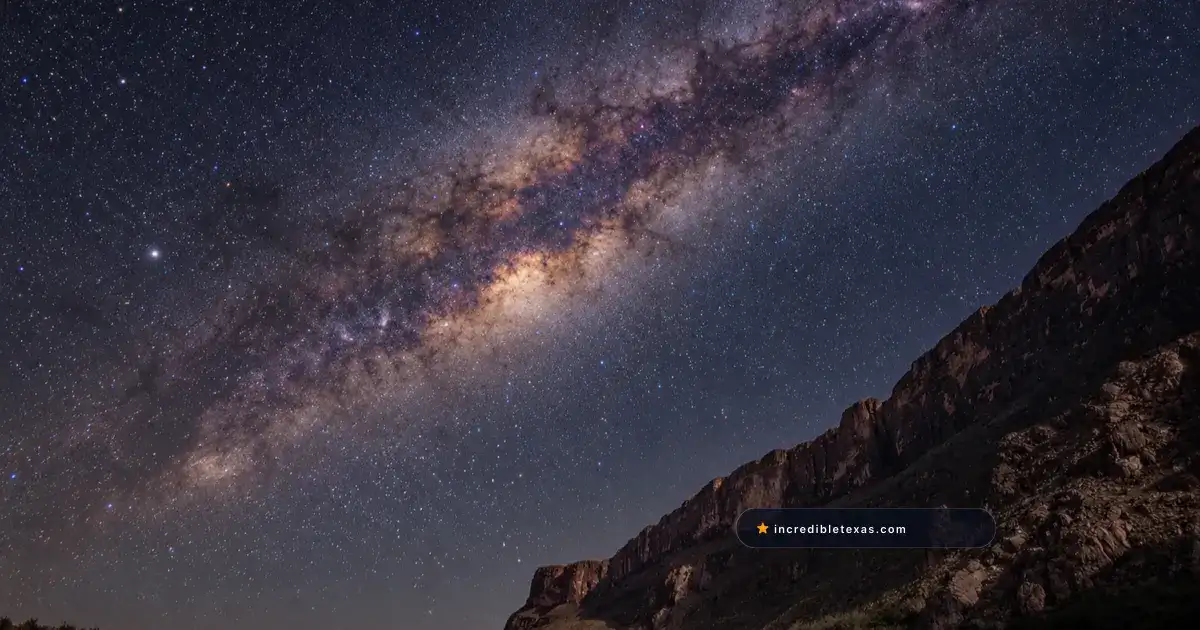
Texas possesses an astronomical inheritance unlike any other state in the nation. Across hundreds of miles of open desert, mountain ranges, and rural river valleys, the night sky reveals itself in complete clarity.
From the research-grade domes of Mount Locke to the granite summits of the Hill Country, stargazing in texas offers travelers an unforgettable journey into the cosmos. This comprehensive texas stargazing guide covers certified sanctuaries, public observatories, and seasonal viewing calendars across every region.
Observers determining where to stargaze in texas can choose between high-altitude research summits, peaceful river valleys, and accessible county parks. With minimal light pollution across western deserts, the Lone Star State provides some of the best stargazing in texas for families and serious astronomers alike.
Key takeaways
- Texas is home to the Greater Big Bend International Dark Sky Reserve, the largest certified dark sky place on Earth encompassing over 15,000 square miles.
- Bortle Class 1 darkness in Far West Texas allows naked-eye viewing of the Milky Way, Andromeda Galaxy, zodiacal light, and faint airglow.
- World-class public observatories like McDonald Observatory in Fort Davis and George Observatory near Houston offer access to research-grade telescopes.
- Hill Country sanctuaries such as Enchanted Rock and Blanco State Park provide accessible Bortle 3 dark sky escapes within an hour of major cities.
- Planning trips within five days of the monthly new moon ensures completely dark, moon-free skies for celestial observation and astrophotography.
Plan your visit
Verified
- Location
- Statewide: Trans-Pecos, Texas Hill Country, Panhandle & Gulf Coast
- Hours
- Park day-use closes 10:00 PM; camping allows overnight observation
- Admission
- State park day passes $3 to $7; observatory tickets $10 to $25
- Best time to go
- Year-round; summer for Milky Way core, winter for stable planetary viewing
Why Texas Offers the Best Dark Skies in the United States
Texas features exceptional dark-sky resources due to vast unpopulated western deserts, high-elevation mountain plateaus, and progressive outdoor lighting legislation. The state contains millions of acres of protected public land where artificial skyglow has been permanently restricted.
This unique combination of low humidity, high elevation, and sparse population creates ideal transparency for telescope observation. For an in-depth breakdown of the world’s largest dark sky sanctuary spanning the borderlands, explore our Greater Big Bend International Dark Sky Reserve guide.
The Bortle Scale: From Houston Neon to Big Bend Blackout
Understanding night sky quality requires examining the nine-class Bortle scale, which measures light pollution from inner-city brilliance to natural darkness. The bortle scale texas parks display ranges from urban Class 9 in Dallas and Houston down to true Class 1 in the Trans-Pecos desert.
In Class 1 and Class 2 environments, the Milky Way casts discernible shadows on the ground, and celestial landmarks like the Andromeda Galaxy appear with the naked eye. In contrast, suburban Class 5 zones wash out faint interstellar gas clouds, leaving only bright planets and major constellations visible.
Knowing the Bortle rating of your destination allows you to pack appropriate equipment. Advanced telescopes perform well in Class 4 rural parks, but experiencing true naked-eye milky way stargazing texas travelers dream of requires venturing into Class 1 and Class 2 reserves.
International Dark Sky Places (IDSP) Certification in Texas
DarkSky International certifies public parks, wilderness reserves, and municipal communities that demonstrate exceptional commitment to night-sky preservation. The international dark sky places texas holds represent one of the highest concentrations of certified acreage anywhere in the world.
Certification requires rigorous baseline light monitoring, municipal lighting ordinances, and continuous public educational programming. Park staff must replace glaring floodlights with fully shielded, downward-directed fixtures that emit warm color temperatures below 3000 Kelvin.
These conservation standards protect delicate desert ecosystems, nocturnal wildlife navigation, and human circadian rhythms. By supporting certified dark sky parks in texas, travelers contribute directly to preserving natural heritage for future generations.
West Texas Dark Sky Sanctuaries: Big Bend and the Trans-Pecos
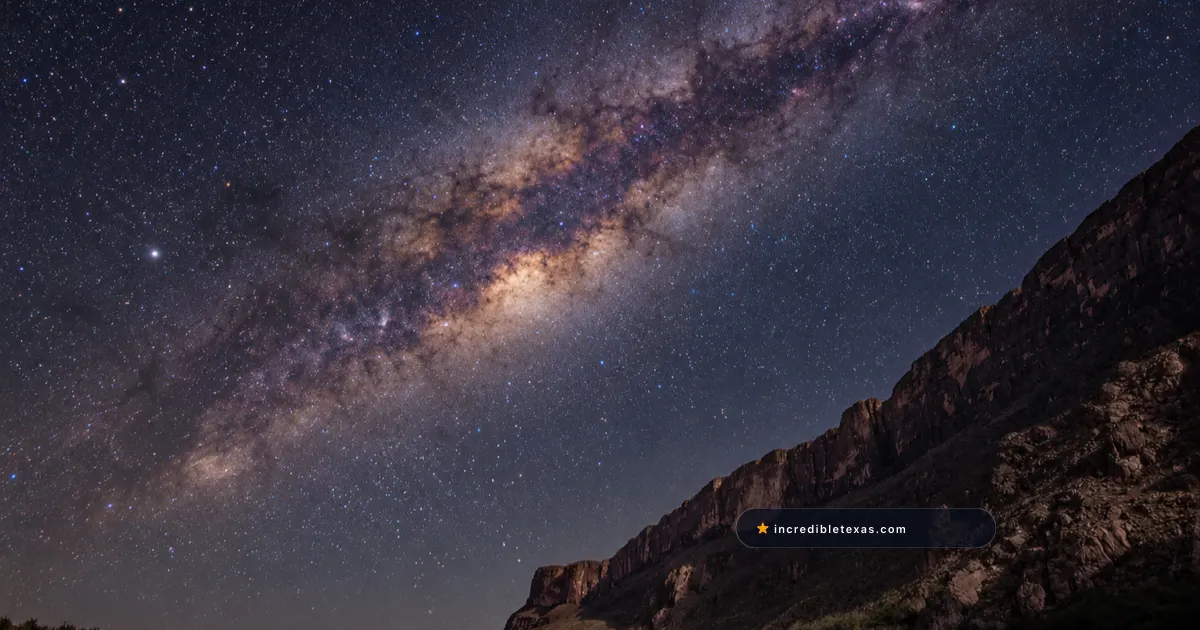
Far West Texas serves as the undisputed crown jewel of American stargazing, anchored by high elevations and minimal human infrastructure. The Trans-Pecos region holds certified Bortle Class 1 night skies, providing some of the clearest celestial views on Earth.
Spanning three expansive counties, the region unites state and national parklands into a contiguous dark-sky corridor. Travelers seeking historic accommodations and private viewing courtyards can review our Marathon Texas stargazing lodging guide for eastern gateway planning.
Big Bend National Park and Big Bend Ranch State Park
Covering more than 800,000 acres along the Rio Grande, Big Bend National Park provides world-renowned dark sky conditions. Low desert valleys, rugged volcanic ridges, and deep limestone canyons provide dramatic foregrounds for celestial viewing.
According to verified research from the National Park Service Big Bend Night Skies Directory, the park regularly registers sky darkness readings above 21.8 magnitudes per square arcsecond. Observers at Sotol Vista Overlook and Santa Elena Canyon experience completely unpolluted views of the Milky Way core stretching overhead.
Adjacent to the national park, Big Bend Ranch State Park adds over 311,000 acres of remote wilderness to the conservation corridor. Its rugged 4WD tracks and primitive backcountry campsites offer complete solitude for serious astronomers far from paved roads.
Dark Sky Gateway Towns: Marathon, Alpine, and Marfa
The gateway communities of Marathon, Alpine, and Marfa provide essential hospitality for night-sky travelers. Each town enforces strict outdoor lighting ordinances designed to protect regional darkness while accommodating visitors.
Marathon sits on the eastern boundary of the dark-sky reserve, offering historic lodging with on-site telescope viewing facilities. Alpine serves as the central commercial hub with railway access and dining, while Marfa provides artistic desert culture beneath starry horizons.
These communities welcome astronomers, offering walking tours, rooftop viewing decks, and astronomy-themed events. Choosing a town base allows visitors to combine wilderness daytime hikes with comfortable nighttime telescope sessions.
| Texas Dark Sky Park | Region | Managing Agency | Bortle Rating | Public Telescope Access |
|---|---|---|---|---|
| Big Bend National Park | West Texas | National Park Service | Bortle Class 1 | Seasonal ranger telescope programs |
| Big Bend Ranch State Park | West Texas | Texas Parks and Wildlife | Bortle Class 1 | Primitive backcountry viewing |
| McDonald Observatory | West Texas | University of Texas | Bortle Class 1 | Research-grade telescope viewing |
| Copper Breaks State Park | North Texas | Texas Parks and Wildlife | Bortle Class 2 | Regular public star party programs |
| Enchanted Rock Natural Area | Hill Country | Texas Parks and Wildlife | Bortle Class 3 | Seasonal public star parties |
| Blanco State Park | Hill Country | Texas Parks and Wildlife | Bortle Class 3 | Grassy lawn open viewing |
| Brazos Bend State Park | Gulf Coast | Texas Parks and Wildlife | Bortle Class 4 | 36-inch George Observatory telescope |
Public Observatories and Legendary Texas Star Parties
While wilderness camping delivers memorable solitude, public observatories provide educational insights and access to massive research instruments. Texas observatories stargazing programs allow visitors to inspect deep-space phenomena through optics that amateur equipment cannot match.
These public facilities combine interactive lectures by professional astronomers with live viewing sessions. For ticket schedules, program fees, and summit access rules, explore our comprehensive McDonald Observatory Star Party tickets guide.
McDonald Observatory Star Parties on Mount Locke
Perched at an elevation of 6,791 feet in the Davis Mountains, the University of Texas McDonald Observatory is one of the world’s leading centers for astronomical research. Its dry, high-altitude setting provides remarkable atmospheric clarity for massive instruments like the 11-meter Hobby-Eberly Telescope.
Three nights per week, the observatory welcomes the public to evening Star Parties held in its outdoor amphitheater. Program attendees observe constellation layouts traced with green laser pointers before rotating through research-grade telescopes in Rebecca Gale Telescope Park.
Looking through these high-aperture instruments reveals crisp details in planetary atmospheres, globular star clusters, and distant spiral galaxies. Official visitor schedules and event reservations are managed via the University of Texas McDonald Observatory Visitors Portal.
Astronomy Programming and Visitor Experiences
Observatory programs cater to both beginning stargazers and experienced observers, providing engaging explanations of astrophysical principles. Staff astronomers explain light-travel times, stellar life cycles, and planetary formation while guests view target objects.
Specialized daytime passes allow visitors to tour the giant summits of Mount Locke and Mount Fowlkes to view telescope mechanics up close. These behind-the-scenes tours reveal how massive 107-inch mirrors rotate smoothly to track celestial movements across the sky.
Attending an organized observatory session is an essential milestone for any astronomy enthusiast. Combining a formal star party with outdoor park camping provides a balanced introduction to Texas night skies.
Hill Country Stargazing: Granite Domes and Natural Areas
The Texas Hill Country offers convenient texas night sky viewing for millions of urban residents living in Austin and San Antonio. Natural limestone canyons and granite batholiths provide natural buffers that block distant metropolitan glow.
These parks feature dark rural skies within two to three hours of major airports. For summit curfews and night hiking regulations, review our dedicated Enchanted Rock night sky guide.
Enchanted Rock State Natural Area Summit and Loop Trails
Located eighteen miles north of Fredericksburg, Enchanted Rock State Natural Area holds official certification as an International Dark Sky Park. Its ancient 425-foot pink granite dome offers a 360-degree elevated horizon for observing constellations and passing satellites.
While the steep Summit Trail closes 30 minutes after sunset for visitor safety, the lower Loop Trail remains open to day visitors until 10:00 PM. Grassy clearings near Sandy Creek provide stable footing and broad southern sightlines for setup.
Photographers frequently frame the granite dome beneath the arching summer Milky Way. Reserving day passes online up to 30 days in advance guarantees entry during clear new-moon weekends.
South Llano River and Devils Sinkhole Clearings
Located further west near Junction, South Llano River State Park offers Bortle Class 3 night skies along a spring-fed river corridor. Shaded pecan groves and open river meadows create comfortable observing environments for campers.
Nearby Devil’s Sinkhole State Natural Area in Rocksprings provides Bortle Class 2 darkness on the edge of the Edwards Plateau. The park’s remote limestone grasslands feature minimal light pollution, allowing clear views of faint deep-sky clusters.
These western Hill Country sanctuaries offer significantly darker skies than parks closer to Interstate 35. They provide peaceful alternatives for travelers seeking quiet overnight camping under the stars.
Central Texas Dark Sky Communities and Riverside Parks
Central Texas communities lead the nation in municipal lighting reform, protecting starry skies right on the doorstep of growing suburbs. Municipalities like Blanco, Dripping Springs, and Wimberley enforce proactive lighting codes that shield rural river valleys from commercial glare.
These certified communities demonstrate that economic development and night-sky conservation can thrive together. For camping reservations and riverfront observation tips, consult our Blanco State Park stargazing guide.
Blanco State Park and the Blanco Dark Sky Community
Blanco State Park sits along the Blanco River, protected by the dark-sky ordinances of the surrounding City of Blanco. This compact 105-acre park offers an accessible Bortle Class 3 retreat less than an hour from Austin and San Antonio.
Visitors can spread blankets across the historic Civilian Conservation Corps pavilion lawn or set up cameras on the limestone ledge above Falls Dam. The calm river surface reflects bright planets and stars, creating memorable photographic compositions.
With 29 developed campsites and six screened shelters, the park allows overnight guests to stargaze throughout the night. It serves as an ideal entry point for families introducing young children to astronomy.
Municipal Lighting Ordinances and Rural Protection
The City of Blanco earned certification as an International Dark Sky Community through strict lighting legislation and community cooperation. Ordinances require all public and commercial fixtures to be fully shielded, directing light downward where needed.
Fixtures must use warm bulbs below 3000 Kelvin, reducing blue light scatter that contributes to atmospheric skyglow. Local businesses and residential property owners actively participate in lighting audits to eliminate stray glare.
These community-driven efforts keep the night sky dark along the Blanco River corridor. They provide a practical model for other Texas towns seeking to preserve their rural heritage against expanding metropolitan light domes.
Escaping Metro Light Domes: North Texas and Coastal Getaways
Living in major metropolitan areas does not mean you must forfeit celestial viewing. Stargazers in Dallas, Fort Worth, and Houston can reach dark-sky parks by driving 45 to 90 minutes outside suburban perimeters.
These accessible getaways feature dark horizons and public astronomy events. For metro dwellers planning weekend escapes, review our comprehensive stargazing spots near Houston guide for driving routes and ticket tips.
Copper Breaks State Park Juniper Canyons
Situated near Quanah in Hardeman County, Copper Breaks State Park is an official International Dark Sky Park featuring verified Bortle Class 2 skies. Located under four hours from Dallas-Fort Worth, it offers North Texas residents a convenient dark-sky escape.
The park’s rugged red shale badlands and juniper breaks create striking foregrounds for wide-angle star captures. Big Break Trail and the shoreline of Big Pond offer open viewing areas with zero commercial light pollution.
Park rangers host regular public star parties, setting up tracking telescopes for visitors to inspect planets and star clusters. Its distance from major highway corridors makes it one of the most dependable stargazing parks in the northern half of Texas.
George Observatory at Brazos Bend State Park
Located 45 miles southwest of downtown Houston, the George Observatory serves as the primary public astronomy destination in Southeast Texas. Perched along the edge of Creekfield Lake inside Brazos Bend State Park, the facility operates under the Houston Museum of Natural Science.
The observatory features three dome telescopes, including the massive 36-inch Gueymard Research Telescope. Saturday night public star parties allow metro families to inspect Saturn’s rings and deep nebulae through research-grade optics.
Surrounding bottomland hardwood forests shield the lake observation deck from city glare. As detailed on the Houston Museum of Natural Science George Observatory Portal, tickets must be purchased online in advance.
Planning Your Texas Stargazing Road Trip: Seasons and Camera Gear
A successful night-sky journey requires careful preparation, from tracking lunar calendars to packing proper red-light accessories. Taking time to plan your itinerary ensures you enjoy optimal viewing conditions and comply with park regulations.
Different seasons highlight different celestial targets, providing varied experiences throughout the year. For technical camera settings, 500 Rule calculations, and lens choices, explore our detailed Texas astrophotography and Milky Way guide.
Astronomical Calendars and New Moon Windows
The moon is the brightest source of natural light pollution in the night sky. To maximize darkness, schedule your stargazing trip within the ten-day window centered on the monthly new moon, starting five days before and ending four days after.
During summer months from June through August, the luminous core of the Milky Way rises early in the evening, dominating the southern horizon. Summer viewing provides dramatic views of dense galactic dust lanes and colorful emission nebulae.
Winter stargazing offers crisp, low-humidity air that produces exceptional atmospheric transparency. While temperatures in desert mountain parks can plunge below freezing, winter skies reveal brilliant constellations like Orion, Taurus, and the Pleiades star cluster.
Astrophotography Gear and Red-Light Etiquette
Preserving natural night vision is essential for safe navigation and courtesy toward fellow observers. Human scotopic vision requires 20 to 30 minutes to develop, and a single flash of white light resets that adaptation instantly.
Always use dedicated red LED headlamps when checking gear bags or walking along park trails. Point headlamps downward toward your feet to avoid blinding neighboring astronomers and ruining long camera exposures.
Official park guidelines are outlined on the Texas Parks and Wildlife Stargazing in State Parks Portal, reminding travelers to respect quiet hours and extinguish unnecessary campfire flames after 10:00 PM. Following these simple etiquette rules ensures that everyone enjoys the wonders of the Texas night.
Frequently Asked Questions
Where is the best place to stargaze in Texas?
Big Bend National Park and Big Bend Ranch State Park offer the darkest skies in Texas, holding certified Bortle Class 1 ratings. The Davis Mountains around McDonald Observatory and Copper Breaks State Park are also world-class stargazing destinations.
How many dark sky parks are in Texas?
Texas is home to more than twenty certified DarkSky International places, including the 15,000-square-mile Greater Big Bend Dark Sky Reserve, multiple national and state parks, and dark-sky communities like Blanco and Dripping Springs.
Can you see the Milky Way in Texas?
The Milky Way is visible to the naked eye across vast sections of Texas from March through October. Stargazers can view the bright galactic core from rural state parks in the Hill Country, North Texas, and throughout the Trans-Pecos desert.
What is the best month for stargazing in Texas?
July and August offer the best views of the vertical Milky Way core directly after dusk, while autumn and winter months deliver crisp, low-humidity air with superior atmospheric stability for telescope viewing.
Do you need tickets to stargaze in Texas state parks?
Visitors must purchase standard state park day passes, which allow access until gates close at 10:00 PM. To stargaze throughout the night, visitors must reserve an overnight campsite or attend scheduled public star party programs.