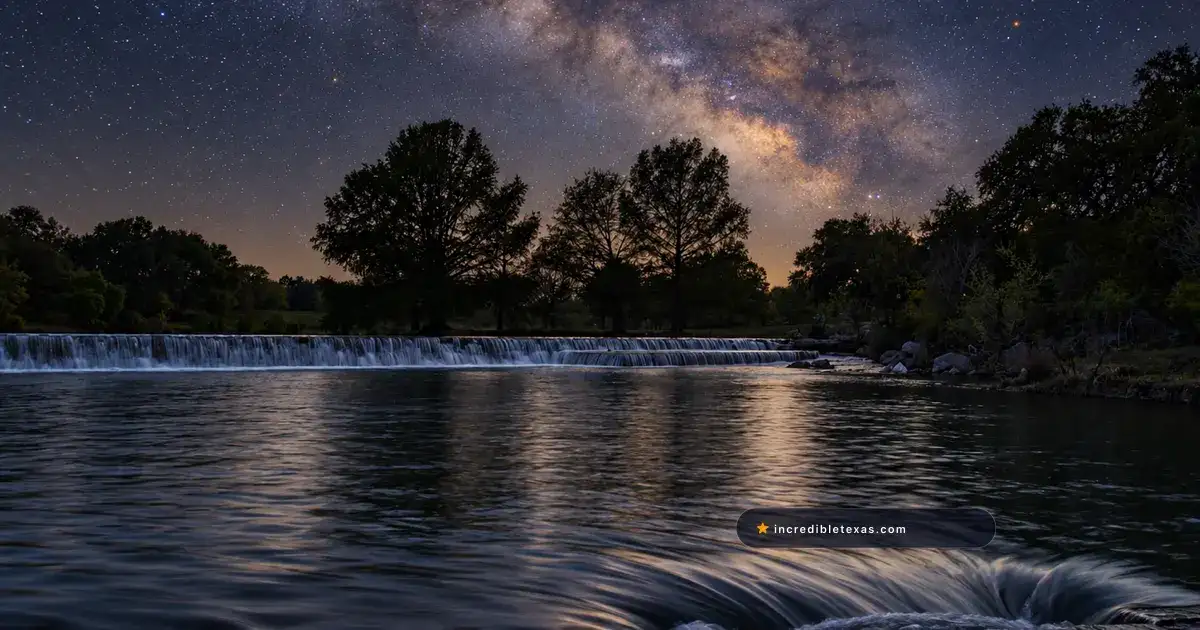
Blanco State Park safeguards a remarkably dark pocket of night sky along a spring-fed stretch of the Blanco River. Positioned equidistant between two growing metropolitan centers, this 104-acre park provides accessible rural stargazing without requiring a multi-day journey into Far West Texas.
Travelers seeking dark skies can escape city glare and set up telescopes along the riverbank in under sixty minutes. The surrounding community actively protects its nighttime heritage, creating an astronomical sanctuary where thousands of stars remain clearly visible.
Key takeaways
- Blanco State Park provides rare Bortle Class 3 night sky conditions situated just one hour from both Austin and San Antonio.
- The surrounding municipality of Blanco is an officially certified International Dark Sky Community with strict lighting ordinances that limit regional skyglow.
- Day-use passes cost $5 for adults (children 12 and under enter free) and allow access until gate closing at 10:00 PM.
- Overnight camping in one of 29 developed campsites or 6 screened shelters grants 24-hour access for late-night Milky Way observation.
- The open grassy field near the historic CCC Pavilion and the clear southern view over Falls Dam offer the best unobstructed vantage points.
Plan your visit
Verified
- Location
- 101 Park Road 23, Blanco, TX 78606
- Hours
- Daily 6am to 10pm (day-use); 24 hours for campers
- Admission
- $5 adults, free for children 12 and under
- Best time to go
- New moon weekends, April to September
Why Blanco State Park Is a Dark-Sky Sanctuary Near Central Texas Metros
Blanco State Park sits in an astronomical sweet spot where rural topography shields observers from the metropolitan light domes of Austin and San Antonio. Classified as a Bortle 3 dark sky zone, visitors can see thousands of stars and the luminous Milky Way arc with the naked eye.
Urban skyglow washes out most constellations for city dwellers living along the Interstate 35 corridor. By traveling west to the Blanco River valley, amateur astronomers experience genuine dark-sky contrast while remaining close to comfortable lodging and things to do in Blanco County.
Understanding the Bortle Class 3 Rating and Sky Quality
Bortle Class 3 skies represent rural-to-suburban transition darkness where the Milky Way still shows intricate structural dust lanes. Celestial objects like the Andromeda Galaxy and the Hercules Cluster can be located with standard binoculars without light filters.
Under a clear blanco state park night sky, zodiacal light is frequently visible during autumn mornings and spring evenings. Finding authentic bortle 3 parks texas drivers can reach in an hour is increasingly rare, making Blanco an indispensable regional asset.
The City of Blanco International Dark Sky Community Protection
Recent municipal designations established the City of Blanco as Texas’s fourth certified International Dark Sky Community. Fully shielded fixtures and warm color temperatures prevent light spill from washing out the surrounding river valley.
DarkSky International certified the City of Blanco as an official dark sky community, protecting rural night skies just 48 miles from the Austin light dome. Municipal ordinances require fully shielded outdoor light fixtures with color temperatures below 3000 Kelvin across all public zones. This proactive legislation ensures that the blanco texas dark sky community will preserve starry skies for generations.
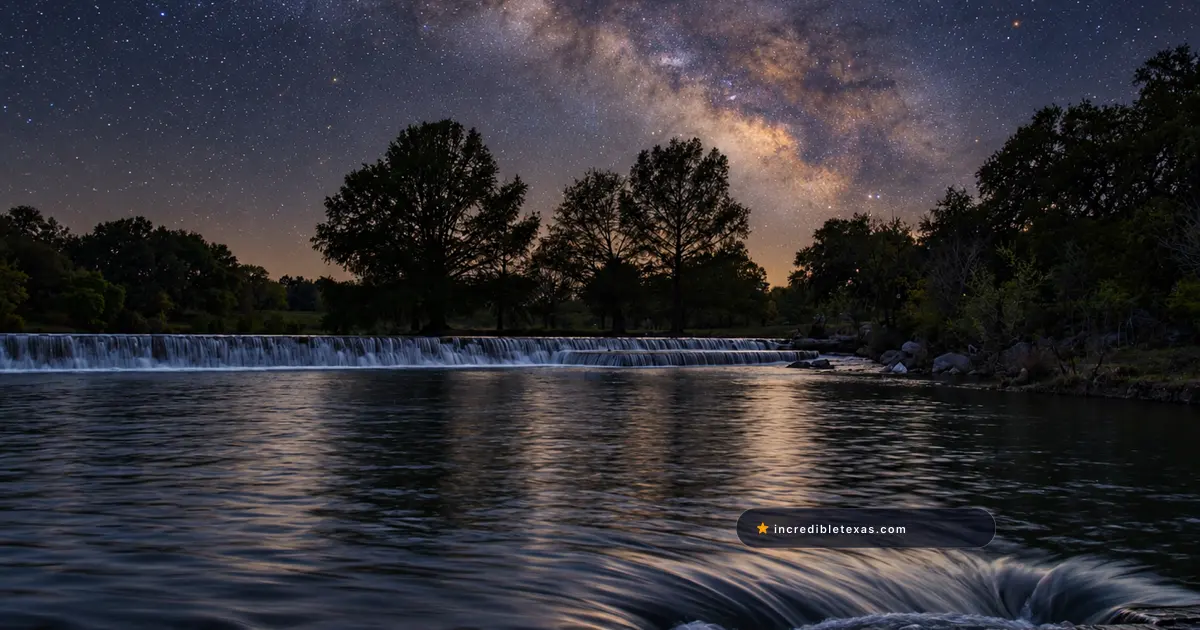
Reference photo by Charles Willgren, licensed under CC BY 2.0. Changes made.
Best Stargazing Locations Along the River Within Park Grounds
The open grassy lawn adjacent to the historic Civilian Conservation Corps Pavilion and the limestone riverbank near Falls Dam provide the best celestial viewing. These cleared clearings minimize tree canopy obstructions and keep the horizon open toward the southern sky.
Towering bald cypress trees border much of the river corridor, which can block wide horizon angles if you set up in the wrong area. Choosing established clearings guarantees wide, open viewing angles from horizon to zenith. For daytime hiking and swimming context, review our Blanco State Park camping and visitor guide.
The Historic CCC Pavilion Lawn
The expansive grassy lawn surrounding the 1930s stone CCC pavilion offers flat terrain ideal for setting up astronomy camp chairs and tripods. Its position away from parked vehicles shields observers from accidental headlight illumination.
Families attending an evening blanco state park star party frequently gather on this manicured green space. The open grass accommodates large Dobsonian telescopes and allows children to move about safely on level ground.
Falls Dam Riverbank and Water Reflections
Positioning yourself along the limestone ledge above Falls Dam gives you an unobstructed horizon view south toward Sagittarius and Scorpius. Calm river pools mirror bright stars and planets, creating exceptional foregrounds for landscape astrophotographers.
The gentle murmur of cascading water adds peaceful acoustic atmosphere to your night sky vigil. Photographers practicing milky way photography blanco techniques find that the stone dam provides an unmistakable architectural anchor against starry skies.
Day-Use Passes vs. Overnight Camping: Night Access Rules
Day-use visitors can remain inside Blanco State Park until the front entrance gates close at 10:00 PM with a standard $5 entry permit. Reserving an overnight campsite or screened shelter provides uninterrupted 24-hour access for 2:00 AM Milky Way core observations.
Casual observers can enjoy several hours of deep darkness between sunset and the 10:00 PM curfew throughout the winter and shoulder seasons. Serious astrophotographers seeking the galactic core during summer months will require an overnight reservation because the Milky Way rises highest after midnight. To compare statewide dark-sky parks and seasonal visibility calendars, explore our comprehensive guide to stargazing in Texas.
Day-Use Entry Permits and 10:00 PM Gate Limits
Texas State Parks require advance online reservations for day passes during busy weekends to guarantee park admission. Day guests must exit the property promptly by 10:00 PM when security gates secure the main park entrance.
Checking the official Texas Parks and Wildlife Blanco State Park Portal confirms current admission rules and gate schedules. Travelers should familiarize themselves with blanco state park day pass hours before heading out from Austin or San Antonio.
Overnight Campsites and Screened Shelters for Late Viewing
Blanco State Park offers 17 full-hookup RV sites, 12 water and electric sites, and 6 screened shelters perched above the river. Campers can step directly outside their tents at midnight to observe deep-sky objects after park gates lock.
Booking blanco state park camping reservations several weeks ahead ensures you secure a riverfront site. Travelers evaluating state parks in Texas with cabins appreciate these ventilated screened shelters as a cost-effective alternative for overnight astronomy outings.
Essential Gear and State Park Night Sky Etiquette
Pack red-lens headlamps, binoculars, reclining outdoor lounge chairs, and light seasonal jackets to maximize comfort during night sessions. All park guests must keep white flashlights switched off and maintain dark-sky lighting courtesies across camping loops.
Preserving dark-sky conditions is a shared responsibility among all park guests. If you want to compare equipment requirements for high-altitude desert astronomy, consult our McDonald Observatory Star Party ticket guide.
Red-Light Flashlights and Preserving Scotopic Vision
Use exclusively red LED flashlights while walking along the riverbank trails to safeguard your biological night vision adaptation. White flashlights, bright mobile phones, and unshielded camp lanterns disrupt nighttime wildlife and neighboring sky observers.
It takes nearly thirty minutes in complete darkness for human rhodopsin pigments to activate fully. A single beam from an unshielded smartphone instantly destroys night vision, blinding the observer for another half hour.
Astronomy Equipment Checklist for Hill Country Observers
A standard pair of 7x50 or 10x50 binoculars reveals lunar impact craters, Jupiter’s Galilean moons, and star clusters like the Pleiades. Walking along pathways mapped in the Texas Parks and Wildlife Blanco River Trail Guide connects observation decks with quiet riverbanks.
Setting up along the water for blanco river stargazing requires preparing for rising evening humidity. Bring lens dew heaters or micro-fiber cloths to keep camera optics clear as cool river mist forms after midnight.
| Equipment Item | Recommended Specification | Purpose for Stargazing |
|---|---|---|
| Red Headlamp | Sub-50 lumen red LED mode | Hands-free trail navigation without resetting eyes |
| Binoculars | 7x50 or 10x50 porro prism | Handheld wide-field sky sweeping for star clusters |
| Reclining Lounger | Zero-gravity folding camp chair | Comfortable viewing of zenith constellations overhead |
| Lens Dew Heater | USB-powered heating band | Prevents fogging on camera optics near the river |
| Star Map App | Red night-mode enabled screen | Identifying planets, satellites, and passing constellations |
How Blanco State Park Compares to Enchanted Rock and Pedernales Falls
Blanco State Park offers gentler terrain and easier vehicle access than the rugged granite dome at Enchanted Rock or the river canyons of Pedernales Falls. While Enchanted Rock provides slightly darker skies, Blanco delivers intimate riverside viewing with zero steep hiking required.
Deciding between these different hill country stargazing spots depends on your physical mobility and telescope bulk. Blanco excels when you want quick trunk-to-lawn telescope transport without climbing treacherous granite stairs.
Blanco vs. Enchanted Rock State Natural Area
Enchanted Rock holds an International Dark Sky Park gold-tier designation but requires strenuous summit climbs in the dark. Blanco State Park allows visitors to observe dark skies from paved picnic grounds just steps from parking stalls.
For travelers comparing stargazing near austin destinations, Blanco provides a stress-free option for families with small children. The easy terrain eliminates concerns about navigating granite cracks or steep cliffs after nightfall.
Blanco vs. Pedernales Falls State Park
Pedernales Falls features vast wilderness acreage but limits night access across steep limestone river stairs. Blanco offers shaded campsites and gentle lawns that are much easier for young children and mobility-conscious travelers.
While the Pedernales Falls State Park guide notes expansive daytime scenery, Blanco provides superior riverside tranquility right beside your campsite. Comparing both parks through the Texas State Parks Blanco Campsites and Fees Directory helps travelers secure the ideal outdoor getaway for stargazing near san antonio.
Frequently Asked Questions
Is Blanco State Park good for stargazing?
Blanco State Park provides outstanding stargazing conditions under rural Bortle Class 3 skies just an hour from Austin and San Antonio. The surrounding city enforces strict municipal lighting ordinances to preserve clear views of the Milky Way.
What Bortle class is Blanco State Park?
Blanco State Park sits within a Bortle Class 3 and 4 transition zone, offering dark rural skies with minimal light pollution. Visitors can view the Milky Way core and faint star clusters with the naked eye on moonless summer nights.
Can you stay at Blanco State Park after dark if you are not camping?
Day-use visitors holding a valid day pass may remain inside the park until front gates close at 10:00 PM. Visitors wishing to stargaze past 10:00 PM must reserve an overnight campsite or screened shelter.
What are the best spots in Blanco State Park to see the Milky Way?
The open lawn adjacent to the historic CCC Pavilion and the limestone riverbank near Falls Dam provide the best unobstructed celestial views. These wide clearings offer broad southern horizons free from dense cypress tree branches.
How far is Blanco State Park from Austin and San Antonio?
Blanco State Park is located approximately 48 miles west of downtown Austin and 50 miles north of San Antonio. Both drives take roughly one hour along US Highway 281 and regional Hill Country highways.