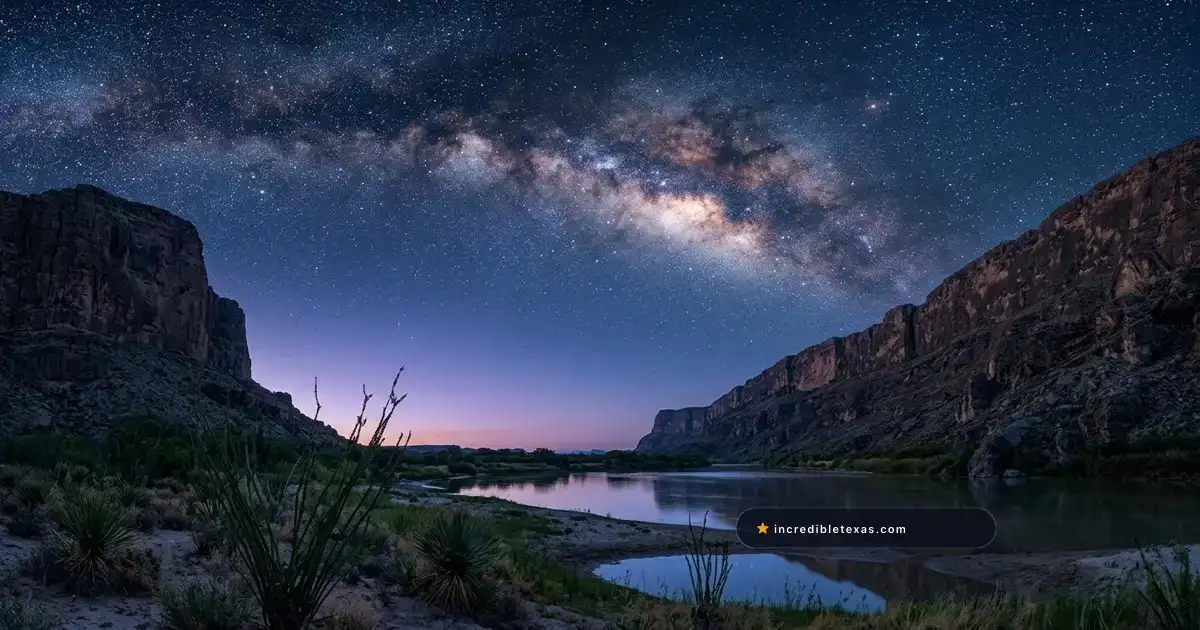
The Greater Big Bend International Dark Sky Reserve safeguards an unprecedented expanse of nocturnal darkness across the Chihuahuan Desert borderlands. Certified by DarkSky International, this massive conservation zone spans international boundaries to protect the nocturnal ecology and astronomical heritage of the American Southwest.
Exploring this vast big bend stargazing reserve gives travelers access to thousands of square miles of Bortle Class 1 night skies. From remote river canyons to mountain peaks crowned with research observatories, the reserve provides extraordinary celestial viewing opportunities.
Key takeaways
- The Greater Big Bend International Dark Sky Reserve spans over 15,000 square miles, making it the largest certified International Dark Sky Place on Earth.
- The reserve unites public lands in West Texas with federally protected wilderness areas in northern Mexico under a unified bi-national conservation framework.
- Calibrated instruments record Bortle Class 1 darkness across the reserve, allowing the Milky Way, zodiacal light, and Andromeda Galaxy to be seen without filters.
- Key anchor properties include Big Bend National Park, Big Bend Ranch State Park, McDonald Observatory, and Black Gap Wildlife Management Area.
- Municipal and county lighting ordinances across Brewster, Presidio, and Jeff Davis counties eliminate commercial light spill to protect scientific research.
Plan your visit
Verified
- Location
- Trans-Pecos region, Brewster, Presidio & Jeff Davis counties, TX
- Hours
- Open 24 hours across public highways and public lands
- Admission
- Free public roadway access; standard park fees apply
- Best time to go
- Year-round, new moon phases
What Is the Greater Big Bend International Dark Sky Reserve?
The Greater Big Bend International Dark Sky Reserve is an internationally certified night sky sanctuary encompassing over 15,000 square miles across West Texas and northern Mexico. It stands as the largest protected dark-sky place in the world, preserving rural darkness across 9.6 million acres.
Establishing this expansive territory required years of cross-border coordination among federal agencies, state parks, university scientists, and private landowners. Travelers touring the region can plan extended backcountry hikes using our Big Bend National Park camping and trails guide to experience these dark corridors firsthand.
Global Significance and Record-Breaking Conservation Scale
Certified by DarkSky International, the reserve is larger than the states of Maryland and Delaware combined. Its immense geographic footprint protects uninterrupted darkness across fragile desert ecosystems and leading astronomical research facilities.
Spanning over 15,000 square miles (more than 9.6 million acres) across West Texas and northern Mexico, the sanctuary is larger than the states of Maryland and Delaware combined, recognized as the world largest dark sky reserve. Certified by DarkSky International, it sets an international benchmark for large-scale environmental preservation.
The designation elevated international dark sky places to landscape-scale ecosystems rather than isolated parks. Today, travelers recognize the greater big bend dark sky reserve as the ultimate destination for observing faint deep-space phenomena.
The Core-and-Buffer Dark Sky Reserve Model
The reserve structure utilizes protected core public wilderness lands surrounded by coordinated buffer zones in rural gateway communities. Municipal lighting codes ensure that residential and commercial development does not degrade the core’s deep-space visibility.
This layered zoning approach shields interior parks from intrusive light creep. Towns like Alpine, Marfa, and Marathon adopt shielded lighting ordinances that maintain darkness across the wider trans pecos dark skies corridor.
Public Lands and Protected Anchor Zones Across West Texas
The reserve anchors three major state and federal parklands, including Big Bend National Park, Big Bend Ranch State Park, and Davis Mountains State Park. Together with Black Gap Wildlife Management Area and McDonald Observatory, these lands provide continuous public dark-sky corridors.
Each public entity manages unique terrain, from volcanic badlands to pine-oak woodlands. Exploring multiple parks allows visitors to compare different elevation profiles while stargazing under uniform darkness.
Big Bend National Park: The 800,000-Acre Desert Core
Covering 801,163 acres along the Rio Grande, Big Bend National Park forms the southern cornerstone of the reserve. Its deep river canyons, Chisos Mountains basin, and desert lowlands maintain certified Gold-Tier dark-sky status with zero artificial light sources.
According to verified reports in the National Park Service Big Bend Night Skies Directory, park visitors regularly experience naked-eye visibility of star clouds and nebulae. Experiencing big bend national park dark sky conditions remains a signature travel memory for wilderness campers.
Big Bend Ranch State Park and River Corridors
Spanning over 311,000 rugged wilderness acres, Big Bend Ranch State Park constitutes Texas’s largest state park. Its remote backcountry 4WD tracks and volcanic canyons offer completely unpolluted night observation along the Rio Grande.
Visitors can explore volcanic rims, historic ranches, and canyon trails detailed in our guide to things to do in Big Bend Ranch State Park. Official park details are available through the Texas Parks and Wildlife Big Bend Ranch State Park Portal, highlighting that big bend ranch state park stargazing provides rare nocturnal solitude far from paved roads.
The Davis Mountains and McDonald Observatory Astronomy Sanctuary
Perched at 6,791 feet elevation on Mount Locke, the University of Texas McDonald Observatory serves as the scientific inspiration for the reserve. Regional dark skies allow astronomers to operate massive optical instruments including the 11-meter Hobby-Eberly Telescope.
The observatory anchors the northern perimeter of the reserve, working directly with surrounding ranching communities to minimize stray light. The mcdonald observatory dark sky reserve initiative pioneered regional lighting ordinances that made the broader international sanctuary possible.
Bi-National Conservation: Protected Wilderness in Northern Mexico
The reserve extends south across the Rio Grande into the Mexican states of Coahuila and Chihuahua, incorporating over 3.6 million acres of federally protected natural areas. This cross-border cooperation protects unfragmented night skies across the Chihuahuan Desert ecosystem.
Light pollution does not recognize national borders, making international partnership vital. If Mexican border towns expanded unshielded lighting, the southern horizon of Big Bend would quickly suffer degraded visibility.
Maderas del Carmen and Canon de Santa Elena Reserves
Mexico’s Maderas del Carmen Flora and Fauna Protection Area and the Cañón de Santa Elena reserve provide immense wilderness buffers south of the border. These roadless mountain ranges prevent commercial skyglow from penetrating into the Big Bend river corridor.
Together with the Ocampo Natural Protected Area, these Mexican reserves safeguard rugged desert peaks rising over 9,000 feet. The absence of electrical grids across these mountain ranges guarantees absolute darkness along the international boundary line.
Cross-Border Collaboration and Habitat Preservation
Scientists and conservation teams from the United States and Mexico coordinate light monitoring and wildlife conservation projects. Protecting natural darkness shields migratory bird flyways and nocturnal pollinators like Mexican long-nosed bats.
Preserving the night sky also supports indigenous wildlife behavior, predator-prey dynamics, and nocturnal foraging patterns. Travelers staying in eastern gateway towns can consult our Marathon Texas stargazing lodging guide for historical context on regional conservation efforts.
Best Stargazing and Night Sky Photography Spots in the Reserve
Top viewing locations include Sotol Vista Overlook along Ross Maxwell Scenic Drive, the Rio Grande gravel bars at Santa Elena Canyon, and the high volcanic bluffs of FM 170. These vantage points provide broad southern horizons with zero foreground light pollution.
Wide open horizons allow astrophotographers to track constellations as they travel from eastern rising points to western settings. Knowing where to set up tripods ensures successful photography sessions without interfering with fellow observers.
Sotol Vista and Ross Maxwell Overlooks
Sotol Vista provides a 360-degree elevated desert panorama overlooking the Chisos Mountains and the Santa Elena Canyon escarpment. It serves as the most popular photography pullout in Big Bend National Park for capturing the vertical Milky Way core.
The stone observation deck sits hundreds of feet above the desert floor, providing clean horizon profiles in all directions. If you plan to attend organized telescope viewing sessions, review our McDonald Observatory Star Party ticket guide for scheduling advice.
Contrabando Dome and Big Hill Along FM 170
Driving FM 170 through Big Bend Ranch State Park brings road trippers to Big Hill Overlook, one of the steepest highway grades in Texas. The high bluff offers dramatic night vistas looking down upon the moonlit curves of the Rio Grande canyon.
Further east along the river road, the historic Contrabando movie set clearing provides evocative architectural foregrounds for time-lapse videos. Finding accessible dark sky places texas explorers can drive to creates an ideal blend of road trip adventure and astronomical wonder.
| Observation Location | Managing Entity | Sky Darkness | Access Road Type |
|---|---|---|---|
| Sotol Vista Overlook | Big Bend National Park | Bortle Class 1 | Paved two-lane highway (Ross Maxwell Drive) |
| Big Hill Overlook | Big Bend Ranch State Park | Bortle Class 1 | Paved scenic highway (FM 170 River Road) |
| Mount Locke Summit | McDonald Observatory | Bortle Class 1 | Paved mountain spur road (Spur 78) |
| Skyline Drive Overlook | Davis Mountains State Park | Bortle Class 1 | Paved scenic park ridge road |
Regional Lighting Ordinances and Night-Sky Protections
Counties across the Trans-Pecos region enforce mandatory outdoor lighting ordinances requiring all commercial and residential fixtures to be fully shielded and aimed downward. These laws ensure that street lamps, industrial facilities, and hotels do not generate upward light pollution.
The legal framework demonstrates that economic activity and astronomical conservation can thrive together. Local businesses benefit from dark-sky ecotourism while reducing their overall energy consumption.
Municipal Ordinances in Brewster, Presidio, and Jeff Davis Counties
Local governments collaborate with the McDonald Observatory Dark Skies Initiative to assist property owners in upgrading exterior lighting. Replacing glaring floodlights with warm, downward-directed LEDs preserves astronomical clarity while enhancing ground visibility.
As outlined on the University of Texas McDonald Observatory Visitors Portal, these dark sky lighting ordinances texas counties enforce have created the world’s most protected astronomical corridor. Rigorous compliance ensures that bortle 1 stargazing texas skies remain clear.
Dark-Sky Etiquette for Visiting Travelers and Campers
Visitors to the reserve must use red-light headlamps, shield camper window blinds, and extinguish unnecessary campfire flames after 10:00 PM. Maintaining strict light etiquette ensures that fellow campers and astronomers enjoy uninterrupted celestial observation.
Packing appropriate red-light gear before your journey protects the fragile dark-sky environment for all visitors. For regional camping recommendations and elevation profiles, explore our comprehensive Davis Mountains State Park visitor guide.
Frequently Asked Questions
What is the Greater Big Bend International Dark Sky Reserve?
The Greater Big Bend International Dark Sky Reserve is a certified 15,000-square-mile dark-sky conservation zone spanning West Texas and northern Mexico. It represents the largest protected dark-sky place in the world, preserving rural night darkness across 9.6 million acres.
How big is the Greater Big Bend Dark Sky Reserve?
The reserve covers over 15,000 square miles (more than 9.6 million acres), making it larger than the states of Maryland and Delaware combined. Its boundaries protect land in Brewster, Presidio, and Jeff Davis counties in Texas alongside Coahuila and Chihuahua in Mexico.
Is Big Bend National Park part of a dark sky reserve?
Big Bend National Park serves as the core southern anchor of the Trans-Pecos dark sky reserve. The park holds Gold-Tier dark sky status, offering visitors world-renowned views of the Milky Way under Bortle Class 1 skies.
Can you see the Milky Way across the entire Big Bend reserve?
Visitors can see the bright band of the Milky Way, star clusters, and the Andromeda Galaxy with the naked eye from virtually anywhere within the reserve on moonless nights. The immense region maintains exceptionally low ambient light levels and clear desert air.
What makes the Greater Big Bend region so dark?
The region benefits from rugged desert geography, low population density, high elevations above 4,000 feet, and mandatory outdoor lighting ordinances across eight West Texas counties. These protections prevent artificial skyglow from washing out celestial views.