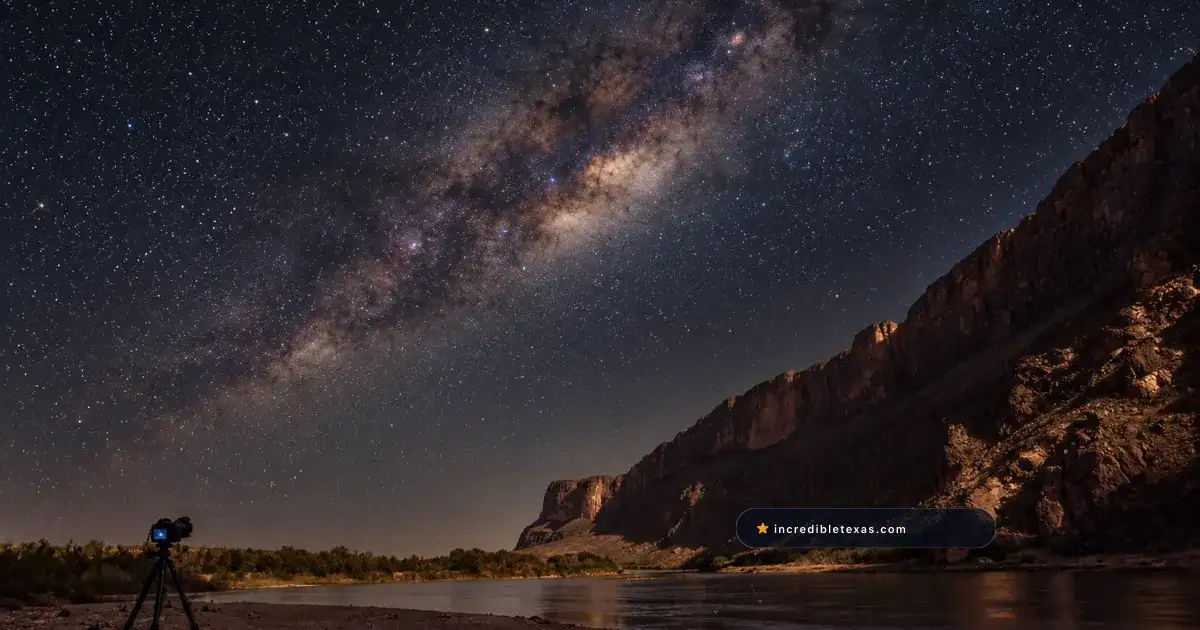
Texas offers some of the finest dark skies in North America, spanning millions of acres where city lights never intrude. From the rugged volcanic peaks of the Trans-Pecos to remote juniper breaks in the Red River Valley, landscape photographers can capture extraordinary starry horizons.
Learning how to master texas milky way photography requires understanding celestial timing, proper exposure math, and state park access rules. With wide-open public lands and certified dark-sky sanctuaries, the Lone Star State provides an ideal canvas for texas astrophotography milky way projects.
Key takeaways
- Milky Way photography season in Texas runs from March through October, peaking during summer when the galactic core stays above the southern horizon for hours.
- Bortle Class 1 and 2 locations like Big Bend National Park and Copper Breaks State Park offer pure black skies without light pollution.
- Recommended camera settings include a wide aperture (f/1.4 to f/2.8), ISO 1600 to 6400, and a shutter speed calculated using the 500 Rule to prevent star trails.
- Shooting during the 10-day new moon window ensures moonless skies between evening astronomical twilight and morning astronomical dawn.
- Texas state parks enforce night gate closures; photographers must reserve camping permits or advance day passes to remain on park grounds after dark.
Plan your visit
Verified
- Location
- West Texas, Hill Country & North Texas Dark Sky Parks
- Hours
- Day use closes 10:00 PM; overnight camping allows all-night shooting
- Admission
- $3 to $12 day passes; standard camping fees apply
- Best time to go
- March through October, New Moon window
When to Photograph the Milky Way in Texas: Seasonal Calendar and Moon Phases
The official milky way season texas photographers look forward to runs from March through October, when the bright galactic core rises above the southern horizon. Early spring requires pre-dawn shooting around 3:00 AM, while midsummer offers prime viewing directly after nightfall from 10:30 PM onward.
Scheduling photo sessions requires aligning the astronomical calendar with clear weather patterns. According to observational data from the University of Texas McDonald Observatory Visitors Portal, regional atmospheric transparency peaks when dry high-pressure systems settle over West Texas. If you want to pair camera outings with public telescope sessions, explore our McDonald Observatory Star Party tickets guide for summit schedules and seasonal program hours.
The Galactic Core Season (March Through October)
The galactic core is invisible from November through February because it sits behind the Sun relative to Earth’s orbital position. It emerges in March as a low horizontal arc in the southeast before dawn and rotates to a dramatic vertical pillar by August and September.
During April and May, the core rises between 1:00 AM and 3:00 AM, providing dramatic panoramic compositions arching across the eastern horizon. By July and August, the core becomes visible as soon as astronomical twilight ends, remaining high in the southwestern sky until midnight.
Late season shooting in September and October provides vertical core alignments right after sunset. These autumn evenings offer comfortable temperatures and low desert humidity, making long camera sessions pleasant before winter arrives.
The New Moon Window and Hourly Timing
Plan photo trips during the 10-day window centered on the monthly new moon, starting five days before and ending four days after. This window guarantees that bright moonlight will not wash out faint nebulae and dust lanes in long-exposure captures.
Even a quarter moon creates substantial atmospheric scatter that dims faint star clusters. Photographers track moonrise and moonset tables to ensure they shoot during true astronomical darkness, when the Sun is at least 18 degrees below the horizon.
Summer twilight lasts longer in Texas than winter darkness, meaning astronomical night does not begin until nearly 10:30 PM in June. Pre-planning your shoot schedule ensures you do not waste battery power shooting while residual sunlight lingers in the upper atmosphere.
Top Texas Dark Sky Locations for Astrophotography
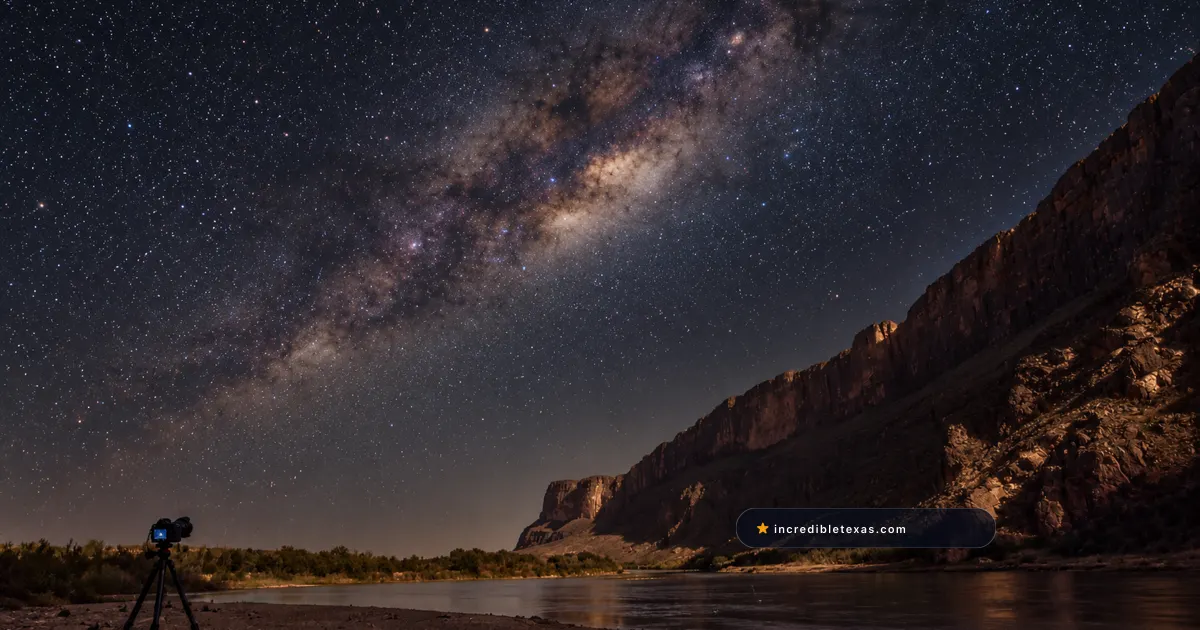
The best places for astrophotography in texas include Big Bend National Park and Big Bend Ranch State Park (Bortle 1), Copper Breaks State Park (Bortle 2), and Enchanted Rock State Natural Area (Bortle 3). These public lands provide low horizons and dark skies.
Selecting the right park depends on your driving distance and preferred foreground elements. For an overview of the world’s largest certified dark sky territory spanning West Texas, review our Greater Big Bend Dark Sky Reserve guide.
Big Bend Region: Bortle 1 Canyons and Desert Peaks
The Big Bend region holds certified Bortle Class 1 night skies, offering some of the purest celestial darkness in North America. On the official bortle scale texas wilderness parks, Class 1 represents pitch-black skies free of urban glow, making big bend astrophotography a bucket-list journey for landscape photographers.
As documented in the National Park Service Big Bend Night Skies Directory, calibrated light meters regularly record darkness readings above 21.8 magnitudes per square arcsecond. Under these unpolluted conditions, the Milky Way casts diffuse shadows across the desert floor, allowing photographers to capture rich detail in the dark dust rifts.
High elevation viewpoints like the Chisos Basin provide cooler summer shooting conditions than the desert river corridor. The combination of dramatic volcanic pinnacles and pitch-black skies produces award-winning compositions.
Copper Breaks State Park: Northern Texas Dark Sky Sanctuary
Located near Quanah in Hardeman County, Copper Breaks State Park is an official International Dark Sky Park featuring Bortle Class 2 skies. Planning a weekend of copper breaks state park astrophotography gives shooters access to rugged juniper breaks and still lake reflections under deeply dark skies.
As documented on the Texas Parks and Wildlife Copper Breaks Portal, the park protects rural night skies from regional municipal growth. Big Break Trail and the shores of Big Pond provide stable, flat terrain for setting up tripods without disturbing wildlife.
Because Copper Breaks sits hundreds of miles from Dallas and Oklahoma City, its southern horizon remains exceptionally clear. Photographers based in North Texas can reach the park in under four hours, avoiding long drives to Far West Texas.
Hill Country Sanctuaries: Enchanted Rock and South Llano River
Enchanted Rock State Natural Area and South Llano River State Park offer Bortle Class 3 night skies within two to three hours of Austin and San Antonio. Capturing an enchanted rock milky way photograph involves framing the arching galactic arm directly above the massive pink granite dome.
While slight light domes from Fredericksburg and Kerrville appear low on the distant horizon, the zenith remains dark enough to reveal the galactic core clearly. South Llano River in Junction offers riverside pecan groves and dark southern views that make excellent night scenery.
These Central Texas parks provide convenient weekend getaways for city residents testing new camera equipment. Advance planning is necessary because both parks frequently reach capacity during spring and autumn weekends.
| Dark Sky Location | Managing Agency | Bortle Class | Primary Foreground Feature | Travel Distance |
|---|---|---|---|---|
| Big Bend National Park | National Park Service | Bortle 1 | Limestone canyons and desert peaks | 8 hours west of San Antonio |
| Big Bend Ranch State Park | Texas Parks and Wildlife | Bortle 1 | Volcanic ridges and Rio Grande bluffs | 8.5 hours west of San Antonio |
| Copper Breaks State Park | Texas Parks and Wildlife | Bortle 2 | Red shale breaks and small lakes | 3.5 hours northwest of Fort Worth |
| South Llano River State Park | Texas Parks and Wildlife | Bortle 3 | Riverbanks and pecan groves | 2 hours west of San Antonio |
| Enchanted Rock Natural Area | Texas Parks and Wildlife | Bortle 3 | Massive pink granite batholith | 1.5 hours west of Austin |
Camera Settings and Gear Setup for Star Photography
Mastering milky way camera settings texas photographers use requires balancing light collection against sensor noise and star trailing. Setting your camera to manual mode ensures consistent exposures throughout the night.
Using a sturdy tripod, a fast wide-angle lens, and a remote shutter cable prevents camera shake during long exposures. For detailed campground advice when packing heavy camera gear, consult our Big Bend National Park camping and trails guide.
Exposure Triangle: Shutter Speed, Aperture, and ISO
Start by setting your lens aperture to its widest opening, typically f/1.8 or f/2.8, to collect the maximum amount of starlight. Keep the aperture wide open to ensure your camera sensor receives enough photons to register faint interstellar dust clouds.
Next, set your ISO between 3200 and 6400 depending on your camera sensor’s low-light noise performance. Modern full-frame sensors handle ISO 3200 with minimal grain, while crop-sensor bodies perform better around ISO 1600 to ISO 3200.
Finally, adjust your shutter speed between 15 and 25 seconds based on your lens focal length. Test exposures will reveal whether the foreground is sufficiently illuminated or requires a subtle boost in exposure time.
The 500 Rule and Preventing Star Trails
Due to Earth’s continuous rotation, pinpoint stars begin to streak into visible trails if your shutter remains open too long. The 500 Rule provides a quick calculation for the maximum exposure time before star trailing occurs: divide 500 by your effective focal length.
For example, using a 20mm lens on a full-frame camera yields 500 divided by 20, which equals 25 seconds of safe exposure time. If you use a crop-sensor camera with a 1.5x crop factor, multiply the focal length by 1.5 first (20mm multiplied by 1.5 equals 30mm; 500 divided by 30 equals 16.6 seconds).
Many astrophotographers now use the more conservative NPF Rule on high-resolution sensors above 30 megapixels. This formula accounts for pixel pitch, keeping exposures slightly shorter (12 to 18 seconds) for tack-sharp pinpoint stars when viewed at 100 percent crop.
Lens Selection and Manual Focus Techniques
Wide-angle lenses between 14mm and 24mm are ideal for capturing both the sweeping Milky Way arc and dramatic Texas landscape features. Lenses with well-controlled sagittal coma flare ensure that stars in the corners of the frame remain round dots rather than stretched wings.
Autofocus cannot lock onto stars in total darkness, requiring manual focus mode on your lens. Turn on live view on your rear LCD screen, locate a bright star or distant planet like Jupiter, and magnify the image to 10x digital zoom.
Carefully rotate your focus ring until the pinpoint of light is as small and sharp as possible. Once focus is locked, place a strip of gaffer tape over the focus ring to prevent accidental shifts while moving your tripod in the dark.
Texas State Park Rules and Night Photography Etiquette
Texas state parks welcome nature photographers, but visitors must respect park operating hours and conservation rules. Day-use permits expire at 10:00 PM across the state park system, at which point security gates automatically close to incoming and outgoing traffic.
Understanding these rules ensures you enjoy productive photo sessions without receiving citations from park police. Official park guidelines are maintained on the Texas Parks and Wildlife Stargazing in State Parks Portal, providing regional event schedules and darkness conservation projects.
Day Pass Reservations and Gate Closure Policies
To remain inside a Texas state park after 10:00 PM, photographers must reserve an overnight campsite. Even if you do not sleep in a tent, holding a valid camping reservation gives you legal authorization to occupy park grounds throughout the night.
Day-use visitors who stay past closing time risk getting locked inside the park or receiving fines from park rangers. Reserving a campsite in advance also provides parking near trailheads and access to restrooms and clean water during long shooting sessions.
Photographers visiting popular Hill Country destinations should review our Enchanted Rock night sky guide for summit curfew specifics and trail closing rules. Reserving day passes up to 30 days ahead ensures access during peak new-moon weekends.
Red-Light Protocol and Light Painting Restrictions
Preserving night-adjusted vision is essential for safe navigation and courtesy toward fellow stargazers. Always use red LED headlamps when adjusting camera settings, checking gear bags, or walking along park trails.
White flashlights and phone screens reset night vision adaptation and ruin long exposures for anyone photographing in the immediate vicinity. Point your headlamp toward the ground rather than at fellow visitors when speaking or moving past other photo setups.
Light painting natural landmarks with high-powered spotlights is restricted or prohibited in many state parks to prevent disturbing roosting birds and nocturnal desert wildlife. Use low-level ambient lighting sparingly, or capture separate foreground exposures during blue hour twilight and blend them in post-processing.
Frequently Asked Questions
When can you see the Milky Way in Texas?
The core of the Milky Way is visible in Texas from March through October. It appears in the southeastern sky before dawn in early spring and transitions to the southwestern sky during evening hours by late summer.
Where is the best place to photograph the Milky Way in Texas?
Big Bend National Park and Big Bend Ranch State Park offer the clearest Bortle Class 1 night skies in Texas. Copper Breaks State Park in North Texas and Enchanted Rock in the Hill Country are also top dark-sky photography destinations.
What camera settings do I need for Milky Way photography in Texas?
Use manual mode with an aperture of f/1.4 to f/2.8, ISO between 1600 and 6400, and a 15 to 25-second shutter speed. Focus manually on a bright celestial object using magnified live view before starting your exposure sequence.
Do Texas state parks allow night photography after gate closing?
Texas state parks close day-use areas at 10:00 PM, and automatic security gates close at that time. Photographers who book overnight campsites can photograph throughout the night within park boundaries.
What is the 500 Rule in astrophotography?
The 500 Rule calculates the longest shutter speed you can use before pinpoint stars begin to streak due to Earth’s rotation. Divide 500 by your camera lens focal length and crop factor to determine the exposure threshold in seconds.