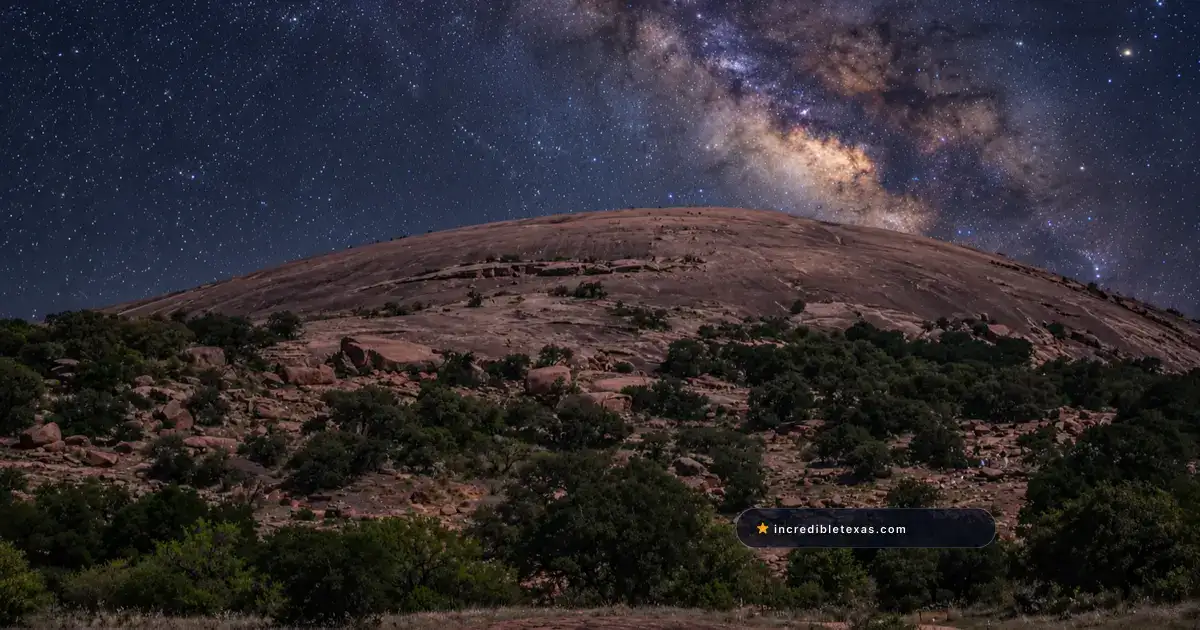
Enchanted Rock State Natural Area provides some of the purest celestial observation conditions anywhere in the Texas Hill Country. Rising dramatically above the Llano Uplift, this colossal pink granite batholith anchors an internationally certified dark-sky environment where thousands of stars illuminate the wilderness.
Experiencing an evening of enchanted rock stargazing requires understanding specific park curfews, trail access rules, and night equipment mandates. The park enforces strict preservation protocols to protect fragile nocturnal wildlife habitats and human night vision.
Key takeaways
- Enchanted Rock State Natural Area is an internationally recognized Gold-Tier Dark Sky Park renowned for clear Milky Way viewing.
- The 0.8-mile Summit Trail closes 30 minutes after sunset for visitor safety, while the Loop Trail and picnic grounds stay open until 10:00 PM.
- Day visitors must hold an advance TPWD reservation and exit by 10:00 PM; overnight campers enjoy 24-hour night sky access.
- Strict park rules require red-filtered flashlights only; white lights, phone screens, and camera flashes are prohibited on trails.
- The southern curve of the Loop Trail and open clearings near Moss Lake offer the best vantage points for Milky Way photography against the granite dome.
Plan your visit
Verified
- Location
- 16710 Ranch Road 965, Fredericksburg, TX 78624
- Hours
- Daily 6:30am to 10pm (day-use); 24 hours for campers
- Admission
- $8 adults, free for children 12 and under
- Best time to go
- New moon weekends, April to September
Enchanted Rock Stargazing Rules: Night Access, Curfews, and Regulations
Enchanted Rock stargazing rules require day visitors to hold an advance online permit and exit the park by 10:00 PM. The Summit Trail closes 30 minutes after sunset for hiker safety, but stargazers can access the Loop Trail and open picnic clearings throughout the evening.
Planning ahead prevents misunderstandings at the check-in station along Ranch Road 965. Understanding the difference between daytime summit exploration and nighttime access ensures a safe outing, as detailed in our comprehensive Enchanted Rock State Natural Area guide.
Summit Trail Night Closures and Safety Regulations
Park rangers close the steep, 425-foot granite Summit Trail 30 minutes after sunset to prevent falls on unlit, sloping rock faces. Hikers may only access the dome summit after dark during authorized, ranger-guided night sky programs.
Venturing onto the enchanted rock summit trail after dark without a guide is strictly prohibited by park police. The smooth granite surface lacks handrails or trail lights, making descending in darkness hazardous for casual walkers.
The Loop Trail and Permitted Evening Viewing Grounds
The lower Loop Trail and designated day-use picnic grounds remain accessible to stargazers until 10:00 PM. These lower elevation routes provide stable footing and wide, open vistas of constellations rising over the massive granite batholith.
Park guests can set up blankets and reclining camp chairs in open clearings near Sandy Creek. As documented in the Texas Parks and Wildlife Enchanted Rock Trail Guide, these designated areas keep observers away from sensitive plant communities while providing broad panoramic views.
Day-Use Passes vs. Overnight Camping for Stargazers
Day-use passes grant access until the main gates close at 10:00 PM, which provides ample time for twilight astronomy during winter and autumn months. Reserving a walk-in tent site or primitive backpacking spot provides 24-hour access for late-night summer Milky Way observation.
Because the park is situated only 18 miles north of town, many visitors combine daytime vineyard tours and things to do in Fredericksburg with an evening stargazing session. However, knowing exact gate cutoffs ensures you do not get locked out.
Day-Pass Reservation System and 10:00 PM Exit Curfew
Day passes cost $8 per adult and must be reserved up to 30 days ahead through Texas Parks and Wildlife online reservation system. Visitors without an overnight camping permit must leave through the automated exit gates promptly at 10:00 PM.
Checking enchanted rock gate hours stargazing guidelines prevents accidental curfew violations. Knowing official enchanted rock night hours helps visitors time their arrival before sunset. All day visitors must wrap up their equipment and head toward the exit by 9:45 PM to allow staff to secure perimeter gates.
Walk-In Campsites and Primitive Backpacking for All-Night Access
Enchanted Rock features 35 walk-in tent sites with water hookups and 20 primitive backpacking sites scattered throughout the backcountry. Overnight campers can step directly outside their tents at 3:00 AM to photograph the galactic core under complete silence.
Securing enchanted rock camping reservations requires booking months ahead, especially for spring and autumn new moon weekends. Check the Texas State Parks Enchanted Rock Campsites Directory to evaluate campground amenities and reserve primitive sites.
Best Milky Way Photography and Stargazing Vantage Points
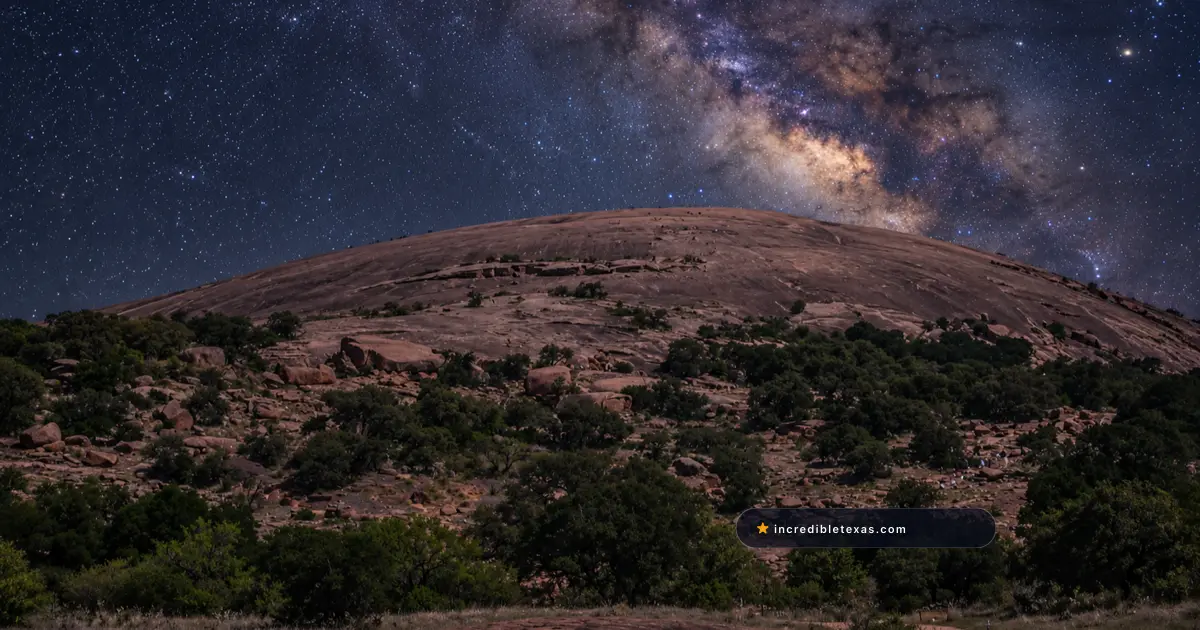
The southern curve of the Loop Trail and open granite flats near Moss Lake offer the most dramatic photographic angles. These positions place the silhouette of the 425-foot granite dome against the glowing southern arc of the Milky Way.
Enchanted Rock covers 1,684 protected acres where calibrated Sky Quality Meters register readings above 21.6 magnitudes per square arcsecond, designating it as a Gold-Tier International Dark Sky Park. This exceptional clarity ensures that faint celestial structures remain visible across wide-angle camera exposures.
The Base of the Granite Dome Along the Loop Trail
Setting up tripods on flat granite ledges along the south Loop Trail provides a sweeping southern panorama. The massive curved silhouette of the batholith creates an iconic foreground element under starry skies.
During late spring and summer, the dense galactic center rises directly behind the main dome. Photographers capturing enchanted rock milky way panoramas use low-level lighting sparingly on the granite foreground to balance sky exposures. If you are comparing riverside observation points, check our Blanco State Park stargazing guide.
Moss Lake and Backcountry Water Reflections
Moss Lake sits on the northern flank of Enchanted Rock, providing calm water surfaces that reflect stars on windless nights. Ephemeral vernal pools on lower granite shelves also offer mirror-like foreground reflections of passing celestial bodies.
Backpackers camping near Walnut Springs or Moss Lake experience unmatched solitude. The stillness of the backcountry allows observers to track shooting stars and faint satellites passing silently through the zenith.
| Viewing Location | Trail Access | Sky Direction | Best Photography Subject |
|---|---|---|---|
| South Loop Trail | 0.3 miles from parking | South / Southeast | Granite dome silhouette against Milky Way |
| Moss Lake Shore | 1.8 miles via Loop Trail | South / Zenith | Calm water star reflections and northern stars |
| Sandy Creek Clearing | 0.2 miles from parking | East / South | Wide-field constellation sweeping with binoculars |
| Base Camp Loop | Steps from campsites | Zenith | Convenient family observing near tent pads |
Essential Dark-Sky Gear and Red-Light Protocols
Park regulations strictly mandate red-light flashlights and headlamps across all trails and viewing areas after twilight. Visitors should bring heavy jackets, sturdy hiking boots, and binoculars while leaving white flashlights and laser pointers behind.
Familiarizing yourself with enchanted rock red flashlight rules ensures you do not inadvertently disturb fellow astronomers. Preparing proper optical gear before departing home makes your night session significantly more rewarding.
Strict Red-Light Enforcement and Night-Vision Preservation
Using white lights or phone screens is strictly discouraged because human night-adapted vision requires 30 minutes to develop. Red light preserves chemical rhodopsin in the retina, ensuring visitors maintain sharp night vision across the park.
Park rangers will ask visitors to extinguish white flashlights immediately. If you need to prepare for extreme desert darkness or high-altitude programs, consult our McDonald Observatory Star Party ticket guide for professional astronomy gear tips.
Recommended Stargazing Equipment Checklist
Essential gear includes a 50-lumen red LED headlamp, 7x50 wide-angle binoculars, a reclining camp chair, and wind-resistant outerwear. Astrophotographers require a heavy-duty tripod with rubber feet that grip granite surfaces firmly without slipping.
Granite surfaces cool rapidly after sunset, creating cold drafts that drain camera batteries. Keep spare batteries warm in an interior jacket pocket to prevent sudden power loss during long-exposure sequences.
Public Star Parties, Astronomy Programs, and Best Viewing Months
Texas Parks and Wildlife hosts seasonal astronomy star parties with volunteer astronomers who provide public telescope viewing in the day-use area. May through September delivers the brightest views of the Milky Way core, while dry winter months offer the clearest atmospheric transparency.
Attending an organized event at this enchanted rock dark sky park connects visitors with experienced observers. These sessions provide an educational introduction to astronomy before exploring other things to do in Blanco County and the surrounding Hill Country.
Ranger-Led Night Hikes and Astronomy Programs
Rangers regularly guide nighttime educational hikes that focus on nocturnal desert ecology, bat navigation, and constellation storytelling. Attending an official park star party gives visitors access to high-power tracking telescopes operated by astronomical societies.
Reviewing the official enchanted rock star party schedule via the Texas Parks and Wildlife Enchanted Rock Portal allows you to align your visit with public programs. Joining an organized enchanted rock night hike is also the only authorized way to stand atop the summit dome after dark.
Seasonal Moon Phases and Astronomical Calendars
Scheduling trips within four days of the new moon guarantees completely dark skies free from lunar washout. Winter offers crisp, low-humidity viewing of the Orion Nebula, while summer features the dense galactic center rising across the southern horizon.
Comparing different hill country dark sky parks helps travelers assemble multi-day astronomy road trips. Planning around moon calendars ensures you experience the full astronomical majesty of the Texas night.
Frequently Asked Questions
Can you hike Enchanted Rock at night for stargazing?
Visitors may hike the lower Loop Trail and explore day-use picnic areas until the park closes at 10:00 PM. The steep Summit Trail closes 30 minutes after sunset for safety, except during ranger-led night hikes.
What are the stargazing rules at Enchanted Rock State Natural Area?
Stargazers must use red-light flashlights exclusively, stay on designated open trails, and obey the 10:00 PM gate closing time. White lights, camera flashes, and off-trail scrambling on granite slopes are strictly prohibited after dark.
Do you need reservations to stargaze at Enchanted Rock?
Advance online day pass reservations are required through Texas Parks and Wildlife to guarantee park entry. Day passes allow access until 10:00 PM, while overnight stargazing past 10:00 PM requires a campsite reservation.
What time does Enchanted Rock close for stargazers?
The park entrance gates close at 10:00 PM for all day-use visitors holding standard day passes. Registered campers staying in walk-in or primitive campsites enjoy 24-hour access to the night skies.
Is Enchanted Rock a certified Dark Sky Park?
Enchanted Rock State Natural Area is a certified Gold-Tier International Dark Sky Park designated by DarkSky International in 2014. The park preserves rural Hill Country darkness through shielded lighting and ongoing public astronomy education.