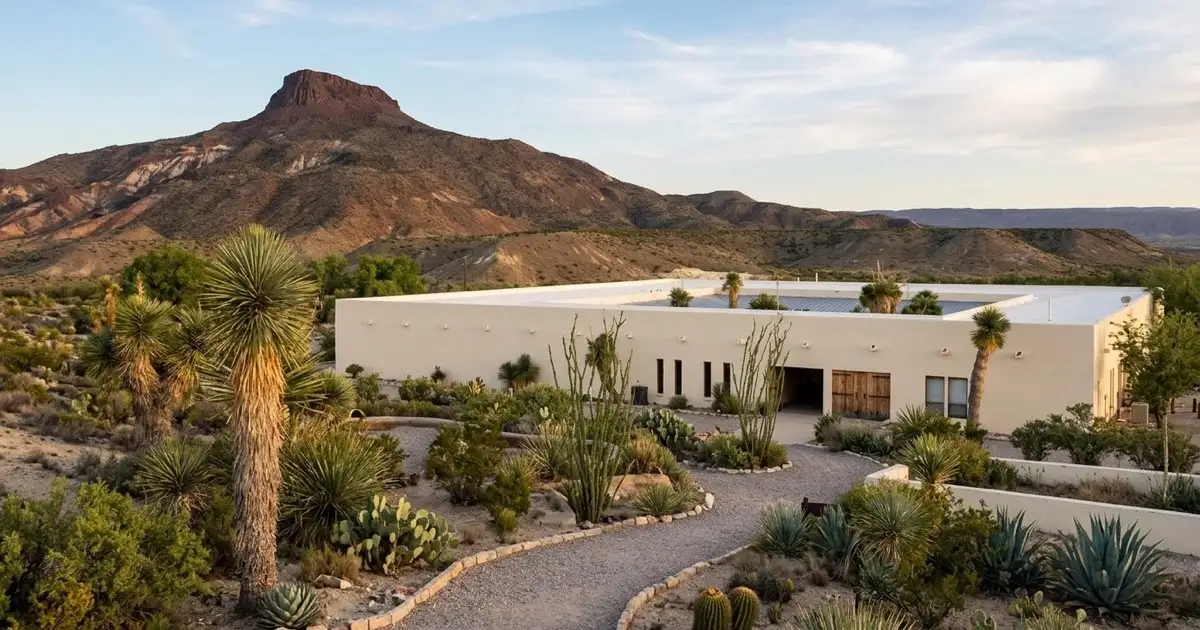
Barton Warnock Visitor Center is the eastern entrance and permit hub for Big Bend Ranch State Park along FM 170 near Lajitas, Texas. Open daily from 8:00 AM to 4:30 PM, the station charges $5 per adult (kids 12 and under free) and pairs bilingual desert exhibits with a two-acre botanical garden.
Many trip-planning sites mistakenly describe this facility as a standalone “Barton Warnock State Park” with on-site cabins and $10 campgrounds. In reality, zero campsites or cabins sit on the visitor center grounds, making this stop your staging desk for River Corridor permits, trail maps, potable water, and desert orientation.
Key takeaways
- Barton Warnock Visitor Center sits 1.5 miles east of Lajitas on FM 170 and operates as the eastern gateway to 311,000-acre Big Bend Ranch State Park.
- Daily admission costs $5 for ages 13 and older ($0 with a Texas State Parks Pass), covering access to the exhibits, desert garden, and River Road trailheads.
- Rangers at Barton Warnock issue River District camping check-ins, river-use permits, and walk-up backcountry permits that cannot be booked online.
- No campsites or cabins exist on the visitor center property; primitive River District sites along FM 170 cost $12 nightly, and the interior Sauceda Bunkhouse is currently closed for wastewater repairs.
- Dogs on a 6-foot leash may walk the outdoor botanical garden and only two state park trails along FM 170: Closed Canyon Trail and Hoodoos Trail.
Plan your visit
Verified
- Location
- 21800 FM 170, Terlingua, TX 79852 (1.5 mi E of Lajitas)
- Hours
- Daily 8:00 AM to 4:30 PM
- Admission
- $5 ages 13+, kids 12 and under free, $70 annual pass
- Best time to go
- October through April for 50°F to 85°F daytime hikes
Hours, Admission Fees, and Permit Desk Basics
Barton Warnock Visitor Center operates daily from 8:00 AM to 4:30 PM with a $5 daily entrance fee for visitors 13 and older, free admission for children 12 and under, and full check-in service for Big Bend Ranch State Park permits. Confirm current alerts on the official Texas Parks and Wildlife Barton Warnock Visitor Center page before leaving paved towns with cell coverage.
Operating Hours and Day-Use Admission Rates
Staff unlock the visitor center lobby and bookstore at 8:00 AM and close the doors at 4:30 PM every day of the week. Because the two-acre garden wraps around the building courtyard, plan your stop before 4:00 PM if you need ranger advice, paper maps, or in-person permit verification.
Your $5 daily entry fee applies to Big Bend Ranch State Park as a whole rather than just the museum building. Once you pay at the desk, rangers issue a vehicle dashboard permit that covers your same-day stops at roadside pullouts and canyon trailheads along our FM 170 River Road driving guide.
| Fee or Pass Type | Current Rate | Coverage and Key Rules |
|---|---|---|
| Adult Daily Entry (13+) | $5 per day | Covers visitor center, garden, and same-day River Corridor trailheads |
| Child Daily Entry (12 and under) | Free | No day-use charge; still requires vehicle count at check-in |
| Texas State Parks Pass | $70 per year | Covers entry for cardholder and vehicle passengers at 80+ parks |
| Texas Parklands Passport | Free or 50% off | Free for qualifying military/veterans; 50% off for TX seniors 65+ |
| Primitive Drive-In Campsite | $12 per night | Charged in addition to the $5 daily adult entrance fee |
Holders of the $70 annual pass enter free with everyone riding in the same passenger vehicle and receive discounts on park store merchandise. Review eligibility details on the TPWD Barton Warnock entrance fee schedule if you plan to visit multiple West Texas parks on one trip.
Picking Up River District, Interior, and Backcountry Permits
Big Bend Ranch State Park divides overnight and day-use management into two separate zones: the River District along FM 170 and the Interior District centered around Sauceda. Even if you reserve a River District day pass or primitive campsite online through the Texas State Parks portal, stopping at Barton Warnock ensures you hold the proper dashboard hangtag and current road warnings.
Backcountry camping permits work differently from drive-in sites because travelers cannot reserve them online in advance. You must stop at Barton Warnock Visitor Center (or Fort Leaton on the western end) upon arrival to pick up walk-up backcountry permits, verify water cache realities, and confirm river-use rules for Rio Grande paddling trips.
Important
If you arrive after 4:30 PM along FM 170, self-pay iron ranger stations at major River Corridor trailheads and roadside camps let you deposit cash fees after hours. However, backcountry hikers and rafters needing specialized permits or topographic maps must check in while the desk is staffed.
Park Store, Topographic Maps, and Junior Ranger Gear
Inside the lobby, the park store sells detailed waterproof trail maps, Chihuahuan Desert plant field guides, postcards, cold drinks, and Texas state park apparel. Buying the large-scale Big Bend Ranch topographic map at the counter is worth the modest expense because park trails rely on rock cairns rather than wooden signposts.
Families traveling with school-age kids can ask rangers for a free Junior Ranger Activity Journal and borrow a Junior Ranger Explorer Pack loaded with binoculars, magnifying lenses, and wildlife guides. Teachers and youth groups also use the grounds as a certified Texas Aquatic Science field site, though group ranger tours require at least two weeks of advance notice.
Inside the Exhibits, Bookstore, and Two-Acre Desert Botanical Garden
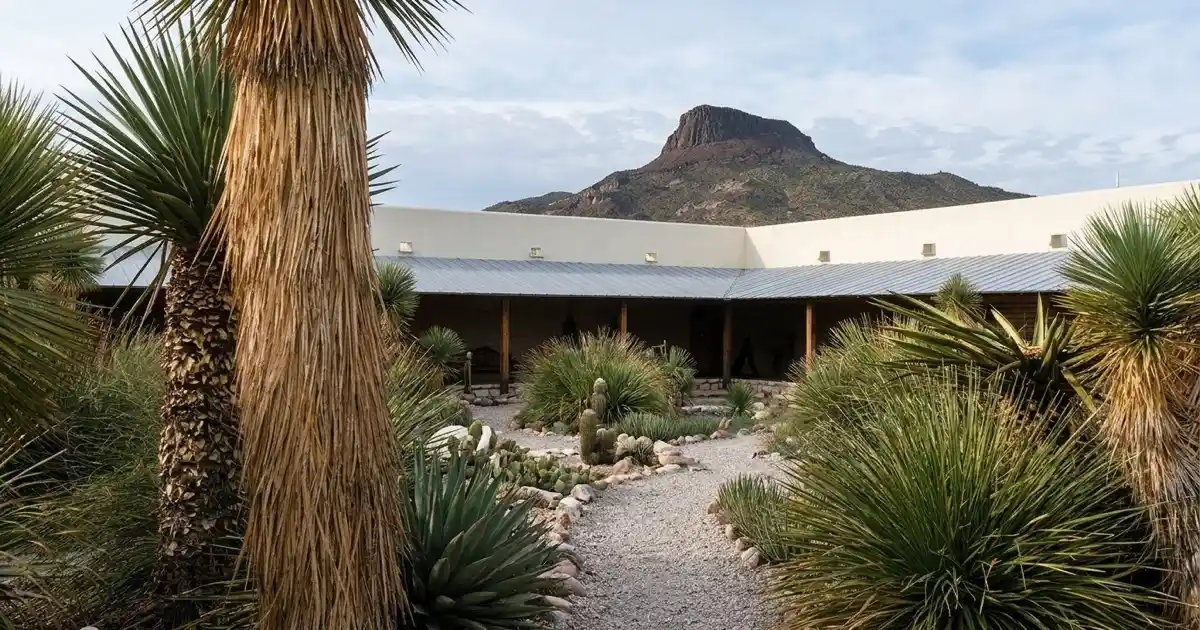
Inside the adobe-style visitor center, the bilingual “Una Tierra: One Land” exhibit traces 570 million years of Big Bend geology and human history, while the two-acre outdoor botanical garden displays native Chihuahuan Desert cacti, agaves, and shrubs. Touring both the air-conditioned gallery and the gravel garden loop takes roughly 45 to 60 minutes before you head deeper into Big Bend Ranch State Park trail and river activities.
The Una Tierra: One Land Exhibit Hall
The main gallery centers on the “Una Tierra: One Land” exhibition, presented in both English and Spanish across wall murals, tactile rock specimens, and dioramas. Exhibits walk visitors through five distinct biological landscapes of the Big Bend country, showing how elevation, sparse rainfall, and volcanic soils divide desert scrub from canyon springs.
Displays also highlight prehistoric rock art, Apache and Comanche presence, frontier mercury mining, and the working cattle ranching era that preceded state acquisition. Because the rooms stay cool year-round, the gallery doubles as a welcome midday break when desert afternoons turn scorching outside.
Walking the Two-Acre Chihuahuan Desert Botanical Garden
Stepping out the back courtyard puts you directly onto a crushed-gravel loop winding through two acres of curated Trans-Pecos flora. Small identification markers sit beside sotol, lechuguilla agave, candelilla, ocotillo, creosote bush, prickly pear, and tall Torrey yuccas framed against dark volcanic mesas.
Walking this short outdoor trail lets you learn which plants carry toxic sap, razor-sharp spines, or medicinal frontier uses before brushing past them on narrow canyon singletrack. Early morning light brings out scaled quail, roadrunners, and black-throated sparrows foraging under the mesquite canopy.
Note
According to the TPWD Barton Warnock historical overview, staff based at this visitor center manage roughly 56,000 acres along the Rio Grande River Corridor while introducing visitors to 570 million years of regional geology.
Dr. Barton H. Warnock and the 1982 Lajitas Museum Origins
The facility did not start as a state park headquarters. In 1982, the Lajitas Foundation built the stucco courtyard complex as the Lajitas Museum Desert Gardens, enlisting West Texas botanist Dr. Barton Holland Warnock (1911 to 1998) to curate native specimen beds around the grounds.
Dr. Warnock taught biology for three decades at Sul Ross State University in Alpine, collecting tens of thousands of regional specimens and authoring foundational wildflower guides for the Big Bend and Guadalupe Mountains. When the Texas Parks and Wildlife Department purchased the roughly 99.9-acre property in October 1990, the agency renamed the center in his honor and designated it the eastern entrance to Big Bend Ranch State Park.
Barton Warnock vs. Fort Leaton, Sauceda, and Big Bend National Park
Barton Warnock functions as the eastern highway gateway to Big Bend Ranch State Park near Lajitas, whereas Fort Leaton guards the western Presidio entrance and Sauceda Ranger Station sits 27 miles down an unpaved interior road. Choosing the wrong checkpoint wastes hours of desert driving on rough gravel or winding canyon asphalt.
Three Big Bend Ranch State Park Hubs Compared
Most first-time visitors arriving from Terlingua, Alpine, or Big Bend National Park start at Barton Warnock because it sits directly on paved FM 170 just east of Lajitas. Travelers coming south from Marfa through Presidio pass Fort Leaton State Historic Site instead, touring a 19th-century adobe trading post before picking up western river permits.
| Park Facility | Geographic Position | Road Access and Vehicle Needs | Best Reason to Stop |
|---|---|---|---|
| Barton Warnock Visitor Center | East Entrance (1.5 mi E of Lajitas) | Paved FM 170; any standard 2WD car | Bilingual exhibits, 2-acre desert garden, River District permits |
| Fort Leaton State Historic Site | West Entrance (4 mi SE of Presidio) | Paved FM 170; any standard 2WD car | Historic adobe fort museum, western River Road check-in |
| Sauceda Ranger Station | Remote Park Interior | 27 miles unpaved dirt road off FM 170; high clearance advised | Deep backcountry trailheads, mountain biking, interior camps |
If you want remote canyon trails, natural springs, and 238 miles of multiuse tracks inside the park core, check the official TPWD Big Bend Ranch State Park overview before attempting the 27-mile Sauceda Ranch Road. Standard passenger sedans risk sidewall punctures on sharp volcanic rock along that unmaintained interior approach, and motorhomes or trailers are strongly discouraged.
Big Bend Ranch State Park vs. Big Bend National Park
Despite sharing a boundary near Lajitas and Study Butte, Big Bend Ranch State Park and its federal neighbor deliver completely different logistics. Check the National Park Service Big Bend National Park portal if your itinerary splits days between state and federal lands.
Big Bend National Park covers more than 801,000 acres with paved scenic drives, a lodge, restaurants, camp stores, and crowded winter trailheads in the Chisos Basin. By contrast, 311,000-acre Big Bend Ranch State Park emphasizes solitude, volcanic badlands, and self-sufficient travel, and our Big Bend National Park planning guide helps you pair both parks without duplicating drives.
Camping, Bunkhouse Status, and Lodging Near Lajitas
Barton Warnock Visitor Center has zero campsites and zero cabins on its immediate property; overnight guests must book $12 primitive River District sites along FM 170 or stay outside park boundaries in Lajitas or Terlingua. Double-checking which Texas State Parks reservation page you select avoids showing up with the wrong permit.
River District and Interior Primitive Campsites
If you want to camp under International Dark Sky Park skies near the Rio Grande without leaving paved road access, book a River District primitive site. In the Texas State Parks reservation portal, these FM 170 sites appear under “Barton Warnock Visitor Center” rather than the main Big Bend Ranch listing, which confuses many travelers.
Every River District campsite costs $12 per night plus the $5 daily adult entrance fee and holds up to eight people. Expect gravel pads, a picnic table, and a fire ring, with zero electrical hookups, zero RV dump stations, and no reliable water spigots at individual sites, as detailed on the Big Bend Ranch State Park primitive campsite rates page.
Sauceda Bunkhouse Closure Alert and Interior Lodging Reality
Outdated travel blogs frequently advertise “cozy air-conditioned cabins at Barton Warnock” with kitchenettes and private porches. No cabins exist at the visitor center, and the state park’s sole indoor lodging is the Sauceda Bunkhouse located roughly two hours deep inside the park interior.
Warning
Active Lodging Closure: According to the TPWD Sauceda Bunkhouse lodging alert, the $35-per-person Sauceda Bunkhouse remains closed due to ongoing wastewater repairs. Call the park directly at (432) 424-3327 before assuming any interior indoor beds are open.
Even when operational, the bunkhouse offers shared single-bed dormitory rooms without provided linens or pets, making it very different from traditional state park family cabins. Travelers seeking air conditioning, hot showers, and private walls should book commercial lodging just outside the park boundary.
Lajitas vs. Terlingua Cabins, Resorts, and RV Parks
Two neighboring desert communities sit minutes from the Barton Warnock parking lot and serve different travel budgets. Lajitas lies 1.5 miles west and centers on Lajitas Golf Resort, a sprawling frontier-style property featuring hotel rooms, resort pools, golf, dining, and the Maverick Ranch RV Park with full hookups.
About 11 miles east along FM 170, Terlingua and Study Butte offer rustic stone ruins converted into boutique rentals, desert casitas, glamping domes, independent motels, and lively evening gathering spots. Explore our Terlingua Ghost Town dining and lodging tips to compare porch restaurants like the Starlight Theatre against quieter stays in Lajitas.
Nearby River Corridor Trails and Pet Policy Rules
While Barton Warnock offers a short self-guided botanical garden loop on site, hikers drive west along FM 170 to access Closed Canyon Trail, Hoodoos Trail, and the 6.4-mile Fresno Divide Trail. Knowing trail distances, slot-canyon hazards, and strict pet boundaries prevents costly turnarounds at trailheads.
Closed Canyon, Hoodoos, and Fresno Divide Trails
The two most popular River Corridor walks sit roughly 22 to 26 miles west of Barton Warnock along paved FM 170, making them effortless half-day pairings after touring the museum. Hoodoos Trail follows an old roadbed for roughly one mile round-trip past eroded volcanic rock towers overlooking the Rio Grande and Mexico.
Four miles farther west, Closed Canyon Trail drops 1.4 miles round-trip into a shaded volcanic slot canyon flanked by towering vertical rock walls. Serious hikers looking for rugged solitude can also tackle the 6.4-mile Fresno Divide Trail through the park’s western badlands.
| Trail Name | Distance From Visitor Center | Round-Trip Length | Dogs Allowed (6-ft Leash) | Primary Trail Hazard |
|---|---|---|---|---|
| Desert Botanical Garden Loop | On-site at Barton Warnock | Under 0.5 miles | Yes (outdoor grounds only) | Unshaded midday sun |
| Hoodoos Trail | Approx. 22 miles west on FM 170 | Approx. 1.0 mile | Yes (FM 170 exception) | Exposed volcanic slope and loose rock |
| Closed Canyon Trail | Approx. 26 miles west on FM 170 | Approx. 1.4 miles | Yes (FM 170 exception) | Severe flash-flood risk in narrow slot walls |
| Fresno Divide Trail | Interior / badlands access | 6.4 miles | No (strictly prohibited) | Zero shade, cairn navigation, remote terrain |
Caution
Flash Flood Danger: Never enter Closed Canyon if rain is falling locally or storms appear anywhere upstream in the Chihuahuan Desert. Slot canyon walls offer zero escape routes, and dry washes flood within minutes during summer monsoon storms.
Dog Leash Rules and Wildlife Restrictions
Big Bend Ranch State Park enforces some of the strictest pet boundaries in Texas to protect desert wildlife and prevent heat injury to dogs. Pets must remain on a physical leash no longer than 6 feet at all times and are banned inside every state park building, including the Barton Warnock exhibit hall and bookstore.
As outlined in the official TPWD Big Bend Ranch dog policy regulations, dogs are allowed only within 1/4 mile of campsites or designated roads and on just two hiking trails in the entire 311,000-acre park: Closed Canyon Trail and Hoodoos Trail. Travelers wanting broader dog-friendly mountain loops on the same West Texas trip often pair a quick stop here with Davis Mountains State Park hiking and mountain trails farther north.
Directions, Restrooms, Water Refill, and Zero-Cell-Service Logistics
Barton Warnock Visitor Center sits at 21800 FM 170 about 1.5 miles east of Lajitas and 11 miles west of Terlingua, providing paved parking, public restrooms, and potable water before cell coverage drops completely. Treating this parking lot as your final infrastructure stop before heading west keeps desert drives trouble-free.
Driving Distances from Lajitas, Terlingua, and Alpine
Every road approaching Barton Warnock Visitor Center from the east is paved two-lane highway suitable for regular sedans, motorcycles, and small campers. Ignore GPS suggestions routing you across remote dirt ranch roads if you are driving a low-clearance passenger car.
| Starting Point | Approximate Distance | Drive Time | Route and Practical Notes |
|---|---|---|---|
| Lajitas Resort Area | 1.5 miles | 2 minutes | Head east on paved FM 170; entrance on north side |
| Terlingua / Study Butte | 11 miles | 15 minutes | Drive west on FM 170; last reliable gas and ice before Presidio |
| Big Bend National Park (Maverick Gate) | 15 miles | 20 minutes | Exit west through Study Butte onto FM 170 |
| Alpine, Texas | 95 miles | 1 hour 40 minutes | Take TX-118 south through Study Butte, then west on FM 170 |
| Presidio / Fort Leaton | 50 miles | 1 hour 15 minutes | Drive east on FM 170 over The Big Hill (15% steep grade) |
Drivers coming south down Highway 118 pass through Study Butte before turning right onto FM 170 toward Lajitas. If you need full grocery aisles, hardware supplies, or affordable fuel before entering the borderlands, stock up at your Alpine Texas basecamp prior to heading south.
On-Site Restrooms, Potable Water, and Offline Map Prep
Barton Warnock offers clean, accessible flush restrooms and potable water spigots right at the visitor center complex. Fill every reusable bottle, hydration bladder, and reserve jug in your trunk here, because potable drinking water disappears once you drive west onto the River Road toward Presidio or north toward Sauceda.
Cell coverage fades rapidly west of Lajitas, leaving most of Big Bend Ranch State Park in a complete wireless dead zone. Before departing Terlingua or Lajitas, download offline Google Maps regions, save screenshots of confirmation codes, and review backcountry advisories shared by Friends of Big Bend Ranch State Park.
Best Time to Visit, Extreme Heat Safety, and Packing
October through April delivers comfortable 50°F to 85°F daytime hiking weather at Barton Warnock, while April through September brings 100°F+ late mornings and exposed sun temperatures reaching 130°F. Timing your trip around desert temperature extremes determines whether you can comfortably explore beyond the air-conditioned exhibits.
Seasonal Temperature Swings and Wildflower Timing
Receiving less than 10 inches of annual rainfall, the Chihuahuan Desert around Lajitas exhibits dramatic daily temperature swings of up to 40 degrees between dawn and mid-afternoon. Winter visitors enjoy crisp 60°F afternoons for hiking and stargazing, yet overnight temperatures routinely drop near freezing in December and January.
Spring brings the busiest crowds alongside desert blooms, particularly ocotillo scarlet blossoms, prickly pear flowers, and yucca stalks following winter moisture. Visit midweek during late October, November, February, or March to enjoy mild daytime weather without peak spring break crowds at Terlingua restaurants and River Road pullouts.
Desert Sun, Hydration, and Footwear Essentials
Big Bend Ranch State Park contains no designated forests and offers virtually no natural trail shade outside narrow slot walls. Between April and September, afternoon air temperatures exceed 100°F by late morning, surface temperatures hit 130°F in direct sun, and heat remains hazardous well past sunset.
Tip
Desert Safety Checklist: Carry at least one gallon of drinking water per person per day, finish all exposed hikes before 11:00 AM during warm months, and wear sturdy closed-toe shoes with ankle support to guard against volcanic scree and jumping cholla spines.
If you are crossing West Texas during hot late-spring or early-fall afternoons and want a cold-water break on the return drive north toward I-10, plan a morning swim reservation at Balmorhea State Park spring-fed desert pool in Toyahvale.
Frequently Asked Questions
What are the Barton Warnock Visitor Center hours and admission fees?
Barton Warnock Visitor Center is open daily from 8:00 AM to 4:30 PM year-round. Daily admission costs $5 per person ages 13 and older, while children 12 and under and Texas State Parks Pass holders enter free.
Are there campsites or cabins on the visitor center grounds?
No campsites or cabins exist on the immediate visitor center property. Travelers book $12 nightly primitive River District campsites along FM 170 through the Barton Warnock reservation page or stay in private resorts and rentals in Lajitas or Terlingua.
What permits can you pick up at the east entrance desk?
Rangers issue Big Bend Ranch State Park day-use passes, River District and Interior District camping check-ins, river-use permits, and walk-up backcountry camping permits. Backcountry permits cannot be reserved online and must be obtained in person upon arrival.
Are dogs allowed at Barton Warnock and nearby trails?
Leashed dogs on a maximum 6-foot leash are welcome in the outdoor two-acre desert botanical garden, but pets cannot enter visitor center buildings. Elsewhere in Big Bend Ranch State Park, dogs are restricted to within 1/4 mile of roads or campsites and only on Closed Canyon Trail and Hoodoos Trail.
Is there potable water, restrooms, and cell service on site?
The facility provides paved parking, clean public restrooms, and potable water for filling bottles before entering the desert. Cellular signal is unreliable to nonexistent along FM 170 west of Lajitas, so visitors should download offline maps in advance.
How far is the station from Lajitas and Terlingua?
Located at 21800 FM 170, the east entrance sits roughly 1.5 miles east of Lajitas (a two-minute drive) and about 11 miles west of Terlingua Ghost Town (a 15-minute drive). Alpine and Big Bend National Park’s Maverick Entrance lie about 95 miles north and 15 miles east, respectively.
What is inside the Barton Warnock exhibits and desert garden?
Inside the building, the bilingual “Una Tierra: One Land” exhibit explores 570 million years of Big Bend geology, archaeology, and desert ecosystems alongside a regional bookstore. Outside, a two-acre botanical garden displays labeled Chihuahuan Desert cacti, agaves, yuccas, and native shrubs.
Planning Your Barton Warnock Stop on a West Texas Loop
Arrive at Barton Warnock Visitor Center right at 8:00 AM if you want ranger trail updates, a paper topographic map, and a shaded morning stroll through the two-acre desert garden before temperatures climb. From there, continue west on FM 170 for Closed Canyon and Hoodoos Trail if you are driving a standard sedan, or book a campsite and high-clearance rig for the rugged interior.
If you want resort beds, golf, and full RV hookups, stay 1.5 miles west in Lajitas; if you prefer live music, porch dining, and eclectic casitas, stay 11 miles east in Terlingua. On multi-day Trans-Pecos road trips returning north via Presidio and Highway 67, you can easily wrap your state park loop into a Marfa Texas weekend art and desert itinerary.