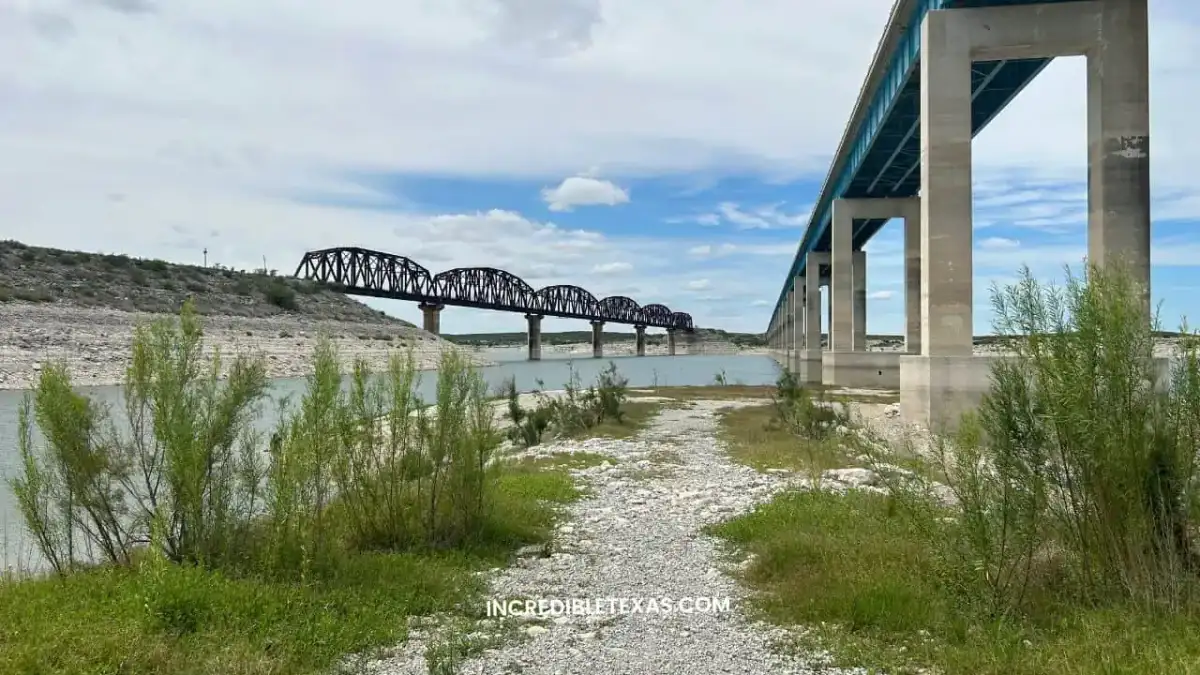
Amistad Reservoir is an expansive 64,900-acre international border reservoir situated on the Rio Grande in Val Verde County, roughly 12 miles northwest of Del Rio. The surrounding federal parklands are managed as Amistad National Recreation Area, encompassing 57,292 acres of limestone canyons, desert shrublands, and clear lake waters.
Key takeaways
- Amistad National Recreation Area charges no general park entrance fee, providing free vehicle and shoreline access year-round.
- Motorized boats require an official Lake Use Pass ($4 daily, $10 for 3 days, or $50 annually), while human-powered craft launch free.
- The park operates five primitive shoreline campgrounds on a first-come, first-served basis, along with boat-in backcountry camping.
- The international border runs down the center of the lake, marked by large channel buoys that separate United States and Mexican fishing jurisdictions.
Planning Your Visit: Location, Fees, and Lake Use Passes
Amistad Reservoir offers outdoor recreation along the United States border with Mexico, combining vast open water with rugged desert terrain. Visitors can review current federal regulations and facility conditions through the NPS Amistad National Recreation Area Portal before traveling. Travelers ranking public waters across the state will find Amistad prominently featured among the best lakes in Texas for deep-water boating.
The recreation area headquarters and visitor center are located at 10477 Highway 90 West near Del Rio, roughly 160 miles west of San Antonio. Visitors should stop in Del Rio for gasoline, groceries, and drinking water, as concession services along the lake are limited.
Free National Recreation Area Admission
Unlike many national parks, Amistad National Recreation Area does not charge an entrance fee to drive into the park or access public shorelines. Hikers, birdwatchers, and sightseers can explore designated day-use areas, view Panther Cave overlook points, and picnic free of charge. America the Beautiful federal park passes are honored for discounts on camping fees.
Motorized Boat Passes and Visitor Center Hours
Every motorized watercraft requiring state registration must display a valid Lake Use Pass while on the reservoir. Boaters can purchase passes at self-pay kiosks or at the visitor center, with prices set at $4 for one day, $10 for three days, or $50 for a full calendar year. The current fee schedule is documented through the NPS Amistad Fees and Passes Directory.
Amistad Reservoir Camping and Overnight Planning
Overnight camping at Amistad Reservoir offers a rugged, self-sufficient experience beneath expansive West Texas skies. Campers comparing regional borderland camping options can review the developed campsite layout in our Falcon State Park camping guide further down the Rio Grande. Amistad focuses primarily on primitive, unhooked campsites that reward self-reliant travelers.
Because designated campgrounds do not provide water or sewer hookups, campers must arrive fully prepared with sufficient drinking water, cooking fuel, and waste disposal supplies. Campgrounds remain open year-round with stays limited to 14 consecutive nights.
Primitive Campgrounds and Governors Landing
The park maintains five designated campgrounds: Governors Landing, San Pedro, Spur 406, 277 North, and 277 South. Governors Landing features shaded ramadas, picnic tables, ground grills, and chemical toilets for $10 per night ($5 for federal senior pass holders). Other primitive sites cost $6 per night or operate free of charge, with all standard sites allocated strictly first-come, first-served.
Backcountry Boat Camping and Group Reservations
Boaters can camp along undeveloped federal shorelines outside of designated harbors and marked historical archaeological zones. Group camping sites at San Pedro accommodate larger scout troops and family gatherings and can be reserved up to 180 days in advance via Recreation.gov. All backcountry campers must pack out all trash and carry portable chemical toilets where shoreline facilities do not exist.
Amistad Reservoir Facilities and Access Comparison
Review the comparison table below to identify the best launch ramp, camping loop, or shoreline access point for your trip to Amistad Reservoir.
| Access Point | Location | Amenities & Facilities | Boat Launch | Overnight Options |
|---|---|---|---|---|
| Diablo East | US 90, 10 mi NW of Del Rio | Paved parking, fish cleaning, marina | Multi-lane concrete ramp | Day-use only, lodging nearby |
| Rough Canyon | End of FM 277 North | Courtesy dock, marina store, restrooms | Paved launch lanes | Primitive camping nearby ($6/night) |
| Governors Landing | Off US 90 near bridge | Covered ramadas, picnic tables, grills | Nearby Diablo East ramp | 15 primitive campsites ($10/night) |
| San Pedro | Off US 90, west of bridge | Shaded tables, chemical toilets | Shallow water access | Group reservations & primitive sites |
| Box Canyon | FM 406, northwest arm | Remote parking, courtesy dock | Concrete boat ramp | Day-use & dispersed boat camping |
| 277 North & South | US 277 corridor | Grills, fire rings, chemical toilets | Nearby water access | Free primitive camping |
Boating, Marinas, and Launch Ramp Access
Boating represents the primary method to explore the immense scale of Amistad Reservoir, whose winding canyons extend up the Rio Grande, Pecan Springs, and Devils River arms. Anglers can contrast this vast waterway with other legendary fisheries in our guide to the best fishing lakes in Texas. Boaters must exercise caution, as underwater limestone shelves can damage boat hulls during fluctuating pool levels.
Full-service commercial marinas operate at Diablo East and Rough Canyon, offering boat slip rentals, fuel docks, ice, and basic tackle supplies. Rental slips and dry boat storage are available for extended seasonal visitors.
Diablo East and Rough Canyon Boat Ramps
Diablo East serves as the main launch facility, featuring high-capacity concrete ramps, extensive vehicle-trailer parking, and lighted navigation markers. Rough Canyon provides access to the Devils River arm, where steep limestone canyon walls shelter boaters from strong open-lake winds. Both facilities include covered fish cleaning tables and accessible restrooms.
Navigating Low Water Conditions and International Buoy Lines
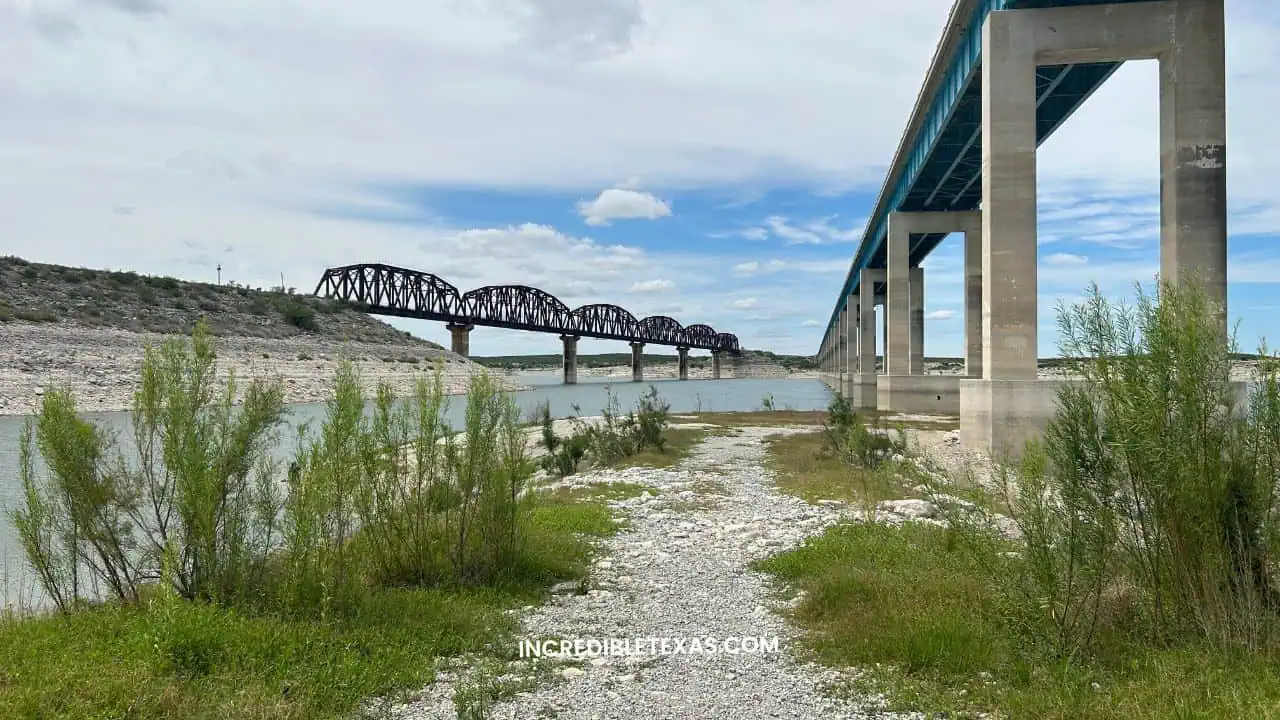
Water elevations on Amistad Reservoir fluctuate widely based on regional droughts and agricultural water releases managed by the International Boundary and Water Commission. Historical water storage trends and engineering milestones are detailed in the TSHA Amistad Reservoir Historical Entry.
Boaters should consult real-time pool elevation data through the Water Data for Texas Amistad Reservoir Gauge before launching. Large numbered buoys mark the international border down the center of the main lake channel, and boaters must be aware of their navigation coordinates at all times.
Amistad Reservoir Fishing: Bass, Catfish, and Border Rules
Amistad Reservoir is celebrated nationwide as a trophy bass fishery, characterized by submerged hydrilla beds, rocky humps, and sheer limestone drop-offs. Anglers can study habitat maps and seasonal catch data through the TPWD Amistad Reservoir Fishing Overview. The lake regularly produces largemouth bass over eight pounds alongside thriving populations of smallmouth bass, striped bass, channel catfish, and blue catfish.
Anglers should review our breakdown of Texas fishing permits and regulations to ensure their recreational licenses and endorsements remain active. Keeping licensing requirements organized avoids confusion while operating near international border waters.
Trophy Largemouth and Smallmouth Bass Tactics
During the spring spawn, largemouth bass move into secondary coves and shallow gravel shelves where sight-casting with soft plastic lizards, senkos, and creature baits is highly effective. In summer and autumn, schooling bass suspend over deep drop-offs and underwater ledges, where deep-diving crankbaits, football jigs, and drop-shot rigs yield heavy limits. Smallmouth bass frequent current-swept rocky points near the mouths of the Devils River and Pecan Springs.
Texas and Mexico Licensing Jurisdictions
Anglers fishing within the United States portion of Amistad Reservoir must hold a valid Texas freshwater fishing license with all required endorsements. If your boat crosses the international buoy line into Mexican territorial waters, every person on board who is fishing must hold a valid Mexican sportfishing license. Mexico boat permits are no longer required for recreational vessels entering Mexican waters temporarily.
Swimming, Paddling, and Prehistoric Rock Art
The crystalline waters of Amistad Reservoir attract swimmers, paddleboarders, and kayakers seeking clear desert waters away from boat wakes. Paddlers can explore sheltered tributary canyons where vertical rock cliffs provide shade and wind shelter. However, users should plan their turnaround times conservatively due to afternoon desert winds.
Open-Water Swimming and Shoreline Safety
Open-water swimming is permitted along natural shorelines, with Governors Landing and San Pedro providing gentle entries into calm cove waters. No lifeguards are on duty anywhere within the recreation area, making life jackets essential for weak swimmers and children. Swimmers must stay outside of commercial marinas, marked boat navigation channels, and active launch ramps.
Paddling Routes to Ancient Rock Art Sites
Kayakers and canoeists can launch from Rough Canyon to paddle along the towering limestone palisades of the Devils River arm. When water levels permit, boaters can view 4,000-year-old Pecos River Style pictographs painted on canyon alcoves, including famous prehistoric murals near Panther Cave. Touching or defacing these sacred Native American archaeological treasures is strictly prohibited by federal law.
Regional Day Trips and Val Verde County Excursions
Amistad Reservoir provides a base for exploring the rich border heritage of Del Rio, Ciudad Acuna, and the lower Pecos River country. Travelers can drive 45 miles northeast along Highway 277 to hike the rugged karst canyons highlighted in our Kickapoo Cavern State Park visitor guide. A trip into historic Del Rio offers visits to the Whitehead Memorial Museum and Texas's oldest continuously operating winery, Val Verde Winery.
Tip
Afternoon canyon winds can create two- to three-foot whitecaps on open lake waters; monitor National Weather Service marine alerts and plan return runs before 1:00 p.m.
Frequently Asked Questions About Amistad Reservoir
Is Amistad Reservoir free to visit?
Amistad National Recreation Area charges no general entrance fee, allowing free road and shoreline access to visitors year-round. However, motorized boaters must purchase an official Lake Use Pass, and overnight campers pay modest nightly site fees.
Do you need a boat pass for Amistad Reservoir?
A Lake Use Pass is required for all motorized vessels that require state registration, costing $4 for a single day, $10 for three days, or $50 for an annual pass. Non-motorized watercraft, such as canoes and kayaks, do not require a Lake Use Pass.
Can you swim in Amistad Reservoir?
Open-water swimming is permitted across most of Amistad Reservoir except within designated harbors, boat launch channels, and marked mooring zones. There are no lifeguards stationed at the park, so swimmers should wear personal flotation devices and exercise caution around rocky ledges.
Can you camp at Amistad Reservoir?
Amistad National Recreation Area operates five primitive shoreline campgrounds where individual sites are available on a first-come, first-served basis without utility hookups. Group campsites at San Pedro and designated boat-in backcountry shorelines provide additional overnight options.
What fishing license do you need on Amistad Reservoir?
Anglers fishing within United States waters must hold a valid Texas freshwater fishing license with current state endorsements. Boaters who cross the international boundary marked by mid-lake buoys into Mexican waters must possess a Mexican sportfishing license.