St. Roch Catholic Church Alleyton TX stands as a historic rural parish serving Catholic families across Colorado County and the surrounding German-Texan farming communities. Located in the unincorporated settlement of Mentz near Alleyton, the church combines traditional Catholic liturgy, seasonal parish festivals, and architectural heritage dating back to the mid-nineteenth century.
Settlement records preserved in the Texas State Historical Association history of Mentz explain that German Catholic pioneers originally named this area Neu Mainz. Travelers exploring rural religious sanctuaries along the Interstate 10 corridor discover a welcoming spiritual home framed by mature live oak trees and quiet rural roads.
Key takeaways
- Mass Schedule: Regular Masses occur on Saturday at 4:00 PM, Sunday at 10:00 AM, and Thursday at 5:30 PM.
- Sacrament of Reconciliation: Confessions are heard Thursday from 5:00 PM to 5:20 PM and Saturday from 3:00 PM to 3:45 PM.
- Parish Origins: Franz Burtschell deeded 4.5 acres in 1857, and German Catholic immigrant families completed the first chapel in 1858.
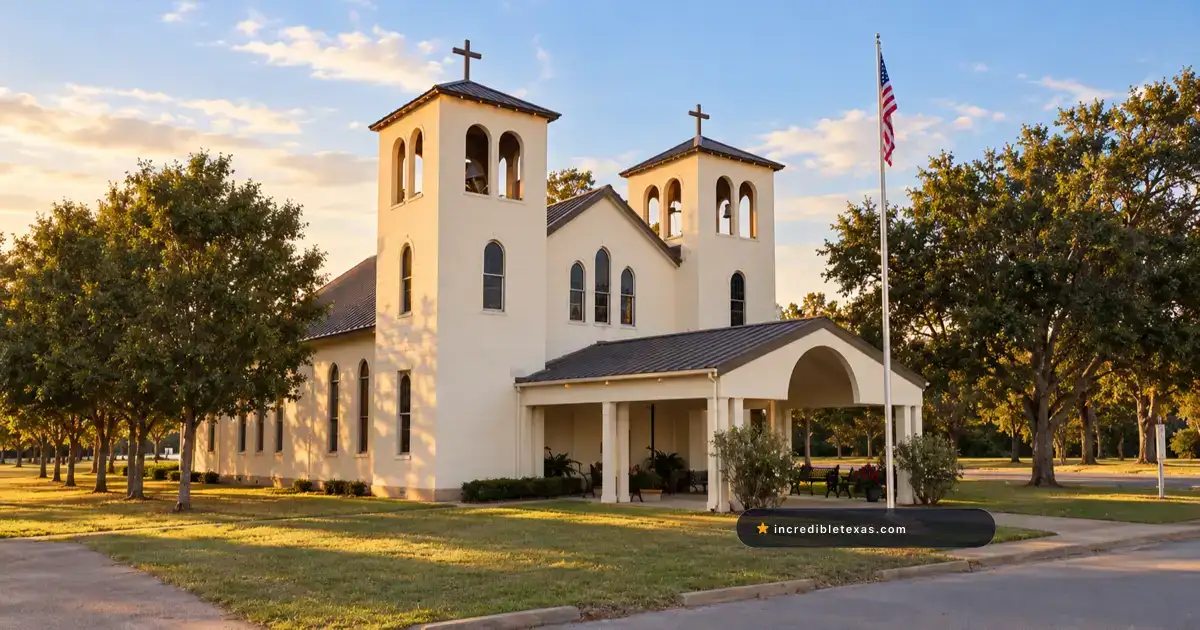
- Historic Sanctuary: Parishioners dedicated the current Romanesque-inspired sanctuary with twin square bell towers in 1941.
- Annual Tradition: The parish hosts the Annual Mentz Picnic on the first Sunday of October, continuing a festival running since 1855.
Plan your visit
Verified
- Location
- 1600 Frelsburg Rd, Alleyton, TX 78935 (Mentz community)
- Hours
- Sat 4pm, Sun 10am, Thu 5:30pm Mass; Confessions prior to Mass
- Admission
- Free admission for worship, visits, and grounds tours
- Best time to go
- Sunday 10am Mass or the Annual Mentz Picnic in October
St. Roch Catholic Church Mass Times and Liturgical Schedule
St. Roch Catholic Church celebrates regular weekend Masses on Saturday at 4:00 PM and Sunday morning at 10:00 AM. A weekly Thursday evening Mass is celebrated at 5:30 PM, providing parishioners and road travelers convenient opportunities for weekday Catholic liturgy. The parish belongs to the Schulenburg Deanery within the Roman Catholic Diocese of Victoria in Texas.
Attending Mass at St. Roch brings worshippers into reverent, community-centered Catholic liturgy. The parish uses the Roman Missal with traditional hymns, Scripture proclamations, and seasonal prayers led by the resident pastor. Visitors from across Texas frequently attend weekend worship while traveling between Houston, San Antonio, and Austin.
Weekend Vigil and Sunday Morning Liturgy
Weekend worship begins with the Saturday Vigil Mass at 4:00 PM. This early evening service serves local agricultural families, weekend travelers, and seniors who prefer worshipping before sunset. Music during the Saturday vigil features organ accompaniment and congregational hymns.
The Sunday morning Mass convenes at 10:00 AM in the main sanctuary. Families, longtime local parishioners, and traveling visitors gather for the principal parish celebration of the week. Worshippers comparing historic religious architecture often contrast this rural setting with large metropolitan sanctuaries such as Cathedral Santuario de Guadalupe in Dallas in North Texas.
Weekday Mass and Sacrament of Reconciliation
Weekday liturgy takes place every Thursday evening at 5:30 PM. This midweek service offers a reflective atmosphere without elaborate musical accompaniment, allowing attendees to focus on silent prayer and the Eucharistic liturgy.
The Sacrament of Reconciliation is offered twice weekly prior to services. Confessions are heard on Thursdays from 5:00 PM to 5:20 PM and on Saturdays from 3:00 PM to 3:45 PM. Penitent travelers seeking private spiritual counsel may also schedule individual appointments by calling the parish office in advance.
Holy Days of Obligation and Seasonal Liturgies
St. Roch observes all Catholic Holy Days of Obligation with expanded liturgical schedules. Solemnities such as the Assumption of the Blessed Virgin Mary, All Saints Day, and the Immaculate Conception feature designated vigil and daytime services.
During Advent and Lent, the parish conducts communal penance services, Friday evening Stations of the Cross, and special liturgical devotions. Christmas Eve, Christmas Day, Holy Week, and Easter Sunday schedules are published in advance through weekly church bulletins and announcements verified on the Texas Historical Commission St. Roch Catholic Church Tour portal.
| Liturgical Celebration | Day of Week | Time | Sacramental Details |
|---|---|---|---|
| Saturday Vigil Mass | Saturday | 4:00 PM | Anticipated Sunday liturgy with hymns and homily |
| Sunday Morning Mass | Sunday | 10:00 AM | Principal parish Eucharistic celebration |
| Weekday Mass | Thursday | 5:30 PM | Quiet evening service in the main sanctuary |
| Thursday Reconciliation | Thursday | 5:00 PM to 5:20 PM | Individual confessions in church confessional |
| Saturday Reconciliation | Saturday | 3:00 PM to 3:45 PM | Weekly pre-vigil confessions or by appointment |
Location, Parking, and Rural Arrival Directions
St. Roch Catholic Church is located at 1600 Frelsburg Road in Alleyton, Texas 78935, situated inside the historic rural community of Mentz. The sanctuary sits roughly eight miles northeast of Columbus and sixty-five miles west of downtown Houston. The campus is positioned near the junction of Farm to Market Road 949 and Frelsburg Road.
Driving to the parish takes visitors across the scenic post oak savannas and rolling pastures of Colorado County. The rural roads carry light local traffic, making arrival straightforward during both daylight hours and early evening services.
Driving Directions from Interstate 10 and Columbus
Travelers arriving from Houston or Katy along Interstate 10 West should take Exit 698 toward FM 949. Turn right onto FM 949 heading north, continuing for approximately four miles until reaching the intersection with Frelsburg Road in Mentz. Turn right onto Frelsburg Road, where the church bell towers become visible on the left side.
Motorists traveling from Columbus or San Antonio can take Highway 90 east from Columbus toward Alleyton, or remain on Interstate 10 East to Exit 698. Country drivers also navigate scenic FM 109 south from New Ulm or Frelsburg, turning onto rural connecting lanes that lead directly into Mentz.
On-Site Gravel and Paved Parking Logistics
The parish grounds offer generous free surface parking across interconnected gravel and paved parking lots. The primary parking lot wraps around the west and north sides of the sanctuary building, providing easy proximity to the church doors and parish hall.
Parking capacity easily accommodates standard weekend Mass attendance without vehicle congestion. During the annual October parish festival, overflow parking expands onto firm grass fields adjacent to the picnic pavilion under the guidance of volunteer parking coordinators.
Wheelchair Accessibility and Step-Free Entry
St. Roch provides dedicated accessible parking stalls marked near the main side entrance ramps. Concrete walkways with gentle slopes connect the parking areas directly to the church interior, eliminating step barriers for guests using wheelchairs, walkers, or strollers.
Inside the sanctuary, wide central and side aisles allow smooth navigation toward pew seating. Designated spaces near front and rear pews offer comfortable seating accommodations for visitors with mobility equipment. Families frequently combine a peaceful Sunday visit here with outdoor recreation at Stephen F. Austin State Park in nearby San Felipe, located just twenty miles east along the Brazos River.
Tip
Arriving 15 to 20 minutes prior to Mass ensures ample time to park on the gravel lots, silence mobile devices, and select preferred sanctuary seating before the entrance processional begins.
Parish Foundation and German Immigrant History in Mentz
The historical roots of St. Roch Catholic Church trace back to 1846, when German Catholic immigrants settled fertile farmland along the Colorado River basin. These early pioneer families originated largely from Büdesheim, located near Mainz and Bingen on the Rhine River in Germany. Under the sponsorship of the Mainz Society, they established an enduring farming settlement they named Neu Mainz.
Life on the Texas frontier presented severe physical challenges for pioneer families carving homesteads out of dense oak woodlands. Despite hardships, the settlers prioritized religious worship, communal fellowship, and spiritual instruction for their children.
Neu Mainz Settlement and the 1858 Pioneer Chapel
Before establishing a permanent sanctuary, the Catholic settlers of Neu Mainz received pastoral visits from missionary priests traveling on horseback from Sts. Peter and Paul Catholic Church in Frelsburg. Pioneering French and German priests such as Father Victor Gury and Father Charles Tarrilion celebrated Mass in private pioneer homes.
In 1857, pioneer settler Franz Burtschell officially deeded 4.5 acres of land to Bishop Jean-Marie Odin of the Roman Catholic Diocese of Galveston. Working cooperatively with local timber and hand-cut lumber, parishioners completed their first wooden chapel in 1858. Settlers named the chapel after Saint Roch, the revered fourteenth-century patron saint of the sick, honoring the famous pilgrimage chapel of Saint Roch located on the Rochusberg overlooking Bingen am Rhein.
The 1871 Hand-Hewn Stone Sanctuary and Early Missionaries
As German agricultural families continued moving into Colorado County following the Civil War, the original wooden chapel became inadequate for the expanding parish. In 1867, parishioners began planning a substantial permanent sanctuary constructed from native sandstone and limestone.
Local farmers hauled heavy stone blocks using ox-drawn wagons from nearby river bluffs and quarries. Completed in 1871, the handsome stone church marked the appointment of the community's first resident Catholic pastor. In 1872, the parish established a parochial school staffed by the Sisters of Divine Providence, providing religious catechesis and bilingual German-English schooling until 1916.
Construction and Dedication of the 1941 Church Building
After decades of faithful service, a devastating fire destroyed the historic stone sanctuary, prompting the community to unite once again in collective sacrifice. Parish leaders and parishioners initiated a major fundraising and building campaign during the late 1930s.
Parishioners completed the current church building in 1941, dedicating the impressive structure with twin square bell towers and warm masonry walls. Texas history enthusiasts exploring religious preservation often compare this German immigrant achievement with eighteenth-century stone landmarks like historic Mission Concepcion in San Antonio.
| Year | Parish Milestone | Historical Significance |
|---|---|---|
| 1846 | Pioneer German Settlement | Immigrants from Büdesheim establish the farming community of Neu Mainz |
| 1857 | Land Deed by Franz Burtschell | Pioneer donates 4.5 acres to Bishop Jean-Marie Odin for church and school grounds |
| 1858 | First Chapel Completed | Parishioners construct frame sanctuary named for Saint Roch of Bingen |
| 1871 | Stone Church Dedicated | Substantial native stone sanctuary completed with resident pastor arrival |
| 1872 to 1916 | Sisters of Divine Providence School | Parish operates Catholic school educating Colorado County rural youth |
| 1941 | Present Sanctuary Dedicated | Current Romanesque church with twin bell towers constructed and blessed |
Sanctuary Architecture, Art Heritage, and Interior Details
The architectural style of St. Roch Catholic Church blends Romanesque revival elements with regional German-Texan craftsmanship. Built in 1941, the exterior features robust brick and masonry construction designed to withstand humid coastal plains weather while echoing old-world European church traditions.
Upon approaching the church, visitors encounter a balanced symmetrical façade anchored by twin square bell towers rising above the rural countryside. The building conveys permanence, peace, and sacred purpose amid the surrounding agricultural landscape.
Twin Bell Towers and Arched Triple-Portico Façade
The twin square bell towers terminate in pyramidal roofs crowned with iron crosses. These towers house the parish bells, which ring across the Mentz community to announce Mass times, the Angelus, weddings, and funeral processions.
Beneath the towers spans a generous triple-arched covered portico. This welcoming entryway shelters parishioners from summer sun and seasonal rainfall before they cross the thresholds into the narthex. Architectural historians can compare these exterior design choices with grand urban stone cathedrals like Saint Mary Cathedral in Austin.
Sacred Statuary and the Legend of Saint Roch
The sanctuary interior preserves traditional Catholic sacred art honoring the parish patron. A prominent statue depicts Saint Roch dressed in pilgrim garments, holding a traveler staff and showing the plague sore on his leg. By his side sits his faithful dog holding a loaf of bread in its mouth.
According to Christian tradition, Saint Roch dedicated his life to caring for plague victims throughout fourteenth-century Italy. When he contracted the disease himself, he retreated into a forest where a miraculous hunting dog brought him bread each day until he recovered. Statues of the Blessed Virgin Mary, Saint Joseph, and the Sacred Heart of Jesus flank the sanctuary altars, providing quiet stations for devotional prayer.
Leaded Stained Glass and Hand-Painted Ceilings
Natural light filters into the nave through leaded stained glass windows installed along both side walls. These windows illustrate sacred mysteries, biblical narratives, and Christian symbols using deep blues, ambers, and ruby-red glass.
The barrel-vaulted ceiling features delicate hand-painted medallions and floral borders that reflect the folk art traditions of German-Texan church decorators. Visitors interested in regional preservation standards can consult historical research published through the Texas Historical Commission National Register program.
| Architectural Feature | Design Style | Visual and Liturgical Role |
|---|---|---|
| Twin Square Towers | Romanesque Revival | House parish bells and provide a landmark silhouette across Mentz |
| Triple-Arched Portico | Arcaded Loggia | Covered weather entrance and fellowship greeting porch |
| Patron Saint Roch Statue | Traditional Polychrome | Portrays Saint Roch with pilgrim staff, wound, and bread-bearing dog |
| Stained Glass Windows | Leaded Pictorial Glass | Depict Gospel scenes and illuminate the central nave with warm light |
| Vaulted Nave Ceiling | Painted Medallion Accents | Displays traditional German-Texan folk motifs and sacred monograms |
Visitor Etiquette, Mass Reverence, and Sacramental Guidelines
St. Roch Catholic Church welcomes pilgrims, travelers, and heritage lovers seeking peaceful reflection or communal worship. Because the church serves as an active consecrated house of prayer, all visitors should conduct themselves with courtesy and quiet reverence upon entering the sanctuary.
Sanctuary doors are opened prior to scheduled liturgies and parish events. Guests visiting between services should check with parish office staff to ensure maintenance or private devotions are not interrupted.
Reverent Sanctuary Conduct and Photography Rules
Upon stepping inside the nave, visitors should immediately silence cellular phones, tablets, and audible smart watches. Maintaining a hushed speaking tone preserves the prayerful environment for parishioners offering private devotions before the Blessed Sacrament in the tabernacle.
Photography and video recording of the exterior façade, bell towers, and grounds are welcomed. Inside the church, photography is permitted before or after liturgical celebrations, provided flash lighting and camera tripods do not block aisles. Photography is strictly prohibited during Mass and confession windows to safeguard sacred liturgical dignity.
Catholic Communion Reception and Pastoral Blessings
In accordance with Catholic canon law and diocesan guidelines, Holy Communion is reserved for practicing Catholics in full communion with the Church who have prepared themselves through prayer and the Sacrament of Reconciliation. Guests from other Christian denominations and non-Christian backgrounds are warmly invited to attend and join in hymns and communal prayers.
During the distribution of Holy Communion, non-Catholic guests may remain seated in their pews in silent prayer. Alternatively, visitors may join the communion line with their arms crossed over their chest to receive a personal priestly blessing. Visitors exploring traditional sacramental theology often compare these guidelines with historic liturgical traditions at St. Paul Lutheran Church in Austin.
What to Wear: Modest Worship Attire Standards
While St. Roch is a rural community where agricultural workers and casual travelers worship side by side, respectful modest attire is customary for weekend services. Business casual or modest casual clothing is appropriate for both men and women.
Parishioners typically wear collared shirts, blouses, slacks, dresses, or neat jeans. Beachwear, athletic tank tops, cut-off shorts, and clothing with irreverent graphics are discouraged inside the sanctuary. Gentlemen should remove caps and hats upon entering the church building.
Note
St. Roch Catholic Church provides printed parish bulletins in the narthex. Bulletins list weekly prayer intentions, parish ministry schedules, second collections, and announcements for upcoming fellowship gatherings.
The Annual Mentz Picnic, Parish Cemetery, and Regional Day Trips
Beyond weekly sacramental liturgies, St. Roch Catholic Church anchors community life through celebrated German-Texan festivals and historic cemetery preservation. The parish grounds feature a spacious air-conditioned parish hall, outdoor barbecue pits, an open-air pavilion, and a historic cemetery dating to the founding decade.
For administrative inquiries regarding cemetery burials, genealogical records, and hall rentals, parish staff operate during regular morning weekday hours. Staff can be reached directly by phone at 979-732-3460.
The Historic Mentz German Picnic Tradition Since 1855
The flagship social event of the year is the Annual Mentz Picnic, celebrated continuously on the first Sunday of October since 1855. This 169-year-old festival attracts thousands of Colorado County residents, former parishioners, and travelers from Houston, Austin, and Victoria.
The picnic menu features authentic Texas German-style pit-smoked beef, pork barbecue, and golden fried chicken prepared in traditional iron cauldrons. Volunteers serve homemade German potato salad, coleslaw, pinto beans, and fresh fruit kolaches. The festival includes live German brass bands, polka dancing, silent and live cattle auctions, bingo, and traditional country games.
St. Roch Cemetery and Pioneer German Epitaphs
Directly behind the church sanctuary lies the historic St. Roch Catholic Cemetery. Established in the late 1850s, this tranquil burial ground contains grave markers for early pioneer settlers who built Neu Mainz, cleared farmsteads, and founded the parish.
Genealogists and historians discover ornate wrought-iron cross grave markers and hand-carved stone monuments. Many nineteenth-century tombstones feature inscriptions engraved entirely in German, referencing birthplace villages in the Rhineland and the pioneer settlement name of Neu Mainz. Visitors walking through the cemetery should remain on established paths and treat all historic monuments with dignity.
Colorado County Day Trips and Regional State Parks
St. Roch serves as an outstanding cornerstone for a broader Colorado County architectural and outdoor weekend road trip. Historical researchers can review regional settlement narratives documented in the Texas State Historical Association Colorado County records.
Travelers pairing religious heritage with outdoor recreation can head northwest along Highway 71 to hike through shaded pine trails at Buescher State Park in Smithville. Combining rural church visits with state park adventures offers travelers an enriching perspective on the living cultural history of Texas.
| Parish or Landmark | Location | Founded | Architectural and Cultural Highlight |
|---|---|---|---|
| St. Roch Catholic Church | Mentz / Alleyton, TX | 1858 | Twin square towers, painted vaulted ceiling, 1855 German picnic tradition |
| Sts. Peter and Paul Catholic Church | Frelsburg, TX | 1847 | Mother parish of Colorado County, classic wooden steeple and pioneer cemetery |
| St. Anthony Catholic Church | Columbus, TX | 1870 | Historic Colorado County seat sanctuary with leaded stained glass windows |
| St. Michael the Archangel | Weimar, TX | 1888 | Grand brick Gothic revival structure featuring soaring belfry and grand chimes |
| Stephen F. Austin State Park | San Felipe, TX | 1940 | Riparian bottomland hardwood trails and early Texas colonial history site |
Frequently Asked Questions
What time are weekend Masses celebrated at the parish?
Weekend Masses take place on Saturday at 4:00 PM and Sunday morning at 10:00 AM. A weekly Thursday evening Mass is also celebrated at 5:30 PM.
Where is St. Roch Catholic Church located in Alleyton and Mentz?
The sanctuary is located at 1600 Frelsburg Road in Alleyton, Texas, within the rural Mentz community. The church sits roughly eight miles northeast of Columbus near the intersection of FM 949 and Frelsburg Road.
When are confessions heard before services?
Confessions are offered on Thursday from 5:00 PM to 5:20 PM and on Saturday from 3:00 PM to 3:45 PM. Penitents may also schedule the Sacrament of Reconciliation by appointment through the parish office.
How do visitors contact the parish office?
Parish staff can be reached by telephone at 979-732-3460 during regular weekday morning office hours. The office coordinates Mass intentions, sacramental records, cemetery plots, and parish hall reservations.
What is the history of the Catholic community in Mentz?
German Catholic immigrant families founded the settlement as Neu Mainz around 1846 and completed their first church in 1858 on deeded land. Following earlier wood and stone structures, parishioners constructed the current twin-towered sanctuary in 1941.
When is the annual Mentz parish picnic held?
The Annual Mentz Picnic takes place on the first Sunday of October on the parish grounds. The long-standing festival features traditional German-style barbecue, fried chicken, auctions, and live polka music.
Can non-Catholic visitors tour the church?
Travelers and architectural enthusiasts are welcome to visit the church and admire its sacred artwork outside of scheduled liturgies. Guests attending Mass are invited to participate in community prayers while refraining from photography during worship.
Is the church building wheelchair accessible?
The parish grounds provide dedicated accessible parking stalls and concrete step-free ramps leading into the main nave. The interior features flat aisles and spacious pew seating suitable for visitors with mobility needs.