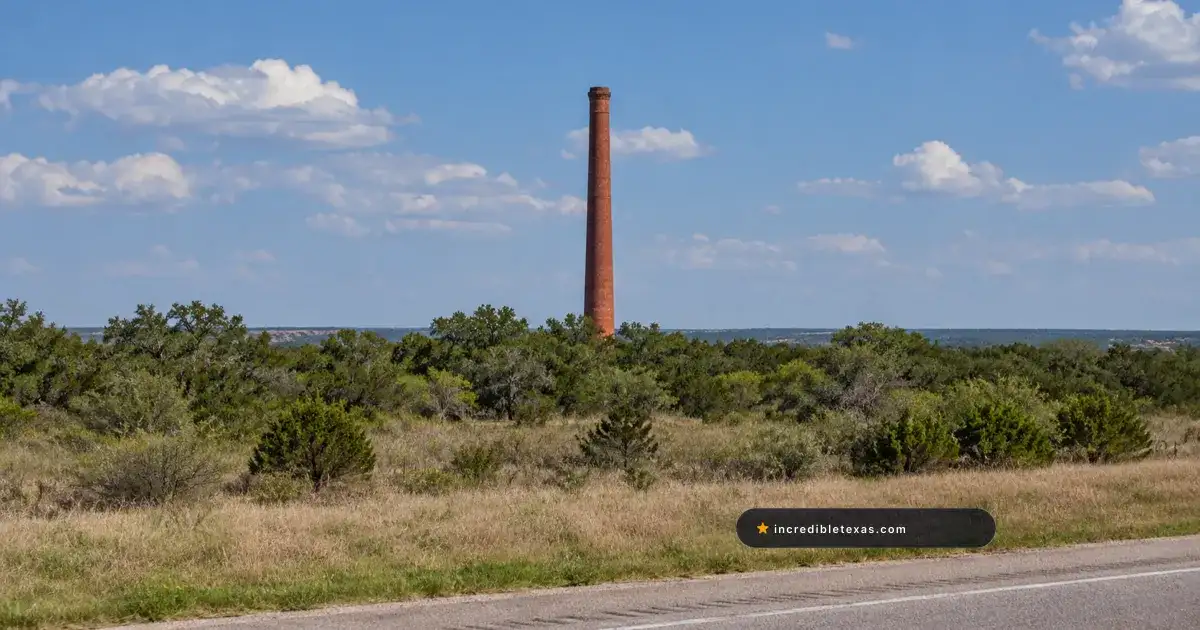
Rising unexpectedly above the scrub oak ridges along Interstate 20, the historic site of Thurber preserves one of the most remarkable industrial ghost towns in the American West. Today, the thurber texas ghost town draws road trippers, photographers, and history buffs eager to explore towering industrial ruins and discover how an isolated company fiefdom briefly powered the state of Texas.
Note
Part of our comprehensive Texas Ghost Towns Road Trip Guide. Explore our full frontier itinerary, boomtown histories, and regional itineraries.
Key takeaways
- Thurber is located 75 miles west of Fort Worth at Exit 367 on Interstate 20 along the Erath and Palo Pinto county line.
- The iconic 128-foot red brick smokestack and outdoor foundation ruins can be viewed free from public roadways during daylight hours.
- The W.K. Gordon Center for Industrial History of Texas charges five dollars for adult admission and operates Tuesday through Sunday.
- Travelers can dine in original brick structures at the Smokestack Restaurant or atop New York Hill.
Plan your visit
Verified
- Location
- 65258 Interstate 20, Mingus, TX 76463 (Exit 367)
- Hours
- Museum: Tue-Sat 10am-4pm, Sun 1pm-4pm; Ruins: Daylight
- Admission
- Ruins free; Museum $5 adults, $2.50 kids ages 5-12
- Best time to go
- Fall through spring; clear weekday mornings
The Rise and Fall of Texas’ Only Pure Company Coal Town
Thurber was established in 1888 by the Texas and Pacific Coal Company, growing into a fully unionized industrial powerhouse of 8,000 to 10,000 residents before oil conversions and mine shutdowns rapidly turned it into a ghost town by 1935.
Unlike typical frontier settlements that formed organically around stage stops or family farm plots, Thurber was completely owned by a single corporation. Understanding thurber texas history requires looking at how the texas and pacific coal company thurber operation controlled every grocery store, residence, saloon, school, and church. Workers were paid in company scrip that could only be spent at company stores.
Historical records from the Texas State Historical Association Handbook of Texas: Thurber document that miners from over eighteen distinct European nationalities immigrated here. Italian stonemasons, Polish miners, Mexican laborers, and Irish railroad workers lived in segregated neighborhoods across the hills.
By 1903, the United Mine Workers organized the labor force, making Thurber the first completely closed-shop, fully unionized company town in the southern United States. When locomotives converted to crude oil after the nearby 1917 Ranger oil discovery, coal demand evaporated. By the mid-1930s, the company auctioned off the houses, pulled up the rail spurs, and abandoned the site, leaving behind iconic erath county ghost towns lore that makes it one of the most notable ghost towns near Dallas-Fort Worth for weekend explorers.
What Remains Today: The 128-Foot Smokestack and Industrial Ruins
The iconic 128-foot red brick smokestack along Interstate 20 serves as the primary visual anchor of Thurber, flanked by concrete foundations, scattered kilns, the company commissary, and restored miner cottages.
Driving down the frontage road off Exit 367 brings travelers up close to the thurber brick smokestack, built in 1908 to vent boiler fumes from the electric power plant. The sheer scale of the brick masonry demonstrates the industrial ambition that once dominated these quiet pastures.
Scattered across the surrounding pastures, crumbling brick foundations and concrete footings indicate where machine shops and coal washing plants once hummed with activity. These evocative thurber ghost town ruins sit partially on private ranch property, but substantial remnants remain visible from public rights-of-way.
| Landmark Feature | Construction Date | Historic Function | Current Accessibility |
|---|---|---|---|
| Industrial Smokestack | 1908 | Electric plant boiler flue | Exterior viewing from frontage road |
| W.K. Gordon Center | 2002 | University research museum | Open Tue-Sun with paid admission |
| Commissary Building | 1890s | Main company department store | Restored restaurant and event space |
| St. Barbara Church | 1892 | Immigrant Catholic parish | Relocated to New York Hill for viewing |
| New York Hill Ruins | 1890s | Management homes and overlook | Public dining and scenic overlook |
Visiting the W.K. Gordon Center: Hours, Admission, and Exhibits
Operated by Tarleton State University at Exit 367 on Interstate 20, the W.K. Gordon Center charges $5 for adult admission and opens Tuesday through Saturday from 10:00 AM to 4:00 PM and Sunday from 1:00 PM to 4:00 PM.
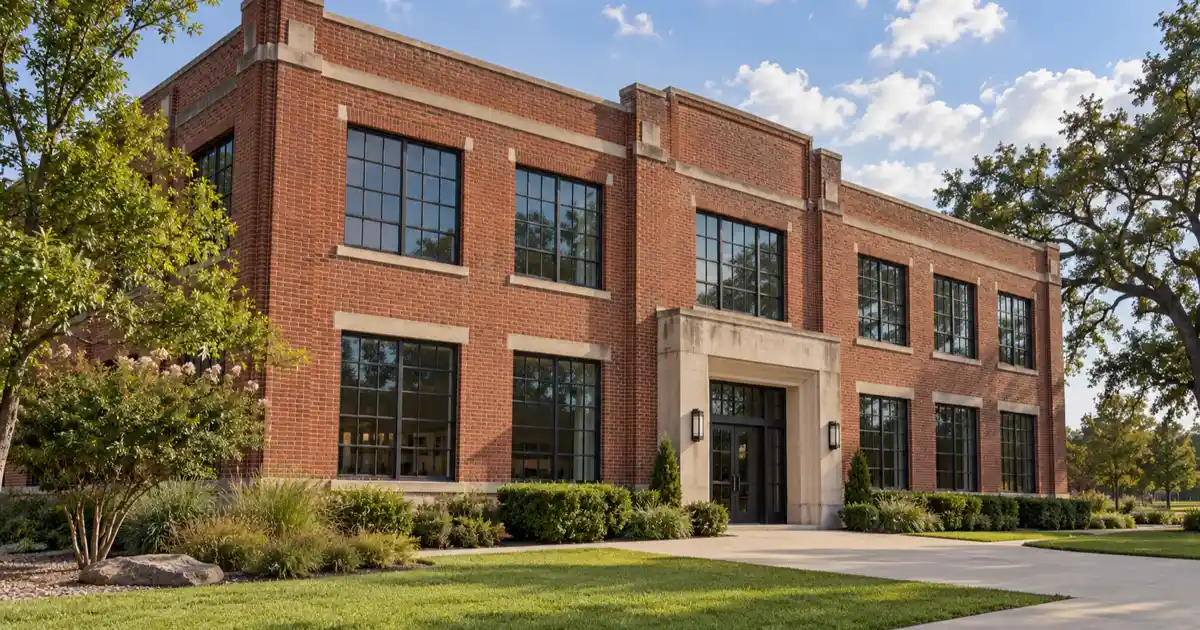
The museum provides deep context for the outdoor ruins, presenting interactive dioramas, authentic mining artifacts, audio recordings of former residents, and reconstructed streetscapes. When touring the wk gordon center thurber tx, visitors can inspect company store ledgers, brass scrip tokens, and historic photographs documenting daily life underground.
Official programming details and seasonal exhibition schedules can be confirmed directly through the Tarleton State University W.K. Gordon Center Portal. The facility offers ample paved parking for passenger cars and recreational vehicles, along with air-conditioned galleries and clean restrooms.
Discounted tickets cost $4 for seniors and military personnel, and $2.50 for children ages 5 to 12. Children under age 5 and Tarleton State University students, staff, and faculty enter free with valid identification.
The Famous Thurber Bricks That Built Texas Highways and Cities
Between 1897 and 1930, the Green & Hunter Brick Company in Thurber manufactured tens of millions of vitrified paving bricks stamped ‘THURBER, TEX,’ which paved historic streets from the Fort Worth Stockyards to Congress Avenue in Austin.
Local clay deposits proved uniquely suited for high-temperature kilns, yielding an exceptionally durable paving brick capable of withstanding heavy wagon wheels and early automotive traffic. Producing thurber paving bricks fort worth projects relied on required operating thirty kilns that employed hundreds of men at peak output.
Contractors across the state relied on Thurber paving blocks for municipal infrastructure. Sections of the historic Galveston Seawall, the Fort Worth Stockyards, and major thoroughfares throughout Dallas still feature these dark red pavers.
Collectors and roadside explorers often search local antique shops and roadside berms for discarded bricks stamped with the distinctive raised lettering. The smooth finish and rich color reflect the skilled craftsmanship of early Texas industrial workers.
Exploring New York Hill, St. Barbara Church, and the Cemetery
New York Hill rises above the former townsite, featuring the restored St. Barbara Catholic Church, panoramic vistas across Erath County, and the historic Thurber Cemetery with tombstones representing over eighteen immigrant nationalities.
During the boom era, company executives and mine supervisors constructed their private residences atop new york hill thurber texas to catch prevailing summer breezes and escape the industrial smoke in the valley. Today, visitors can drive up the winding hill to enjoy wide panoramic views across the surrounding countryside.
At the summit sits St. Barbara Catholic Church, named after the patron saint of miners. The wooden chapel has been lovingly restored, serving as an emotional link to the European families who risked their lives in the shafts below.
Located roughly one mile north of town, the Thurber Cemetery features hand-carved markers written in Italian, Polish, German, and Spanish. Much like the historic mining graveyard highlighted in our Terlingua Ghost Town guide, visiting the cemetery requires respectful behavior and strict adherence to historical preservation ethics.
Planning Your Trip: Highway Logistics, Dining, and Nearby Stops
Located 75 miles west of Fort Worth on Interstate 20, Thurber makes an accessible day trip with dining options at the Smokestack Restaurant and convenient side trips to Lake Mineral Wells or Possum Kingdom.
Travelers driving along Interstate 20 can stop for lunch at the smokestack restaurant thurber, situated inside the former company mercantile building directly opposite the museum. Alternatively, the New York Hill Restaurant at the top of the hill provides hearty chicken fried steak and fruit cobblers paired with elevated scenery.
Outdoor enthusiasts can easily combine a morning in Thurber with an afternoon hiking or camping trip. Head north on Highway 16 to explore the granite cliffs and lakefront trails detailed in our Possum Kingdom State Park visitor guide.
Travelers interested in climbing and camping permits can also reserve passes through Texas Parks and Wildlife Department Lake Mineral Wells. Combining these outdoor recreation areas with historic frontier landmarks creates a memorable journey through North Texas history.
Frequently Asked Questions About Thurber Texas
Can you walk up to the Thurber smokestack?
The 128-foot smokestack is visible directly from Interstate 20 and can be viewed safely from adjacent access roads and parking areas. Visitors should observe all private property and safety fencing around the historic brick base.
How much does it cost to tour Thurber Texas?
Viewing the outdoor ruins, smokestack exterior, and New York Hill overlooks is free. Admission to the indoor exhibits at the W.K. Gordon Center is five dollars for adults and two dollars and fifty cents for children.
Where can you eat when visiting Thurber?
Travelers can dine at the Smokestack Restaurant, housed inside a restored historic company building right by the interstate. The New York Hill Restaurant also serves homestyle meals with elevated panoramic views over the former townsite.
Why did Thurber Texas become a ghost town?
Thurber declined when Texas railroads switched their locomotive engines from bituminous coal to fuel oil following the 1917 Ranger oil boom. The mining company dismantled most company-owned houses and commercial structures during the 1930s.