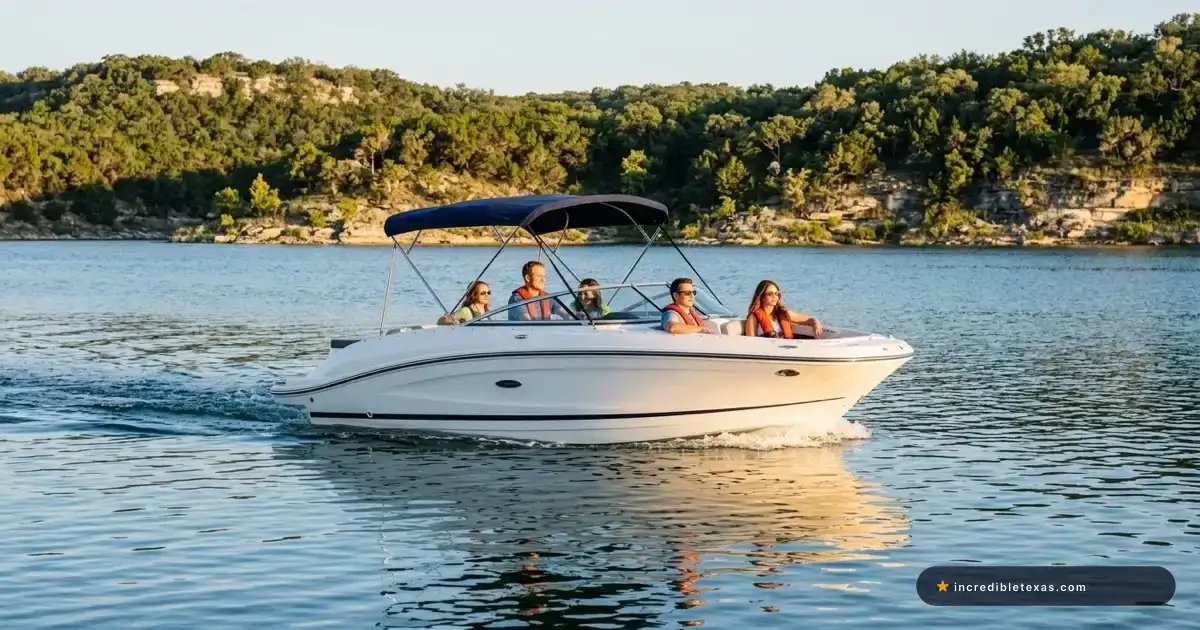
Texas Game Wardens and county marine patrols conduct routine safety inspections across public lakes without needing probable cause to pull a boat over. Across 1.7 million acres of public freshwater and 367 miles of coastline, Texas boating laws and regulations govern more than 580,000 registered motorboats, holding recreational skippers to strict equipment, licensing, and sobriety standards.
Renting a pontoon on Lake Travis or launching a bass boat on Lake Conroe requires specific onboard safety gear, a clear understanding of the 1993 operator birthdate cutoff, and strict adherence to zero-headway zones. Missing a single life jacket or running an engine cut-off switch disconnected results in Class C misdemeanor citations before your boat ever leaves the cove.
Key takeaways
- Anyone born on or after September 1, 1993, must complete a TPWD-approved boater education course to legally operate any motorboat over 15 horsepower or any personal watercraft (PWC).
- Children under 13 years of age must wear a USCG-approved life jacket at all times while aboard any vessel under 26 feet in length that is underway.
- Kali’s Law mandates that motorboat operators on vessels under 26 feet wear an engine cut-off switch lanyard or wireless link whenever traveling faster than slow headway speed.
- Passengers may legally possess and consume alcoholic beverages aboard recreational boats in Texas, but operators face strict Boating While Intoxicated (BWI) enforcement at a 0.08 blood alcohol limit.
- Personal watercraft (jet skis) are prohibited from operating between sunset and sunrise on all Texas public waterways and must maintain at least 50 feet of clearance from other vessels and shorelines.
Who Needs a Boater Education Card in Texas?
You need a Texas Boater Education Certificate if you were born on or after September 1, 1993, and plan to operate a motorboat with more than 15 horsepower, a windblown vessel over 14 feet, or a personal watercraft on public waters.
The state of Texas does not issue a traditional, revocable motorboat operator license. Instead, compliance is governed by the mandatory boater education provisions established in the Texas Water Safety Act under Chapter 31 of the Texas Parks and Wildlife Code. A frequent compliance question among new boaters is who needs boater safety course in Texas before launching on public reservoirs.
Boaters who complete a state-approved classroom or online course earn a lifetime certification. Carrying a verified Texas boater education card satisfies state compliance without requiring recurring renewal fees or retesting.
Age and Supervision Requirements for Youth Operators
Texas law sets clear age thresholds for vessel operation based on vessel horsepower and supervision. Children under 13 years of age are prohibited from independently operating any motorboat powered by greater than 15 horsepower or any personal watercraft under any circumstances.
A child under 13 may only operate such craft when accompanied on board by a person who is at least 18 years of age. That supervising adult must be legally authorized to operate the vessel, which means they must possess a valid boater education certificate if born on or after September 1, 1993.
Youth between the ages of 13 and 17 may operate independently only after meeting Texas boat license requirements by carrying their official course completion card on board. Without this credential, youth operators must have an authorized adult accompanying them on the water.
Out-of-State Boater Education Reciprocity
Visitors traveling to Texas lakes from other states do not need to retake a Texas-specific boater safety course. Under TPWD boating rules, Texas honors all boater education cards that carry official accreditation from the National Association of State Boating Law Administrators (NASBLA).
Active-duty United States military personnel and members of the Coast Guard are exempt from the mandatory boater education requirement under state rules. Commercial boat captains holding a valid Master, Mate, or Operator license issued by the US Coast Guard are also exempt.
Operators must carry either a physical certificate card, an authorized digital course completion card, or an official mobile app display along with photo identification. Failing to present proof of certification during a lawful water safety check is a Class C misdemeanor punishable by fines up to $500.
Mandatory Boat Safety Equipment by Vessel Length
Every vessel on Texas public waters must carry one USCG-approved wearable life jacket per passenger, a sound-producing device, navigation lights for low-light hours, and marine-grade fire extinguishers for enclosed fuel compartments.
The state categorizes recreational motorboats into four distinct length classes to establish legal safety gear baselines. Reviewing the complete checklist of Texas required boat safety equipment under official TPWD Required Boating Safety Equipment regulations prevents ramp citations and keeps your crew secure.
| Vessel Class | Length Overall | Wearable PFDs Required | Throwable PFD Required | Fire Extinguisher (B-1/5-B) | Sound Device Required |
|---|---|---|---|---|---|
| Class A | Less than 16 feet | 1 per person on board | Not required | 1 (if enclosed fuel/engine) | Whistle or horn audible 0.5 mi |
| Class 1 | 16 ft to less than 26 ft | 1 per person on board | 1 Type IV throwable cushion/ring | 1 marine-grade approved | Whistle or horn audible 0.5 mi |
| Class 2 | 26 ft to less than 40 ft | 1 per person on board | 1 Type IV throwable cushion/ring | 2 B-1 or 1 B-2 unit | Bell and whistle/horn audible 1.0 mi |
| Class 3 | 40 feet to 65 feet | 1 per person on board | 1 Type IV throwable cushion/ring | 3 B-1 or 1 B-2 plus 1 B-1 | Bell and whistle/horn audible 1.0 mi |
Life Jackets and Personal Flotation Devices (PFD) Rules
Texas law mandates that all vessels carry at least one US Coast Guard-approved wearable personal flotation device for each person aboard. Every life jacket must be in serviceable condition, free of rips or broken buckles, and appropriately sized for the intended wearer.
Under Texas life jacket laws children under 13 years of age must wear a USCG-approved Type I, II, or III life jacket at all times while aboard any vessel under 26 feet in length that is underway. In legal terms, “underway” refers to any time a craft is not anchored, moored to a dock, or safely beached aground.
For all vessels 16 feet in length and longer, operators must also carry at least one immediately accessible Type IV throwable flotation device, such as a buoyant ring buoy or square boat cushion. Standup paddleboards, canoes, and kayaks are exempt from the Type IV throwable cushion requirement, but every paddler must still have a wearable life jacket readily accessible.
Fire Extinguishers, Sound Devices, and Visual Signals
Motorboats with enclosed fuel tank compartments, closed living spaces, or permanently installed double bottoms must carry USCG-approved marine fire extinguishers. Vessels under 26 feet require at least one 5-B marine extinguisher, unless the vessel features open construction with portable fuel tanks and an outboard motor.
All motorboats must carry an efficient sound-producing device capable of signaling intentions and operating in reduced visibility. A mouth whistle or handheld air horn audible for at least one-half mile satisfies the legal requirement for Class A and Class 1 recreational vessels.
Visual distress signals (VDS), including USCG-approved red flares, orange distress smoke, or electric distress lights, are required when operating on coastal waters or the Gulf of Mexico. While not strictly mandated on landlocked inland reservoirs, carrying visual signaling gear is strongly advised across expansive waters like Possum Kingdom Lake.
Navigation Lights and Nighttime Boating Standards
All vessels operating between sunset and sunrise must display functional navigation lights compliant with statutory visibility ranges. Motorboats underway must display an all-round white masthead light visible for at least two miles, alongside red (port) and green (starboard) sidelights visible for one mile.
Manually propelled craft, such as canoes, kayaks, and rowboats, must have a functional white flashlight or lantern immediately at hand. Operators must illuminate the white light in time to avert potential collisions with oncoming motorized traffic.
Anchored vessels must display an all-round white light visible for 360 degrees when stationed outside designated anchorage zones after dark. Operating after dusk with inoperative or unapproved light fixtures is one of the most common causes of nighttime boating citations in Texas.
Kali’s Law and Engine Cut-Off Switch Requirements
Kali’s Law requires operators of motorboats under 26 feet in length to attach the engine cut-off switch lanyard or wireless transmitter to their body or life jacket whenever navigating at speeds above slow headway steerage.
Passed by the Texas Legislature under House Bill 337 and codified in Section 31.1071 of the Texas Parks and Wildlife Code, this statute was enacted to eliminate runaway boat accidents. Known formally as Kali’s Law Texas boating standards mandate that cut-off links remain fastened whenever the vessel moves above idle speed.
| Operating Speed | Vessel Status | Cut-Off Switch Requirement |
|---|---|---|
| Headway or Idle Speed | Docking, ramp departure, or trolling steerage | Cut-off lanyard attachment is optional |
| Above Headway Speed | Planing, open cruising, or wake towing | Cut-off lanyard or wireless link is mandatory |
Important
Kali’s Law applies to all motorboats under 26 feet in length manufactured with an engine cut-off switch. Operating above headway speed without the lanyard or wireless link attached is a Class C misdemeanor punishable by fines up to $200.
When the Cut-Off Switch Must Be Physically Attached
The operator must physically attach the cut-off lanyard to their wrist, belt, or personal flotation device before accelerating past headway speed. If using a wireless electronic cut-off link, the wearable sensor fob must be paired and turned on before the craft begins planing.
Headway speed is legally defined as the slowest speed at which a vessel can operate while still maintaining steerage and course control. You are not required to wear the kill switch lanyard while idling away from a boat ramp slip, navigating a marina no-wake cove, or docking.
The moment you push the throttle forward to get the boat up on plane, the cut-off link must be fastened to the operator. Under the Texas engine cutoff switch law, keeping this safety line engaged ensures that an ejected helm driver cannot be struck by a circling runaway craft.
Vessel Exemptions and Retrofitting Guidance
Kali’s Law applies to all motorboats under 26 feet in length that were manufactured with an engine cut-off switch installed. The statute does not mandate retrofitting older vessels that were built and sold without an emergency switch mechanism.
However, boat owners are strictly prohibited from disabling, bypassing, or removing an existing cut-off switch installed by the original manufacturer. If a boat came from the factory with an engine kill switch, that safety mechanism must remain fully operational.
Tip
Keep a spare engine cut-off lanyard secured in your vessel’s glove compartment or dry box. If your primary lanyard drops overboard during an accidental helm disconnect, having a backup allows you to restart the engine and retrieve the swimmer immediately.
Texas Personal Watercraft (PWC) and Jet Ski Regulations
Texas law restricts personal watercraft operation to daytime hours between sunrise and sunset, mandates wearable life jackets for all riders, and requires maintaining at least 50 feet of clearance from other boats and shorelines.
Personal watercraft, commonly referred to as jet skis, Sea-Doos, and WaveRunners, are classified as Class A motorboats under Texas law. Because of their agility and rapid acceleration, operators must adhere to strict Texas boat regulations codified under Section 31.106 of the Texas Water Safety Act.
| Protected Zone or Hazard | Mandatory Clearance Distance | Legal Operating Exception |
|---|---|---|
| Other Motorboats & Jet Skis | 50 feet minimum | Flat-wake headway speed only |
| Docks, Piers & Boat Ramps | 50 feet minimum | Flat-wake headway speed only |
| Shorelines & Swim Areas | 50 feet minimum | Flat-wake headway speed only |
| Persons in the Water | 50 feet minimum | Emergency rescue maneuver only |

Daytime-Only Operating Window and Nighttime Ban
Operating a personal watercraft between sunset and sunrise is strictly illegal across all public waters in Texas, regardless of whether aftermarket navigation lights are installed. PWCs lack the structural profile and visual silhouette needed for safe nocturnal navigation at typical recreational speeds.
The legal operational window begins precisely at official sunrise and concludes at official sunset. Operating a jet ski during dusk after the sun dips below the horizon is treated as a Class C misdemeanor offense by marine patrol officers.
Every person aboard a personal watercraft must wear a USCG-approved personal flotation device at all times while the craft is on the water. Inflatable life jackets that require manual cord pulling or water immersion activation are not approved for PWC riders under Texas regulations.
Safe Distance Rules and Prohibited Wake Jumping
When examining Texas jet ski laws age limits dictate who can operate without direct supervision, but all riders must obey shoreline buffer zones. PWC operators must maintain a minimum distance of at least 50 feet from any other vessel, person, dock, pier, boathouse, shoreline, or designated swim area.
The only exception to this 50-foot perimeter occurs when operating at slow, flat-wake headway speed while docking or departing. Weaving through congested boat traffic or following closely behind a wakeboarding boat to jump its wake is explicitly classified as reckless operation under Texas law.
Jumping the wake of another vessel within 100 feet of that craft is strictly prohibited. Every PWC equipped with a lanyard-type engine cut-off switch must have that lanyard securely fastened to the operator’s wrist or life jacket at all times.
Alcohol and Boating Laws: Open Container vs. BWI in Texas
Texas law permits passengers on recreational boats to consume alcoholic beverages, but operating any boat or jet ski with a blood alcohol concentration of 0.08 or greater constitutes Boating While Intoxicated with mandatory jail time.
There is significant confusion among Texas boaters regarding alcohol rules on public lakes. The legal boundary separating a relaxed afternoon on the water from an arrest revolves around the distinction between passenger consumption and driver impairment under Texas Penal Code Chapter 49.
Why Open Container Laws Do Not Apply to Boat Passengers
Many newcomers ask can you drink on a boat in Texas before stocking up on refreshments for an afternoon on the water. The Texas open container statute (Texas Penal Code Section 49.031) applies strictly to motor vehicles driven on public highways, roads, and street rights-of-way, meaning it does not apply to recreational vessels on public lakes, rivers, or bays.
Adult passengers on a pontoon boat or cruiser may legally open, hold, and consume beer, wine, or liquor while the vessel is cruising. Coolers stocked with alcoholic beverages are permitted on board, provided local municipal park ordinances at the launch ramp do not prohibit alcohol on dry land.
However, glass containers are strictly prohibited along many riverbeds and shoreline parks under regional authority rules. On waters like Canyon Lake, bringing glass bottles onto the shoreline or docks can result in municipal citations even before you launch.
Boating While Intoxicated (BWI) Penalties and Enforcement
While passengers may drink, the vessel operator is held to the exact same legal intoxication standards as a motorist driving an automobile on an interstate highway. Operating a watercraft while intoxicated (BWI) under Texas Penal Code Section 49.06 is a serious criminal charge.
Familiarizing yourself with Texas BWI law penalties highlights why having a designated sober driver is just as essential on the water as on the highway. Intoxication is legally defined as having a blood alcohol concentration of 0.08 or higher, or lacking the normal use of mental or physical faculties.
| Conviction Level | Statutory Offense | Maximum Fine | Jail Sentence Range | Driver’s License Suspension |
|---|---|---|---|---|
| 1st Offense | Class B Misdemeanor | Up to $2,000 | 72 hours to 180 days | 90 to 365 days |
| 2nd Offense | Class A Misdemeanor | Up to $4,000 | 30 days to 1 year | 180 days to 2 years |
| 3rd Offense | Third-Degree Felony | Up to $10,000 | 2 to 10 years (state prison) | 180 days to 2 years |
Refusing to provide a requested breath or blood specimen triggers an automatic 180-day driver’s license suspension under Texas implied consent statutes. Marine enforcement officers routinely conduct seated field sobriety evaluations on law enforcement patrol craft when assessing suspected operators.
Texas Boat Registration, Titling, and Tax Rules
All motorized vessels operating on Texas public waterways must be titled and registered with the Texas Parks and Wildlife Department on a two-year cycle, with fees scaled across four distinct hull length classes.
Vessel documentation in Texas is managed through the TPWD Boat Registration and Titling Section rather than the Department of Motor Vehicles. Both the vessel hull and any outboard motor rated over 25 horsepower require separate Certificates of Title under state administrative rules.
Registration decals and numbers must be properly displayed on both sides of the boat’s bow. The validation sticker must be placed three inches behind the state registration numbers in clear, unshaded block letters at least three inches in height.
Vessel Length Classes and Biennial Fee Schedule
Texas vessel registration remains valid for two full calendar years from the date of issue. Statewide Texas boat registration fees are categorized into four length classes based on centerline measurement from stem to stern.
| Length Category | Vessel Classification | Biennial Registration Fee | Certificate of Title Fee |
|---|---|---|---|
| Under 16 feet | Class A | $32.00 | $27.00 |
| 16 ft to less than 26 ft | Class 1 | $53.00 | $27.00 |
| 26 ft to less than 40 ft | Class 2 | $110.00 | $27.00 |
| 40 feet and over | Class 3 | $150.00 | $27.00 |
Vessel transactions between private parties or through marine dealerships are subject to the standard 6.25% Texas vessel and outboard motor sales and use tax. Boat owners must complete the title transfer process within 45 days of the sale date to avoid late penalty assessments.
Anglers hauling boats between reservoirs should also review state environmental regulations. Texas law requires all boaters to drain all water from livewells, bilges, and motors before leaving any freshwater lake to prevent the spread of invasive zebra mussels, and pair their trip with current Texas fishing permits and regulations.
Do Kayaks, Canoes, and Paddleboards Need Registration in Texas?
Non-motorized canoes, kayaks, rowboats, and standup paddleboards are completely exempt from Texas vessel registration and titling requirements. You can launch and paddle any human-powered watercraft across public waters without paying state registration fees or displaying hull numbers.
However, the instant you mount any mechanical propulsion to a kayak or canoe, that exemption ends. Attaching a small 12-volt electric trolling motor or a lightweight gas engine legally reclassifies the vessel as a motorized watercraft.
Once motorized, a paddlecraft must be fully titled ($27) and registered ($32 for vessels under 16 feet) with the Texas Parks and Wildlife Department. The owner must display TX registration numbers and validation decals on the bow, and carry an emergency sound device and required lighting.
Frequently Asked Questions About Texas Boating Laws
Can Game Wardens stop your boat without probable cause in Texas?
Yes, Texas Parks and Wildlife Game Wardens and certified marine safety officers have statutory authority under the Texas Water Safety Act to conduct routine water safety inspections on any vessel without probable cause. Officers may board your craft to inspect required personal flotation devices, fire extinguishers, registration decals, and sound signaling devices.
Do you need a boating license to rent a boat in Texas?
Commercial boat rental liveries require any operator born on or after September 1, 1993, to present a valid Texas Boater Education Certificate or an approved equivalent course card before releasing a rental craft. Operators born before that date only need a valid government-issued photo identification confirming their date of birth.
At what age can a child drive a boat alone in Texas?
A youth must be at least 13 years of age and hold an official Boater Education Certificate to independently operate a motorboat with more than 15 horsepower or a personal watercraft. Children under 13 may only steer or throttle the craft when accompanied on board by an adult who is at least 18 years old and legally certified to operate the vessel.
Are life jackets mandatory for adults on Texas lakes?
Adults are not legally required to wear a life jacket while cruising on Texas public waters, provided a properly sized, readily accessible USCG-approved wearable personal flotation device is on board for every person. However, all adults must wear a life jacket when operating or riding on a personal watercraft (jet ski) or while being towed on skis, wakeboards, or tubes.
Does a BWI affect your Texas driver’s license?
Yes, a conviction for Boating While Intoxicated in Texas triggers an automatic administrative suspension of your standard Texas motor vehicle driver’s license ranging from 90 to 365 days for a first offense. Refusing to submit to a lawful chemical breath or blood test requested by a marine officer results in an immediate 180-day driver’s license suspension under Texas implied consent laws.
Final Safety Checklist for Texas Boaters
Preparing your vessel before pulling away from the marina dock protects your passengers and prevents citations on the water. Ensure that you have verified weather forecasts, confirmed wind advisories, and calculated fuel reserves to maintain one-third of a tank for your return trip.
Review the official Texas Parks and Wildlife Department Boating Regulations guide before launching on unfamiliar lakes. Staying knowledgeable about right-of-way rules, maintaining your equipment, and designating a sober skipper ensures every trip across Texas lakes remains safe and memorable.