
Examining what would happen if Texas were a country reveals economic, geopolitical, and resource figures that rival the world’s most powerful sovereign states. Evaluating Texas if it were a country provides an eye-opening benchmark against sovereign powers, reflecting a distinct heritage explored in our guide to the heritage of Texas traditions and culture.
Key takeaways
- Texas generates an estimated $2.9 trillion Gross State Product, which would rank as the eighth-largest economy in the world ahead of Canada, Italy, and Russia.
- The regional economy of the Dallas-Fort Worth metropolitan area outproduces Poland, while the Greater Houston economy exceeds Belgium.
- Texas produces approximately 5.6 million barrels of crude oil daily, surpassing major OPEC producers including Iraq, Iran, and the United Arab Emirates.
- Texas operates its own independent electrical grid managed by ERCOT, powering 90 percent of the state’s electric load isolated from federal interstate networks.
- The 1845 Joint Resolution for Annexing Texas contains a unique statutory clause permitting the state to divide into up to five distinct states with local consent.
Global GDP Ranking: How the Texas Economy Compares to Sovereign Nations
If Texas operated as an independent nation, its estimated $2.9 trillion gross output would rank as the eighth-largest economy in the world. When analyzing the Texas economy vs countries around the globe, the Lone Star State consistently ranks near the top of the G20.
According to preliminary national benchmarks from the International Monetary Fund and official data published in the Office of the Texas Governor Economic Report, Texas reached a historic $2.9 trillion Gross State Product. Evaluating Texas as an independent nation reveals an economy positioned immediately behind France and the United Kingdom in overall output.
The official Texas GDP ranking in the world confirms an eighth-place global standing. Examining the Texas economy compared to world nations demonstrates extraordinary industrial diversity, as Texas produces more monetary value than 185 sovereign member states of the United Nations.
| Entity | GDP / GSP (Current Trillions) | Global GDP Rank | Population (Millions) | Daily Oil Output | Primary Economic Pillar |
|---|---|---|---|---|---|
| United States (Total) | $28.70T | 1st | 336.0M | 13.2M bpd | Diversified Tech & Finance |
| Texas (Standalone) | $2.90T | 8th | 30.5M | 5.6M bpd | Energy, Tech, Aerospace, Trade |
| Italy | $2.25T | 9th | 58.8M | <0.1M bpd | High-End Manufacturing & Luxury Goods |
| Canada | $2.14T | 10th | 39.5M | 4.8M bpd | Natural Resources, Finance, Services |
| Russia | $2.02T | 11th | 144.0M | 9.5M bpd | Hydrocarbons, Mining, Defense |
| Mexico | $1.79T | 12th | 129.0M | 1.9M bpd | Automotive Manufacturing, Agriculture |
| Australia | $1.72T | 13th | 26.5M | 0.3M bpd | Raw Materials, Mining, Banking |
| South Korea | $1.71T | 14th | 51.7M | 0.0M bpd | Semiconductors, Consumer Tech, Autos |
Why Texas Outproduces Canada, Russia, and Italy
Texas outproduces Canada, Russia, and Italy because its business base combines abundant natural resources with high-yield technology and finance clusters. This balanced output establishes a Texas GDP world rank that outclasses most advanced economies across Europe and the Americas.
Russia maintains an economy driven primarily by fossil fuel exports and heavy industry, but structural sanctions and state-dominated monopolies limit its broader commercial growth. Comparing the Texas population vs sovereign nations shows 30.5 million Texans outproducing 144 million Russian citizens by nearly 45 percent in annual gross value.
Italy possesses world-renowned manufacturing and fashion houses, yet persistent demographic aging and sluggish Southern productivity constrain its national figures. Texas expands its baseline through steady domestic migration, bringing skilled labor and corporate investment from across North America every single month.
Metro Superpowers: Dallas-Fort Worth and Houston vs. European Nations
The individual metropolitan statistical areas in Texas function as sovereign-scale economic engines in their own right. According to municipal demographic data tracked in our Texas cities by population guide, the Dallas-Fort Worth Metroplex and Greater Houston contain over 15.6 million residents combined.
The gross metropolitan product of Dallas-Fort Worth exceeds $650 billion annually, making the North Texas urban corridor larger than the national economy of Poland or Sweden. DFW serves as the central North American transport hub, home to American Airlines, AT&T, and ExxonMobil.
Greater Houston generates an annual output surpassing $600 billion, outperforming the national economies of Belgium and Norway. Houston functions as the energy capital of the Western Hemisphere and hosts the Texas Medical Center, the largest medical complex on Earth with over 10 million annual patient encounters.
Global Energy Powerhouse: Texas Oil and Wind vs. International Producers
Texas functions as an international energy titan, producing approximately 5.6 million barrels of crude oil daily alongside top-tier global wind power generation. Reviewing Texas energy production vs countries highlights a rare combination of heavy fossil extraction and cutting-edge renewable development.
Energy markets across five continents monitor West Texas pipeline flows because the Permian Basin and Eagle Ford Shale dictate global pricing benchmarks. The state accounts for roughly 43 percent of all crude oil extracted in the United States and 28 percent of marketed natural gas.
Unlike traditional petro-states that depend solely on fossil fuels, Texas has simultaneously built out one of the world’s most sophisticated renewable energy infrastructures. Wide open plains in West Texas and consistent Gulf Coast winds generate historic levels of non-carbon electricity.
Texas Crude Oil Output Compared to OPEC Nations
When evaluated against member countries of the Organization of the Petroleum Exporting Countries (OPEC), Texas would rank as the third-largest oil producer on the planet. Only the United States as an aggregate country and Saudi Arabia extract more daily crude than Texas fields.
Texas crude oil production reached 5.6 million barrels per day, outperforming Iraq (4.3 million bpd), the United Arab Emirates (3.2 million bpd), and Iran (3.1 million bpd). It comfortably surpasses neighboring petro-giants Kuwait, Nigeria, and Venezuela.
Refining infrastructure along the Gulf Coast complements this extraction capacity. The Port of Corpus Christi and the Port of Houston operate deep-water crude export terminals that supply refined petroleum products to European and Asian buyers every day.
Leading the Clean Energy Surge: Texas Wind Power on the World Stage
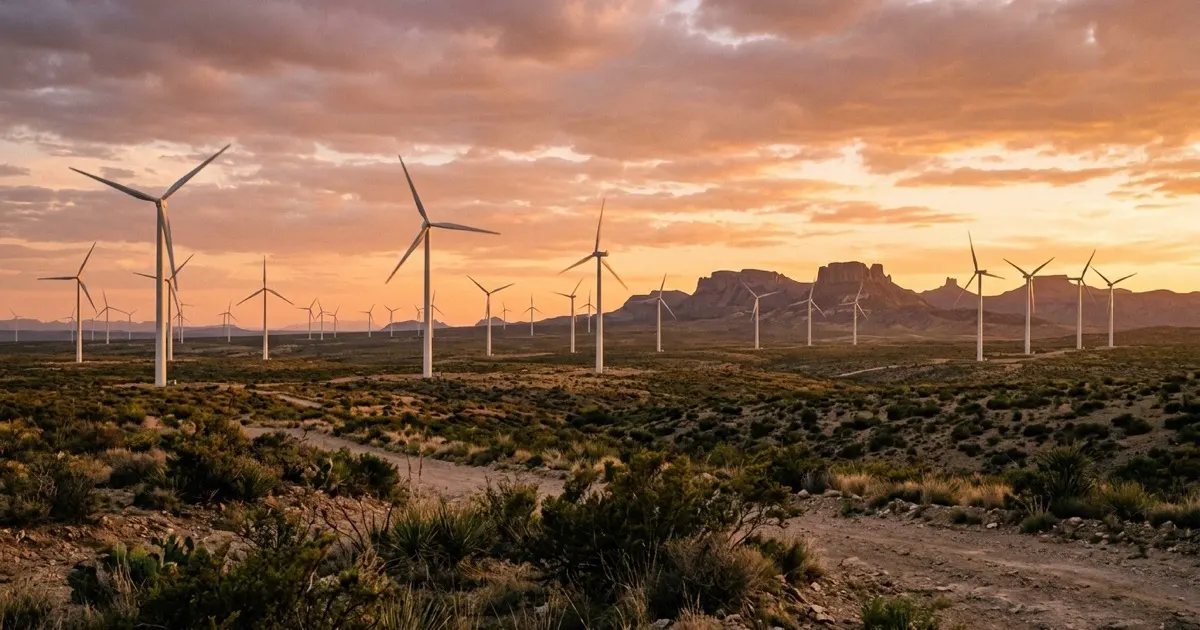
Texas leads the United States in clean wind generation, with installed wind turbine capacity exceeding 40,000 megawatts. If Texas were an independent nation, its wind power fleet would rank fourth globally, trailing only China, the total United States, and Germany.
Brisk, predictable winds sweeping across the Panhandle and West Texas mesas drive massive turbine farms like the Roscoe Wind Farm, which spans over 100,000 acres. On windy spring days, renewable generation regularly supplies more than 50 percent of the total instantaneous electrical demand across the entire state.
Solar energy installation in Texas is expanding along an identical trajectory, adding gigawatts of photovoltaic capacity in Central and South Texas. This dual mastery of hydrocarbons and renewables shields the state from global energy transitions.
Note
Texas generated over 119 terawatt-hours of wind electricity in a single calendar year, surpassing the total wind power output of Spain, the United Kingdom, and France combined.
The Isolated Grid: Why Texas Operates an Independent Electrical System
Texas maintains its own independent electrical grid because state leadership chose to avoid federal regulatory oversight under the Federal Power Act of 1935. Managed by ERCOT, the Texas Interconnection powers 90% of the state and operates entirely isolated from neighboring national interconnections.
Essential ERCOT independent power grid facts explain why the state maintains a closed electrical loop insulated from federal interstate commerce mandates. By keeping high-voltage power lines inside state borders, Texas utilities historically avoided Federal Energy Regulatory Commission rate-setting mandates.
The Electric Reliability Council of Texas oversees high-voltage transmission across 52,700 miles of power lines. This self-contained operational status reinforces the concept of Texas as an autonomous country with its own domestic energy governance.
During extreme weather events, this island grid cannot readily import thousands of megawatts from neighboring states, creating complex reliability debates. In our detailed study of Texas weather extremes and climate records, rapid 50-degree temperature drops and 143-degree statewide swings illustrate why the electrical system faces intense seasonal stress. Yet during normal operations, it allows Texas to approve transmission lines and connect renewable projects years faster than federally regulated regional grids.
Global Trade and Headquarters Dominance: 22 Consecutive Years Leading the Nation
Texas has led the United States as the top export state for 22 consecutive years, exporting hundreds of billions of dollars in refined goods annually. Supported by 55 Fortune 500 global corporate headquarters, Texas maintains commercial trade relationships that match major continental economic hubs.
Data from the Texas Comptroller of Public Accounts Economic Analysis confirms that Texas ships over $440 billion in global merchandise exports annually. Major trading partners include Mexico, Canada, the Netherlands, China, and South Korea.
Advanced manufacturing and semiconductor fabrication anchor this trade surplus alongside energy shipments. Samsung’s multi-billion dollar semiconductor fabrication facilities in Taylor and Texas Instruments campuses in Sherman cement the state’s role in global microprocessor supply chains.
Massive defense manufacturing hubs like Lockheed Martin in Fort Worth contribute to Texas military defense spending impacts that rival mid-sized European allies. Fortune 500 giants like Tesla, Hewlett Packard Enterprise, Oracle, and Caterpillar relocated global headquarters to Texas, leveraging zero personal income taxes and regulatory advantages detailed by the Texas Economic Development Corporation Global Business Portal.
Historical Precedent: The Sovereign Republic of Texas (1836 to 1845)
Texas was once an authentic sovereign country, operating as the Republic of Texas for nine years between winning independence from Mexico in 1836 and joining the United States in 1845. The young nation issued its own currency, commanded a navy, and established formal foreign embassies in London and Paris.
Following the decisive Battle of San Jacinto on April 21, 1836, General Sam Houston secured Texian independence from General Santa Anna. The newborn republic drafted a constitution, elected presidents, and governed a vast territory extending northward into modern-day Colorado, Kansas, and Wyoming.
Studying Texas republic history facts reveals that European superpowers formally recognized Texas sovereignty. Historic records detailed by the Texas State Historical Association Handbook of Texas document that France opened an official legation in Austin, while the Republic of Texas maintained a diplomatic embassy in London near St. James’s Palace.
This distinct sovereign chapter shaped the state’s cultural identity. Visitors touring the historic Texas State Capitol in Austin can study artifacts from the republic era, including the original red, white, and blue national seal that still adorns the granite rotunda floor.
The Five-State Legal Provision: Fact-Checking the 1845 Annexation Treaty
Under the 1845 Joint Resolution for Annexing Texas, statutory language allows Texas to consent to forming up to four additional states out of its existing territory. While Texas cannot unilaterally secede from the United States under constitutional law, it retains the unique historical legal option to partition itself into five separate states.
When Congress drafted the terms of admission, northern and southern politicians engaged in fierce debates regarding the balance of free and slave states in the Senate. To resolve this gridlock, legislators inserted language permitting future territorial subdivisions.
Archival records preserved in the Texas State Library Annexation Archives contain the precise clause: “New States of convenient size, not exceeding four in number, in addition to said State of Texas, and having sufficient population, may hereafter, by the consent of said State, be formed out of the territory thereof.”
Tip
If Texas ever chose to invoke this division clause, the resulting five states would instantly gain 10 total U.S. Senators instead of two. For more legal fact-checking on state folklore and historical statutes, explore our investigation into weird Texas laws and urban legends. However, the cultural pride and political unity of the Lone Star State make any voluntary partition virtually impossible.
Secession, by contrast, is completely illegal under federal jurisprudence. In the landmark 1869 Supreme Court case Texas v. White, Chief Justice Salmon P. Chase established that the American union is “an indestructible Union, composed of indestructible States,” settling the legal permanence of Texas statehood.
To understand the geographical scale that would make such a five-state partition feasible, read our collection of mind-blowing Texas geography facts detailing how single Texas counties outsize entire northeastern states.
Frequently Asked Questions About Texas as an Independent Country
Where would Texas rank in the world economy if it were a country?
Texas would rank as the eighth-largest economy in the world based on its $2.9 trillion Gross State Product. When curious observers ask what rank would Texas be if it was a country, official benchmarks place it ahead of Canada, Italy, Russia, South Korea, and Australia.
Is the Texas economy larger than Canada or Russia?
The Texas Gross State Product exceeds Canada’s $2.14 trillion economy and Russia’s $2.02 trillion economy by several hundred billion dollars. Texas achieves this higher economic output despite having a smaller population than either country.
Why does Texas have its own independent power grid?
Texas maintains an isolated electrical grid to keep electricity transmission within state borders and avoid federal interstate commerce regulations established in 1935. The Electric Reliability Council of Texas manages this standalone grid, which serves 90 percent of the state’s total electric load.
Was Texas ever an independent sovereign nation?
Texas was an internationally recognized sovereign nation known as the Republic of Texas from 1836 until its annexation by the United States in 1845. During those nine years, the republic maintained its own army, currency, and diplomatic embassies in Paris and London.
Can Texas legally divide itself into five states?
The 1845 Joint Resolution for Annexing Texas includes a statutory provision permitting the state to consent to creating up to four additional states from its territory. However, modern legal scholars debate whether federal admission procedures would still require congressional approval.
Final Perspective: The Global Stature of the Lone Star State
Evaluating the metrics of Texas through the lens of a sovereign country highlights an astonishing concentration of demographic growth, economic output, and natural resources. Generating $2.9 trillion in gross value, leading global oil and wind production, and housing 55 Fortune 500 headquarters proves that the phrase “everything is bigger in Texas” is a measurable economic reality.
Whether analyzing the history of its 19th-century republic or marveling at metropolitan regions that outproduce entire European countries, Texas commands a unique presence on the world stage. To experience the diverse landscapes and historic communities that fuel this dynamic powerhouse, explore our curated guide to the best places to visit across Texas.