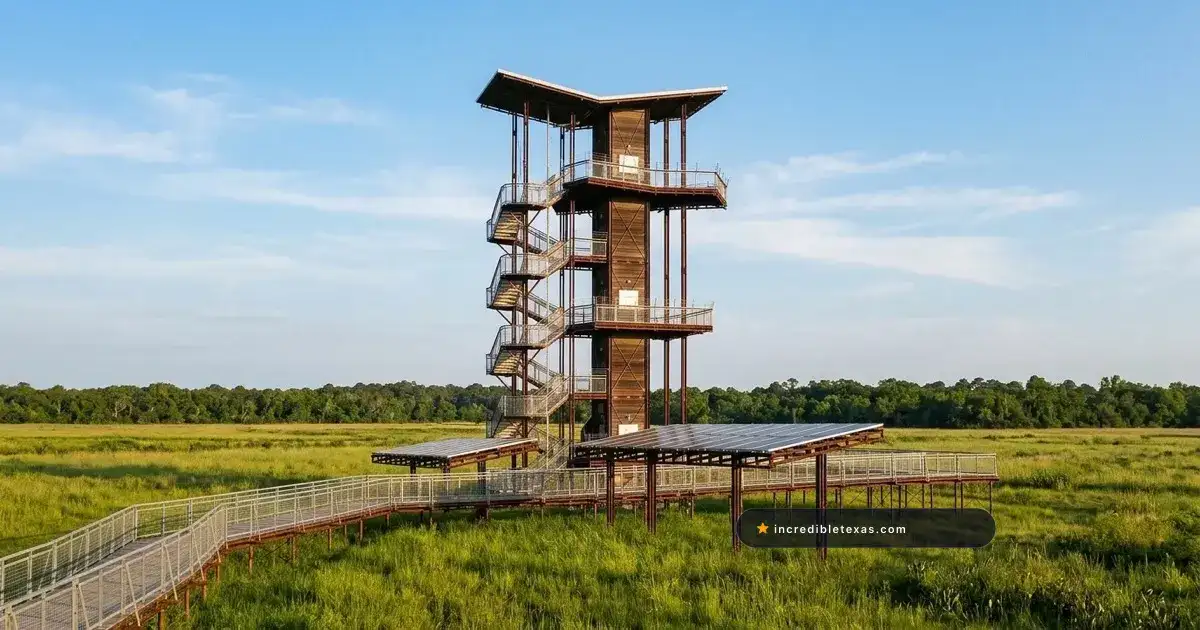
Sheldon Lake State Park protects 2,800 acres of bald cypress swamp, restored tallgrass prairie, and former fish hatchery marshes 15 miles northeast of downtown Houston. As the only free state park in Houston, it pairs an 82-foot skyline observation tower with license-free freshwater angling and stroller-friendly wetland boardwalks.
Key takeaways
- Free Daily Admission: Entry and parking at Sheldon Lake State Park cost $0 year-round at 14140 Garrett Road, Houston, TX 77044.
- 82-Foot Observation Tower: The John Jacob Observation Tower offers ramp, stair, and elevator access overlooking downtown Houston and the San Jacinto Monument.
- License-Free Fishing: Visitors cast without a Texas fishing license on the 1,200-acre Sheldon Reservoir and at two family catch-and-release hatchery ponds.
- Separate Boat Launch: Kayaks and motorboats launch exclusively from the Pineland Road south ramp under strict no-wake headway speed limits.
- Day-Use Only (No Camping): Zero campgrounds, RV hookups, or cabins exist inside the park, making Lake Houston Wilderness Park the closest wooded overnight base.
Plan your visit
Verified
- Location
- 14140 Garrett Rd, Houston, TX 77044 (15 miles NE of downtown)
- Hours
- 8:00 AM to 5:00 PM daily (to 7:00 PM May-Sep weekends)
- Admission
- Free daily admission
- Best time to go
- October to May for mild hikes, waterfowl, and spring rookeries
Hours, Free Admission, and Two-Unit Park Layout
Sheldon Lake State Park charges $0 daily entrance fees across its 2,800-acre property in northeast Harris County, ranking among the top free outdoor things to do in Houston. Visitors should check seasonal gate cutoffs and the split between trail parking and boat ramps before heading out.
Daily Gate Hours and Weekend Day-Pass Reservations
Headquarters, restrooms, and trailhead gates at 14140 Garrett Road open daily from 8:00 AM to 5:00 PM. Saturday and Sunday gate hours extend to 7:00 PM from May through September, while outer reservoir banks remain open from sunrise to sunset.
Headquarters and gated parking close on Thanksgiving Day, at 12:00 PM on Christmas Eve, and on Christmas Day. Mild Saturdays in spring and autumn often fill the Garrett Road parking lot to capacity by 10:30 AM, so book a $0 TPWD day-pass reservation via the Texas Parks and Wildlife Sheldon Lake State Park Official Guide.
Garrett Road Headquarters vs Pineland Road Boat Access
Outdated GPS directories sometimes route drivers to legacy gates along Beaumont Highway. Set navigation directly to 14140 Garrett Rd, Houston, TX 77044, located two miles east of Beltway 8 (Sam Houston Tollway), for the visitor center, observation tower, and walking loops.
Watercraft cannot launch from the Garrett Road learning campus. Boaters and kayakers heading onto the 1,200-acre reservoir must drive south via the US Highway 90 (Beaumont Highway) exit to the separate public boat ramp off Pineland Road.
Climbing the 82-Foot John Jacob Observation Tower
Rising above loblolly pines and marsh ponds, the John Jacob Observation Tower stands 82 feet tall as the signature landmark of Sheldon Lake State Park. Built with weathered steel, timber, and solar arrays, the tower sits a flat five-minute walk from headquarters.

Houston Skyline and San Jacinto Views From Two Decks
Two viewing platforms split the climb across distinct canopy heights. The lower deck looks directly into lily-lined marsh basins where American alligators, turtles, and herons hunt.
Climb or ride to the 82-foot top deck to clear the pine canopy completely. Looking 15 miles southwest on a low-humidity morning, visitors get an unobstructed Houston skyline view stretching straight to downtown skyscrapers.
Turn southeast across the Carpenters Bayou basin to spot the 567-foot limestone shaft of the San Jacinto Monument. Visitors pairing a morning marsh walk with Texas Revolution history can plan that 20-minute drive south with our San Jacinto Museum and Monument guide.
ADA Ramp, Staircase, and Elevator Access Tips
Built as an ADA-accessible state park that Houston families of every mobility level can share, the tower provides step-free routes to both decks. A gently graded ramp leads wheelchairs and strollers onto the lower wetland platform, while stairs and an outdoor passenger elevator serve the 82-foot upper deck.
Tip
Skyline Visibility & Elevator Access: Arrive between 8:00 AM and 9:30 AM after a fall or winter cold front for crisp views of downtown Houston. Call headquarters at (281) 456-2800 before departing if your group relies on the tower elevator, as Gulf storms occasionally trigger brief maintenance holds.
Walking Trails, Boardwalks, and 28 Naturalized Hatchery Ponds
Roughly two miles of flat trails wind through the 40-acre learning campus and neighboring pine-oak woods at Sheldon Lake State Park. Packed-earth levees and wheelchair-accessible boardwalk trails give Houston parents an easy 60-minute stroller route across prairie, swamp, and marsh.
Pond Loop Trail and WWII Reservoir Origins
Most walks start on the Pond Loop Trail, a 0.6-mile circuit of boardwalks and grassy dikes threading between 28 hatchery ponds. Federal engineers originally dammed Carpenters Bayou in 1942 and 1943 to supply freshwater to World War II shipyards along the Houston Ship Channel.
According to the Texas Parks and Wildlife Sheldon Lake Park History, Texas bought the site in 1952 and opened a 28-pond fish hatchery in 1955. After the hatchery closed in 1975 and became a state park in 1984, biologists let native sedges, water lilies, and bald cypress reclaim the basins.
Prairie Trail, Wetland Loop, and Forest Connectors
Outer loops beyond the Pond Loop Trail boardwalk preserve rare Gulf Coast tallgrass prairie. Both the Prairie Trail (0.6 miles) and Wetland Loop (0.2 miles) wind past big bluestem, Indiangrass, blazing star, and seasonal wildflowers.
Four short forest paths add shaded variety along the north edge: Swamp Rabbit and Bent Pine trails (0.4 miles and 0.2 miles) plus Armadillo (0.08 miles) and Kinglet (0.07 miles). For another free urban boardwalk hike inside Loop 610, compare the boardwalk trails at Houston Arboretum and Nature Center.
| Trail Name | Length | Surface | Habitat & Highlights |
|---|---|---|---|
| Pond Loop Trail | 0.6 mi | Boardwalks & flat levees (stroller friendly) | 28 hatchery ponds, lilies, gators, viewing decks |
| Prairie Trail | 0.6 mi | Crushed aggregate & packed earth | Coastal tallgrass prairie, wildflowers, monarchs |
| Swamp Rabbit Trail | 0.4 mi | Natural pine soil (muddy after rain) | Shaded loblolly pines and woodland songbirds |
| Wetland Loop | 0.2 mi | Compacted earth & boardwalks | Shallow marsh, frogs, dragonflies, herons |
| Bent Pine Trail | 0.2 mi | Dirt forest path | Quiet pine corridor linking prairie and pond dikes |
| Armadillo & Kinglet | 0.15 mi | Short dirt connectors | Quick shaded cutoffs near the observation tower |
License-Free Fishing on Sheldon Reservoir and Family Ponds
Sheldon Lake fishing draws anglers across Harris County because Texas waives freshwater license and stamp requirements inside state park boundaries. That license-free rule applies across shoreline banks, ADA piers, designated family ponds, and boats on the 1,200-acre Sheldon Reservoir.
Catch-and-Release Family Ponds vs Protected Sanctuary Waters
Check posted signs carefully around the 28 hatchery ponds before casting. Only two designated basins operate as catch-and-release family fishing ponds where kids and supervising adults can cast, while the other 26 ponds remain closed wildlife sanctuaries.
Anglers at those family fishing ponds for kids must use pole-and-line gear, pinch barbs flat, and release every sunfish, bass, or catfish immediately. Across the entire park, rangers enforce a strict two pole fishing limit per person and prohibit cast nets, trotlines, and traps.
Bank and Pier Angling on the 1,200-Acre Reservoir
Anglers targeting legal-sized keepers head west to the Garrett Road crossing along the main 1200 acre Sheldon Reservoir. Shoreline banks and two wheelchair-accessible piers sit right beside bridge pilings where moving water funnels baitfish between upper Carpenters Bayou and open flats.
Weedless frogs, Texas-rigged worms, and spinnerbaits worked along lotus and hydrilla mats tempt largemouth bass, while cut shad draws channel and blue catfish.
Standard community fishing limits apply on the main lake, including a 14-inch minimum and five-fish daily bag on largemouth bass. Confirm current size thresholds on the Texas Parks and Wildlife Sheldon Reservoir Fishing Regulations page and compare nearby waters in our guide to the best fishing lakes around Houston.
Boating, Kayaking, and Pineland Road Ramp Rules
Launching onto Sheldon Reservoir reveals Spanish-moss-draped bald cypress swamps and lotus flats untouched by wakeboard traffic. Strict speed rules and shallow submerged timber keep the entire 1,200-acre impoundment calm for paddlers and skiffs.
Headway Speed Limits and Shallow Stump Navigation
Every boat, canoe, and kayak launches from the Pineland Road boat ramp at the southern end of the Sheldon Reservoir boat ramp zone off US Highway 90. Free trailer parking sits beside the concrete ramp, though no rentals operate on site, so bring your own kayak, life jacket, and whistle.
Park regulations mandate headway speed only (idle, no-wake motor speed) across the entire lake. Because depths average four to six feet over submerged WWII stumps and summer weeds, local anglers favor kayaks, electric trolling motors, or outboards under 10 horsepower; check launch details on the Texas Parks and Wildlife Sheldon Reservoir Public Access Map.
Spring Waterbird Rookery Buffers on Carpenters Bayou
From March through July, bald cypress swamp islands along Carpenters Bayou in the upper basin host one of metropolitan Houston’s largest colonial waterbird rookeries. Hundreds of roseate spoonbills, great egrets, snowy egrets, anhingas, and cormorants pack the canopy to raise chicks.
Anyone kayaking Sheldon Lake during nesting months must follow no-wake rules and honor posted seasonal bird rookery buffer zones around rookery islands. Approaching too closely flushes parent birds off nests, exposing eggs and chicks to predators, heat, and alligators waiting below.
Birding, Wildscape Gardens, and Alligator Safety Rules
Anchored along the Central Flyway and the Upper Texas Coast Birding Trail, the Sheldon Lake Environmental Learning Center records more than 300 bird species. Visitors exploring Sheldon Lake birding hotspots share those trails with green architecture and resident American alligators.
Environmental Learning Center and Wildscape Garden
Covering 40 acres around headquarters, the learning campus features solar panels, rainwater cisterns, geothermal climate control, and recycled boardwalk decking. Families can borrow free Junior Ranger Explorer Packs at the front desk, while schools book TEKS-aligned wetland labs in advance.
Steps from headquarters, the Wildscape demonstration garden displays native Gulf Coast plants suited for Houston backyards. Coral honeysuckle, Turk’s cap, milkweed, and Gulf muhly attract monarch butterflies and migrating ruby-throated hummingbirds each spring and fall.
Alligator Etiquette and Six-Foot Dog Leash Rules
Sheldon Lake alligators live year-round in the main reservoir, Carpenters Bayou, and all 28 hatchery ponds. Sunny spring and autumn mornings regularly bring six-to-ten-foot gators onto grassy pond levees, rivaling the famous alligator viewing trails at Brazos Bend State Park.
Warning
Alligator Safety Rules & Dogs on Leash: Keep at least 30 feet back from every alligator, and retreat immediately if one hisses. Dogs must stay on a physical 6-foot leash at all times, remain out of indoor buildings, and never wade or drink near pond edges.
Does Sheldon Lake State Park Have Camping or Cabins?
Outdated third-party travel directories often claim the park rents six air-conditioned cabins and tent loops. Zero public campgrounds, RV hookups, or rental cabins exist inside Sheldon Lake State Park, and gates lock at dusk for all general visitors.
Important
Day-Use Facility Only: Do not tow an RV or pack overnight tents expecting check-in at 14140 Garrett Road. Confirm day-use group pavilion rules on the Texas Parks and Wildlife Sheldon Lake Fees and Facilities Schedule.
Day-Use Only Policy and Ranger Family Workshops
Overnight stays occur only during occasional, pre-registered Texas Outdoor Family instructional workshops led by state park rangers. Outside of those ticketed educational weekends, sleeping in tents, hammocks, or vehicles inside park boundaries is prohibited.
Closest Tent, Cabin, and RV Campgrounds Near Sheldon Lake
Visitors planning camping near Sheldon Lake have four dependable alternatives within an hour’s drive. Driving 24 miles north to New Caney unlocks forested cabin and tent camping at Lake Houston Wilderness Park, making a split weekend simple: birdwatch free at Sheldon Lake by afternoon, then sleep under tall pines at Lake Houston Wilderness Park.
RVers looking for the closest campground to Sheldon Lake with full 30/50-amp hookups can book gated pads five minutes south at Sheldon Lake RV Resort. Travelers comparing day-use marshes here against Brazos Bend State Park or Huntsville State Park should pick those larger state parks whenever multi-night electric loops and 20-plus trail miles top the priority list.
| Park / Facility | Drive Distance | Entry / Nightly Fee | Overnight Options | Best Fit |
|---|---|---|---|---|
| Sheldon Lake State Park | On site (Garrett Rd) | $0 Free entry | None (Day-use only) | Free skyline tower, boardwalks, fishing |
| Sheldon Lake RV Resort | 5 mins (3 mi south) | ~$45-$65/night | Full-hookup 30/50-amp RV pads | RVers wanting fast boat ramp access |
| Lake Houston Wilderness Park | 28 mins (24 mi north) | $3 entry; $15-$125/nt | Tent sites, A-frame shelters, cabins | Closest wooded tent and cabin stays |
| Brazos Bend State Park | 50 mins (46 mi SW) | $7 adult; $15-$80/nt | Electric RV/tent loops, shelters, cabin | Classic state park camping & observatory |
| Huntsville State Park | 65 mins (72 mi north) | $7 adult; $15-$60/nt | 160 campsites, shelters, cabins | Piney Woods shade & Lake Raven kayaks |
Best Seasons to Visit and Northeast Houston Packing List
Seasonal heat, Gulf humidity, and bird migrations shape every outing among free things to do in northeast Houston. October through May delivers mild temperatures, lower mosquito counts, and peak bird activity.
Fall, Winter, and Spring Wildlife Windows
Late October through February brings 60°F to 72°F highs alongside bald eagles, ospreys, and wintering ducks across the ponds. March through May rewards Upper Texas Coast birdwatchers with prairie wildflowers, bellowing alligators, and pink roseate spoonbills nesting in the cypress rookeries.
June through September pushes afternoon heat indexes past 100°F across unshaded pond dikes and prairie loops. Arrive at the 8:00 AM gate opening during summer, or drive north in the afternoon for taller forest cover along the shaded pine trails at Huntsville State Park.
Essential Gear for Humid Coastal Marsh Trails
No camp store or vending stand operates at 14140 Garrett Road, so pack these essentials before leaving Beltway 8:
- Water (2 Liters Per Person): Fill bottles at headquarters restrooms before walking the unshaded Prairie Trail and Pond Loop.
- DEET or Picaridin Repellent: Coastal marshes hold mosquitoes year-round, especially after Houston rainstorms.
- Polarized Sunglasses & 8x42 Binoculars: Cut surface glare to spot bass and submerged alligators while scanning tower and rookery birds.
- Sun Hat & Closed-Toe Shoes: Sturdy soles handle muddy forest connectors after Gulf downpours.
- Barbless Hooks & Pliers: Required for kids casting at the two catch-and-release family ponds.
Frequently Asked Questions About Sheldon Lake State Park
Is Sheldon Lake State Park really free to enter?
Yes, daily admission and on-site parking at 14140 Garrett Road are completely free year-round for all visitors. Booking a free online day-use pass through the Texas Parks and Wildlife reservation portal is still smart on mild spring and fall Saturdays when parking spaces fill quickly.
Does Sheldon Lake have overnight camping or cabins?
No, the park operates strictly as a day-use facility and has zero public tent campgrounds, RV hookups, or rental cabins. Travelers looking for wooded campsites or lakeside cabins can drive 24 miles north to Lake Houston Wilderness Park in New Caney or book a private pad at nearby Sheldon Lake RV Resort.
Do you need a fishing license at Sheldon Lake?
No Texas fishing license is required when casting from shoreline banks, accessible piers, or boats inside park boundaries. Anglers must fish by pole and line only with a maximum of two poles per person, and family fishing inside the hatchery complex is limited to two designated catch-and-release ponds.
Can you climb the John Jacob Observation Tower with a wheelchair or stroller?
Yes, a gentle ramp leads to the lower observation deck, and an outdoor elevator carries wheelchairs and strollers up to the 82-foot top deck. Call park headquarters at (281) 456-2800 before arriving if you rely on the elevator, as Gulf Coast humidity occasionally prompts brief maintenance holds.
Where is the boat ramp for Sheldon Reservoir?
Watercraft cannot launch from the 14140 Garrett Road headquarters entrance and must instead use the south boat ramp off Pineland Road near US Highway 90. All boats on the 1,200-acre reservoir must travel at no-wake headway speed and stay clear of colonial waterbird rookery islands during spring and summer nesting.
Are dogs allowed on the trails at Sheldon Lake State Park?
Leashed dogs are welcome on outdoor walking loops, boardwalks, and picnic grounds provided they stay on a physical leash no longer than six feet. Keep pets away from pond shorelines, out of all park waters, and out of indoor Environmental Learning Center buildings to avoid resident alligators.
Are there alligators in Sheldon Lake and the hatchery ponds?
Wild American alligators live year-round throughout the 1,200-acre reservoir, Carpenters Bayou, and all 28 naturalized hatchery ponds. Maintain at least 30 feet of clearance from basking gators, never feed wildlife or discard fish scraps near shore, and keep small children within arm’s reach on pond levees.