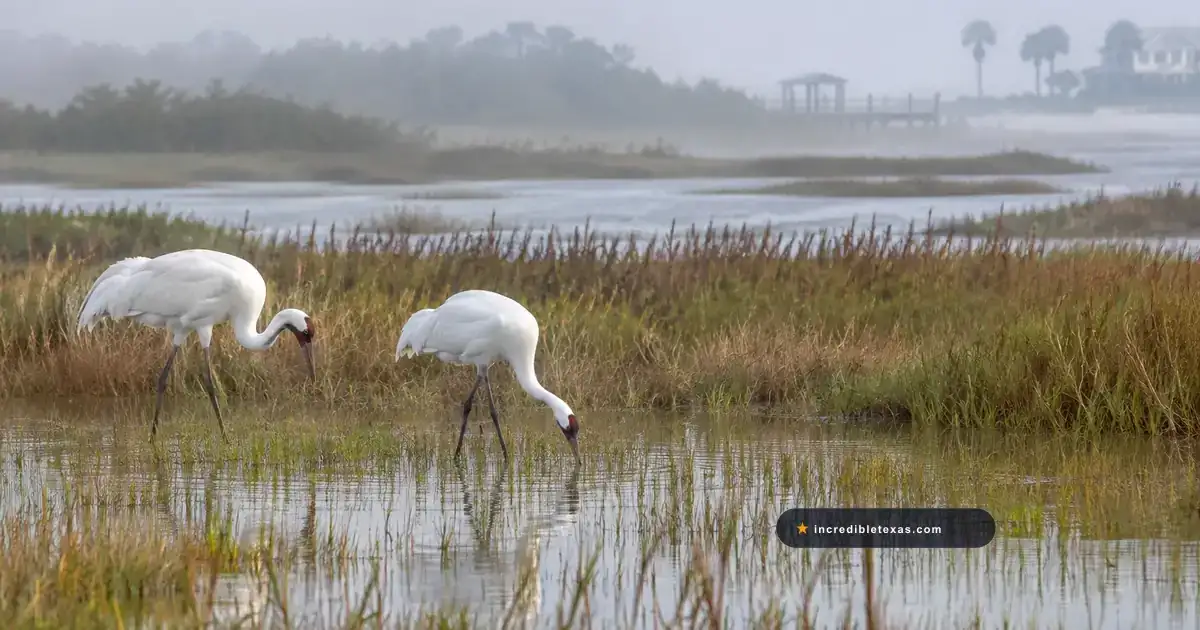
Rockport whooping crane boat tours give wildlife travelers front-row access to one of the greatest conservation comeback stories in North American history. Every winter, the world’s only natural wild flock of whooping cranes travels 2,500 miles from Canadian nesting grounds to feed in the protected tidal salt marshes surrounding Rockport and Fulton, Texas.
Note
Part of our comprehensive guide to the best things to do in Rockport-Fulton TX. Explore our full regional itinerary, maritime landmarks, and barrier island routes.
Key takeaways
- Peak Migration Window: Whooping cranes arrive in mid-November and stay through late March, with peak viewing concentrations between December and February.
- Primary Harbor Departures: Guided 3-hour tours depart daily from Fulton Harbor on shallow-draft catamarans like the Skimmer, with tickets starting around $125 per person.
- Guaranteed Sightings: Experienced local captains navigate calm bayside channels along the edge of Aransas National Wildlife Refuge, offering close views of territorial crane families.
- Goose Island Living Legend: Visiting The Big Tree on Lamar Peninsula takes travelers to a thousand-year-old coastal live oak measuring over 35 feet in trunk circumference.
Winter Whooping Crane Migration in Rockport
The winter arrival of whooping cranes transforms the Coastal Bend into a world-renowned international ecotourism destination. Standing nearly five feet tall with an impressive 7.5-foot wingspan, the whooping crane (Grus americana) ranks as the tallest native bird species in North America. Seeing these brilliant white birds stride through cordgrass marshes against the Texas coastal sky is an unforgettable sight.
The Aransas-Wood Buffalo Migration Corridor
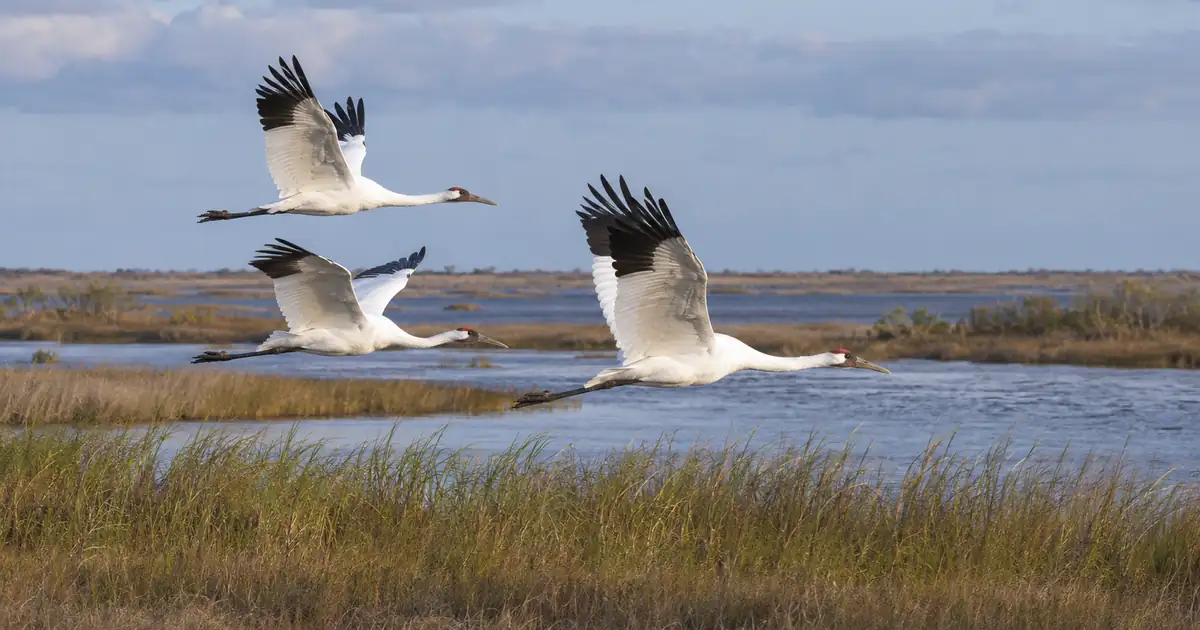
The entire wild flock that winters along the Texas coast belongs to the Aransas-Wood Buffalo population. In the 1940s, habitat destruction and unregulated hunting reduced this majestic flock to just 15 surviving birds. Through decades of coordinated international protection between the United States and Canada, that population has rebounded to more than 500 wild individuals.
The cranes spend their summers nesting in remote wetlands across Wood Buffalo National Park on the border of Alberta and the Northwest Territories. In autumn, family groups begin a grueling 2,500-mile journey across North America, flying south across Saskatchewan, the Great Plains, and Central Texas before reaching the barrier islands of the Coastal Bend.
Once they arrive in the coastal marshes of Aransas National Wildlife Refuge, mated pairs establish strict feeding territories that span hundreds of acres. The birds defend these shallow tidal wetlands fiercely through the winter months, feeding primarily on blue crabs, wolfberries, and small marine organisms trapped in the flats.
Migration Timeline and Peak Viewing Months
Timing your visit to the Coastal Bend determines the quality and quantity of bird sightings. While scout birds occasionally touch down in late October, the full population settles in stages across November.
| Migration Phase | Calendar Months | Bird Density & Behavior | Recommended Planning Action |
|---|---|---|---|
| Early Arrival | Late October to Mid-November | Family units arrive; establishing feeding territories | Great weather; lower crowd density |
| Peak Concentration | December through February | Full flock resident; active territorial displays and crab hunting | Book tours 3 to 5 weeks in advance |
| Spring Preparation | March to Early April | Courtship dancing; pre-migration staging on marsh flats | Moderate crowds; warm spring days |
| Departure North | Mid-April to May | Most birds aloft; few scattered subadults remain | Focus on resident shorebirds and spring migrants |
Winter travelers should note that while viewing is possible through late March, mid-winter months offer the sharpest atmospheric clarity and highest bird counts. December and January deliver crisp blue skies that make bird plumage stand out vividly against dark green marsh grasses.
Rockport and Fulton Boat Tour Operators
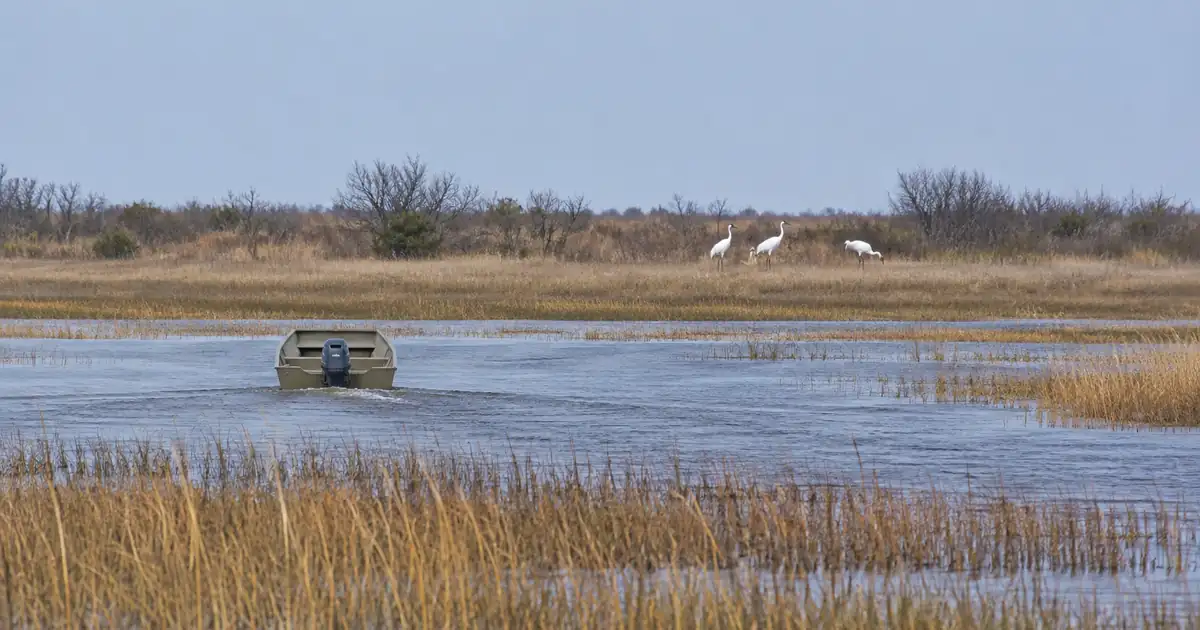
While visitors can view cranes from the elevated land-based observation tower at the refuge, boat tours provide the superior vantage point. Cranes feed along the marsh shoreline, often within 50 to 100 yards of the Intracoastal Waterway. Navigating these sheltered bayous on specialized shallow-draft watercraft allows travelers to observe natural foraging behavior without disrupting the birds.
The Skimmer with Rockport Birding Adventures
The best-known excursion vessel operating in the Coastal Bend is the Skimmer, run by Rockport Birding and Kayak Adventures. Captain Tommy Moore and his team have guided wildlife expeditions across these bays for decades, departing from Fulton Harbor at 214 North Fulton Beach Road, directly beside Duck Blind Coffee.
The Skimmer is a custom-designed, multi-level catamaran purpose-built for wildlife photography and birding. It features a heated and air-conditioned lower interior cabin for cold mornings, alongside an open-air upper observation deck that provides unobstructed 360-degree photography angles. The vessel carries shallow-draft engines that navigate tidal backwaters without disturbing delicate submerged seagrass meadows.
Tours on the Skimmer run approximately three hours and cost around $125 per passenger. Because the captains know individual family territories along the refuge shoreline, sightings of whooping cranes are guaranteed during peak winter season. Passengers also regularly encounter roseate spoonbills, reddish egrets, American oystercatchers, black skimmers, and coastal bottlenose dolphins.
Port Aransas and Private Charter Alternatives
Travelers based on Mustang Island can also access crane excursions from Dennis Dreyer Municipal Harbor in Port Aransas. The Wharf Cat, operated through Fisherman’s Wharf, runs seasonal trips across Carlos Bay to the refuge boundary. Comparing regional transit and harbor docks is easy when reviewing the best things to do in Port Aransas.
For photographers seeking specialized setups, several licensed local captains offer private six-pack skiff charters. These smaller flat-bottom boats accommodate two to four photographers, allowing captains to angle the hull for optimal morning light and hold position while crane families feed on blue crabs. Private charters generally start at $600 for half-day outings and should be reserved several months in advance.
What to Expect on a 3-Hour Marsh Excursion
Morning tours typically depart between 7:30 AM and 8:30 AM, capitalizing on calm bay waters before afternoon thermal breezes develop. After leaving Fulton Harbor, boats travel north through Aransas Bay, entering the protected Intracoastal Waterway near Dunham Point and Ayres Bay.
During the cruise, onboard naturalist guides share running commentary covering crane biology, wetland conservation history, and coastal ecology. Restrooms are available on larger passenger catamarans, and complimentary morning coffee is often provided. Travelers should pack light snacks, bottled water, and camera equipment in padded water-resistant bags.
Visiting The Big Tree at Goose Island State Park
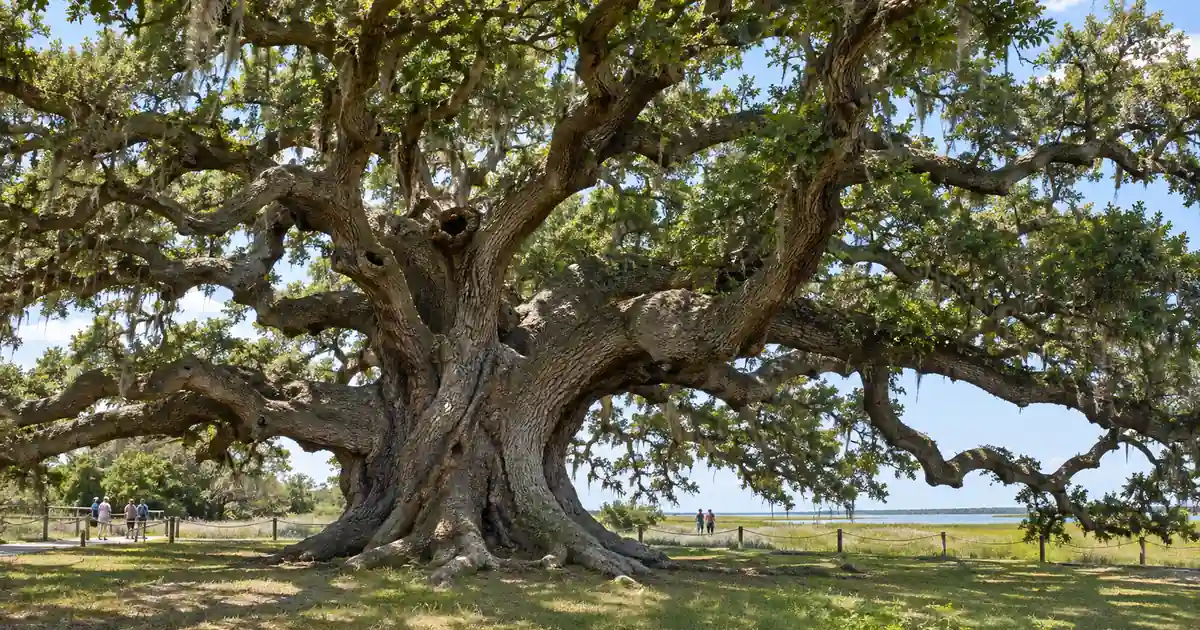
No wildlife pilgrimage to the Coastal Bend is complete without visiting The Big Tree, located just ten miles north of downtown Rockport on the Lamar Peninsula. Preserved within the boundary of Goose Island State Park, this ancient coastal live oak (Quercus virginiana) represents one of the most remarkable living botanical specimens in the American South.
Botanical History and Scale of a Thousand-Year Oak
Forestry experts and the Texas A&M Forest Service estimate The Big Tree is between 1,000 and 1,100 years old. That means this solitary tree was already a mature sapling when Ancestral Karankawa hunters fished Aransas Bay, and it stood fully grown long before Spanish explorers charted the Texas coastline.
The physical dimensions of The Big Tree demonstrate its incredible survival over centuries of Gulf storms:
| Botanical Metric | Measured Dimension | Context and Significance |
|---|---|---|
| Trunk Circumference | 35 feet, 1 inch (421 inches) | Requires six adults holding hands to encircle |
| Total Height | Approximately 44 feet | Stunted vertical growth due to constant salt-spray winds |
| Crown Spread | 90 feet across | Massive horizontal limbs supported by low wooden braces |
| Estimated Age | 1,000 to 1,100+ years | Former National Champion Coastal Live Oak (1966-2003) |
The tree survived Category 4 Hurricane Harvey in August 2017 with minimal damage, even as the eye wall made landfall directly over the Lamar Peninsula. Its deep, interconnected root system anchors into ancient shell hash and coastal clay, providing a living lesson in botanical resilience.
Goose Island State Park Logistics and Fees
The Big Tree stands at 202 South Palmetto Street in Rockport, Texas 78382. Access to the monument site is free, located in a quiet roadside park area just outside the main gate of Goose Island State Park. Visitors can park in designated gravel bays along Palmetto Street and walk along a shaded accessible boardwalk that encircles the root zone to protect the tree’s sensitive root structure.
For travelers who wish to explore the remainder of Goose Island State Park, day-use entry costs $5 per adult, while children 12 and under enter free of charge. The park features a 1,620-foot lighted fishing pier extending into Aransas Bay, shaded bayside camping loops, and sheltered kayak launch points. You can confirm park hours and reserve day-use passes through the Texas Parks and Wildlife Goose Island Portal.
After admiring The Big Tree, take time to tour the restored Victorian architecture at Fulton Mansion State Historic Site.
Optics, Camera Gear, and Weather Preparation
Photographing whooping cranes from a moving boat deck across windy coastal bays requires specific equipment and technique. Preparing your gear properly ensures sharp, clear images and a comfortable journey across the water.
Choosing Binoculars and Spotting Scopes
For standard wildlife viewing, quality 8x42 or 10x42 roof-prism binoculars provide the ideal balance between magnification and field of view. Magnifications higher than 10x are difficult to stabilize on a moving boat engine deck. If you own image-stabilized binoculars, bring them along, as they excel at dampening hull vibration.
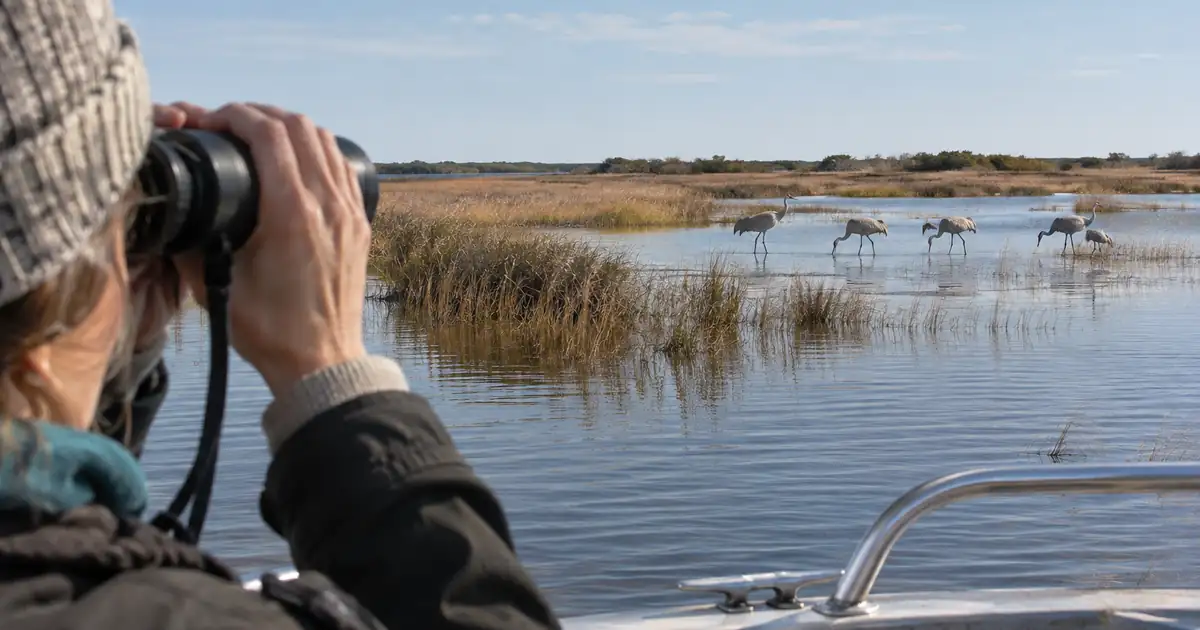
Tripods and spotting scopes are generally impractical on commercial tour boats due to deck movement and limited aisle space. Rely instead on hand-held optics with rubberized grips and wide neck straps to prevent equipment from sliding on wet railings.
Telephoto Camera Settings for Boat Deck Vibration
Photographers targeting close-up behavioral images of whooping cranes need telephoto focal lengths between 300mm and 600mm. A 100-400mm or 150-600mm zoom lens mounted on a full-frame or crop-sensor camera body offers the versatility needed to capture both wide habitat scenes and tight portraits of feeding crane pairs.
Recommended camera settings for boat-based marsh photography include:
- Shutter Speed: Keep shutter speeds at 1/1200 second or faster (1/2000 second for birds in flight) to neutralize boat drift, water chop, and telephoto lens shake.
- Aperture: Shoot between f/6.3 and f/8 to ensure the bird’s full head, bill, and plumage remain tack-sharp.
- ISO: Use Auto ISO with an upper threshold of 3200 to allow fast shutter speeds under early morning overcast skies.
- Focus Mode: Set your camera to continuous autofocus (AF-C / AI Servo) with animal eye-detection tracking active.
Winter Coastal Weather and Clothing Layers
Before boarding your morning boat tour, you can test long telephoto zoom lenses and binocular optics along the calm shoreline of Rockport Beach Park.
Winter mornings on the Texas coast can feel surprisingly frigid. Even when onshore temperatures read 55 degrees Fahrenheit, traveling at 15 knots across open bay waters creates an effective wind chill near freezing.
Dress in three warm layers: a moisture-wicking base layer, an insulating fleece or down vest, and a windproof, waterproof outer shell jacket. Bring a warm knit beanie, lightweight gloves that allow you to operate camera dials, and polarized sunglasses to cut through bay water glare.
Planning a Complete Coastal Bend Wildlife Day
A whooping crane boat tour pairs naturally with other regional attractions to create an enriching coastal weekend. Because boat tours finish by midday, travelers have ample afternoon hours to explore historic sites, nature boardwalks, and fresh seafood restaurants across Fulton and Rockport.
Sample One-Day Rockport Wildlife Itinerary
Here is a tested schedule for a memorable winter wildlife day:
- 7:00 AM: Grab hot breakfast tacos and fresh roast coffee at Duck Blind Coffee in Fulton Harbor.
- 7:45 AM: Check in at the Skimmer boarding gate and claim a seat on the observation deck.
- 8:00 AM to 11:00 AM: Cruise along the Aransas National Wildlife Refuge marsh line, photographing whooping crane pairs, dolphins, and shorebirds.
- 11:30 AM: Enjoy fresh blackened redfish or Gulf oyster po’boys on the harbor deck at Charlotte Plummer’s Seafare Restaurant.
- 1:00 PM: Drive ten minutes north across the Copano Bay causeway to Lamar Peninsula and marvel at The Big Tree.
- 2:30 PM: Walk the bayside trails and pier at Goose Island State Park to spot wintering reddish egrets.
- 4:00 PM: Return south to Fulton for a tour through historic Victorian mansions and harbor docks.
- 5:30 PM: Catch the golden hour sunset across Aransas Bay from the peaceful breakwaters at Rockport Harbor.
Tour boat captains monitor water levels using the NOAA Port Aransas Tide Station to navigate shallow marsh bayous safely. Travelers expanding their coastal exploration can discover cultural attractions and bayfront parks with our curated guide to the best things to do in Corpus Christi. Official regional tourism resources and lodging directories are maintained by the Rockport-Fulton Chamber of Commerce.
Frequently Asked Questions About Whooping Crane Tours
When is the best time to see whooping cranes in Rockport?
The best window runs from December through February when the full wintering population settles into the salt marshes of Aransas National Wildlife Refuge. Early arrivals appear by November, while departing birds begin flying north to Canada in late March and April.
How much do whooping crane boat tours cost in Rockport?
Scheduled passenger boat tours typically cost around $125 per adult for a 3-hour guided excursion. Private boat charters accommodating smaller photography groups generally range from $600 to $1,050 depending on duration and boat capacity.
Where do whooping crane boat tours depart in Rockport?
Most primary boat operators depart from Fulton Harbor at 214 North Fulton Beach Road, directly adjacent to the Duck Blind Coffee shop. Other regional operators run departures from Dennis Dreyer Municipal Harbor in Port Aransas.
Can you see whooping cranes from land without a boat tour?
You can spot cranes from the observation tower and auto tour loop at Aransas National Wildlife Refuge, though birds are often distant. Commercial boat tours provide far closer views because they navigate shallow coastal bayous bordering the birds feeding territories.
How old is The Big Tree at Goose Island State Park?
Botanists estimate The Big Tree is over 1,000 years old, making it one of the oldest and largest coastal live oaks in North America. The tree measures more than 35 feet in trunk circumference and has survived major hurricanes for centuries.
Do you need reservations for whooping crane tours in Rockport?
Advance reservations are strongly advised because weekend tours sell out weeks ahead during peak winter migration months. Booking two to four weeks in advance ensures your seats during the December through February season.