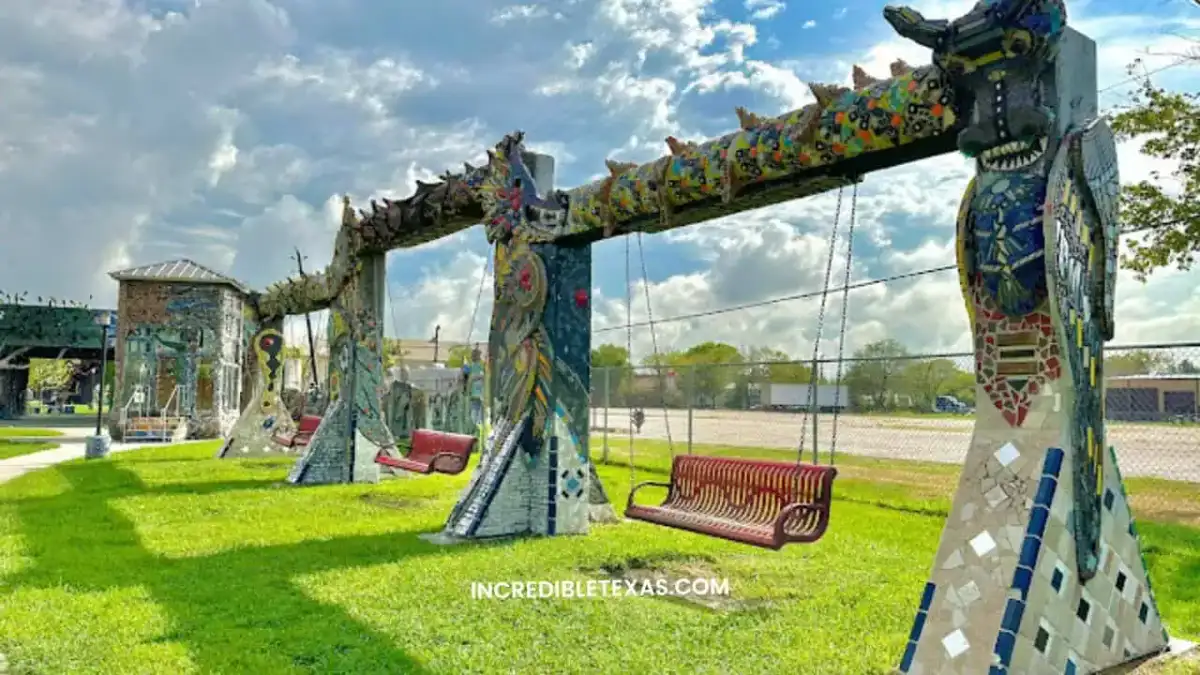
Smither Park Houston ranks among the city's most distinctive cultural landmarks because it functions as an evolving folk art gallery rather than a traditional athletic greenspace. Situated across a half-acre footprint in the historic East End, the park welcomes visitors daily from dawn until dusk with completely free admission, active mosaic craftsmen on Saturdays, and whimsical structures built from recycled materials.
Key takeaways
- Location & Hours: Located at 2441 Munger Street in Houston’s East End; open seven days a week from dawn to dusk with $0 admission.
- Creative Mosaic Design: Encompasses a 400-foot Memory Wall, amphitheater, and pavilion adorned with broken ceramic tiles, seashells, and mirror fragments.
- Saturday Artisan Workshops: Local mosaic artists frequently work on-site on Saturdays from 10:00 AM to 2:00 PM, allowing guests to observe the creative process firsthand.
- Parking & Logistics: Free curbside street parking lines Munger Street; typical visits range between 30 and 60 minutes.
- Cultural Hub: Operated by The Orange Show Center for Visionary Art, the park honors longtime arts patron John H. Smither.
Positioned immediately adjacent to the Orange Show, this open-air environment offers an ideal stop for travelers compiling a list of the best things to do in Houston. The park provides shaded seating, photographic angles, and artistic inspiration without requiring advance ticket purchases.
Plan your visit
- Location
- 2441 Munger Street, Houston, TX 77023 (East End neighborhood)
- Hours
- Open daily from dawn to dusk (approximately 7:00 AM – 7:30 PM)
Smither Park Houston Hours, Address, Admission, and Visitor Rules
Official smither park hours extend daily from dawn to dusk, giving self-guided sightseers early morning and golden hour access. The exact smither park address is 2441 Munger Street, Houston, TX 77023, situated inside a quiet residential pocket of the East End near Gulfgate.
Standard smither park admission is completely free, making it one of the top recommended free things to do in Houston. As outlined by The Orange Show Center for Visionary Art, the venue maintains an open-gate policy where guests wander freely through the mosaic installations without reservations or fees.
Neighborhood smither park parking is unmetered and readily available along Munger Street and surrounding residential streets. While visiting, guests must respect the property by leaving mosaic tiles intact, keeping pets on handheld leashes, and disposing of all picnic trash in designated receptacles.
What Smither Park Is and Why It Stands Out
Unlike urban turf fields or playground complexes, this property operates as a permanent creative environment dedicated to self-taught and visionary folk art. Across the half-acre parcel, artists have covered almost every vertical and horizontal architectural plane in textured mosaic murals.
The materials illustrate creative domestic upcycling. Thousands of discarded items, including cracked porcelain dishes, ceramic coffee mugs, oyster shells, marbles, and mirror tiles, form dazzling reflective surfaces. According to the City of Houston Mayor's Office of Cultural Affairs, community-driven grassroots projects like Smither Park enrich neighborhood identity while anchoring Houston's cultural arts districts.
Travelers comparing the best Houston parks to explore discover that Smither Park offers a creative counterpoint to large manicured facilities like Hermann Park or Memorial Park. Visitors come here specifically to appreciate human craft, memory, and folk architecture up close.
What Visitors See at Smither Park Houston
The primary landmark spanning the western border is the 400-foot Memory Wall. This continuous concrete structure features hundreds of individual mosaic panels created by distinct artists, commemorating lost loved ones, local flora, mythical beasts, and Houston cultural motifs.
At the center of the lawn stands the Lindley Fish Amphitheater, a whimsical outdoor stage shaped like an enormous gaping fish with iridescent scales. The amphitheater hosts live acoustic performances, poetry readings, and storytelling gatherings throughout the year. Adjacent to the stage, the covered Vinson Pavilion provides shade beneath mosaic columns.
| Park Feature | Dimensions & Type | Materials Used | Visitor Purpose |
|---|---|---|---|
| The Memory Wall | 400-foot continuous wall | Ceramic dishes, glass mirrors, coins, tiles | Memorial panels honoring community figures |
| Lindley Fish Amphitheater | Large sculptural stage | Cobalt tiles, iridescent glass, metal frame | Acoustic performances and community seating |
| Vinson Elkins Pavilion | Covered open-air shelter | Sculpted concrete columns, geometric mosaics | Shaded picnicking and workshop staging |
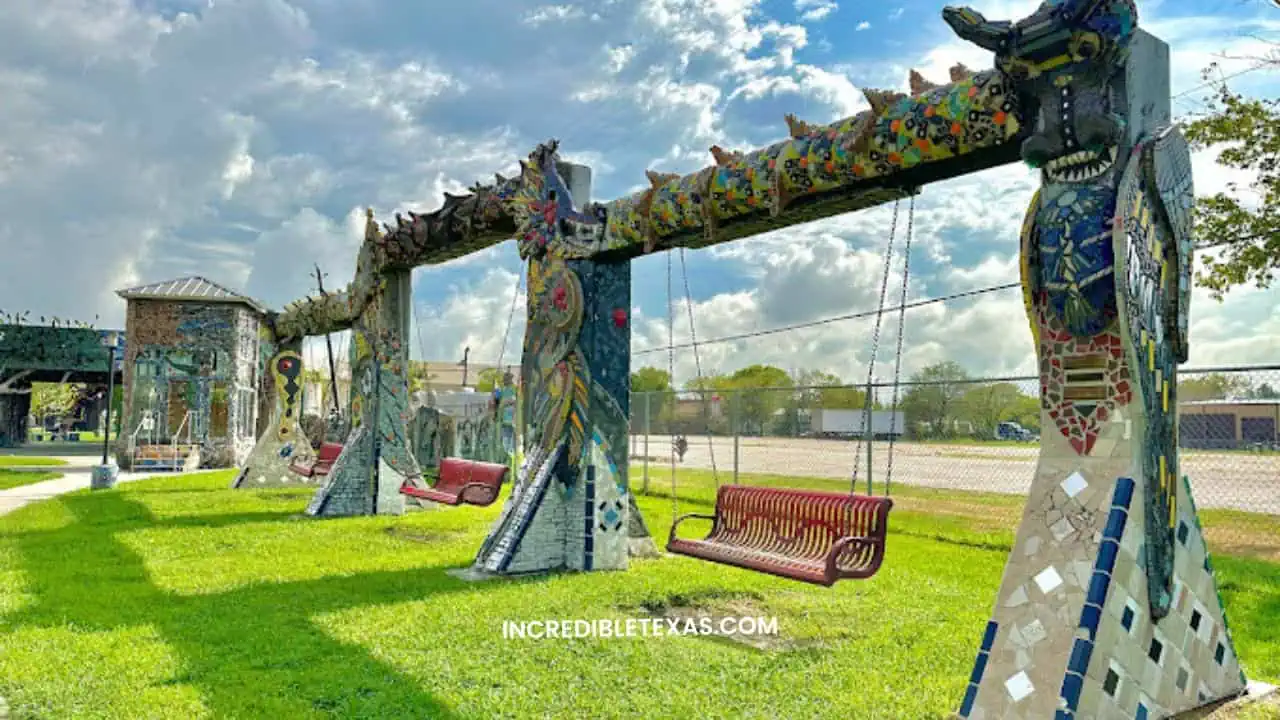
| Marble Tower & Swings | Interactive play structures | Glass toy marbles, welded iron chains | Tactile enjoyment for children and families |
| Meditation Garden | Quiet perimeter alcove | Tumbled stones, sea glass, green tiles | Peaceful reading and mindful reflection |
Every detailed corner reveals playful elements. An intricate smither park mosaic swing allows guests to rock beneath shade trees, while a towering column studded with thousands of toy glass marbles catches sunlight. As highlighted in Condé Nast Traveler, the compact footprint ensures that guests can absorb every artistic installation within an unhurried 45-minute stroll.
Smither Park Houston History and the Orange Show Connection
Smither Park emerged from personal tribute and civic philanthropy. Stephanie Smither conceived the visionary project following the 2002 passing of her husband, John H. Smither, a passionate folk art collector and longtime board member of The Orange Show.
To design the master plan, Smither partnered with builder and folk artist Dan Phillips, renowned across Texas for constructing houses out of recycled materials. Groundbreaking took place in 2010, and the park officially opened to the public in 2016. As detailed in the Houston Chronicle, more than 300 artists and volunteers have permanently contributed panels to the site.
The shared boundary with the smither park orange show creates a unified campus for visionary folk art in the East End. Travelers organizing regional road routes frequently combine this creative compound into diverse day trips from Houston.
How to Plan a Visit to Smither Park Houston
Planning a trip to Smither Park is simple because no advance reservations are needed. The best window to visit is Saturday between 10:00 AM and 2:00 PM, when volunteer artisans often install fresh mosaic tiles and chat with guests about their techniques.
Photography enthusiasts should plan their arrival during the golden hour shortly before sunset, when low-angle sunlight strikes the mirrored shards and metallic tiles across the Memory Wall. Couples compiling creative Houston date ideas often treat the park as an unhurried late-afternoon stroll followed by dinner in nearby East Downtown.
Packing recommendations are straightforward: bring a camera or smartphone with ample storage, sunglasses for high-glare surfaces, comfortable walking footwear, and bottled water during humid summer afternoons.
How Smither Park Houston Fits Into a Houston Day
Because exploring the park requires roughly 45 minutes, it pairs seamlessly with other East End and downtown activities. After admiring the mosaics, visitors can sample authentic Mexican pastries along Navigation Boulevard or grab specialty coffee on Wayside Drive.
Families researching day trips from Houston with kids can easily connect Smither Park with a visit next door to the Orange Show or an afternoon exploring the interactive exhibits at downtown discovery centers. Its central location allows travelers to navigate between artistic curiosities and culinary destinations without spending hours in freeway traffic.
FAQ About Smither Park Houston TX
Is Smither Park Houston free to visit?
Yes, Smither Park is completely free to enter. There are no gate charges, parking fees, or timed admission tickets required for general day visits from dawn to dusk.
How long does a visit to Smither Park take?
Most visitors spend between 30 and 60 minutes exploring the park. Because the property covers half an acre, visitors can view all major mosaic structures and the Memory Wall at a relaxed walking pace.
Can visitors see artists working at Smither Park?
Yes, local mosaic artists frequently work on-site on Saturdays. Weather permitting, volunteer craftspeople mix mortar and apply new tiles to expanding walls between 10:00 AM and 2:00 PM.
Is Smither Park family-friendly?
Yes, the park is open and welcoming to visitors of all ages. Children enjoy searching for whimsical figures like lizards, rocket ships, and dragons embedded in the mosaic murals.
What is the best thing to see first at Smither Park?
The 400-foot Memory Wall is the most popular starting point. It displays the greatest variety of individual mosaic designs and reveals the community-driven scope of the park.
Is Smither Park accessible and easy to walk?
Yes, the park features level paved concrete paths connecting all pavilions and sculptures. The flat half-acre terrain accommodates strollers and wheelchair users comfortably.
Final Take
Smither Park represents a singular celebration of Houston folk art and the creative reuse of everyday materials. Visitors looking for distinctive photography backdrops, intricate mosaic craftsmanship, or a relaxed weekend walk will find this East End space deeply engaging.
Adding Smither Park to a Houston itinerary provides an up-close look at an evolving public art project where local creativity and civic memory continue to shape every surface.